Six months ago, I could not finish a single book.
I would buy books, get excited for two days, then leave them on my nightstand collecting dust. My phone had won. Every single night.
Then I tried something so small it felt silly: just 10 pages a day. No pressure. No big reading goals. Just 10 pages.
What happened next actually surprised me. This one small reading habit for self improvement changed how I focus, how I sleep, how I think, and even how I talk to people.
This is not a “read 50 books a year” story. This is a real, honest, slow story about what happens when you build a reading habit that actually sticks.
If you have ever felt like your attention span is broken, or you want a simple reading habit self improvement plan that does not feel overwhelming, this post is for you.
Table of Contents
Why I Started a Reading Habit in the First Place
My problem was never that I disliked reading. My problem was that I made it too big.
I used to think reading meant finishing an entire book in a weekend. So I never even started. I was scrolling instead, feeling tired, distracted, and honestly a little bored with my own brain.
One night I read a simple idea online: small habits beat big goals. So I picked one rule.
Just 10 pages. Every day. No matter what.
That was it. No fancy planner. No 5 a.m. wake-up call. Just 10 pages, sometimes at lunch, sometimes in bed, sometimes in the bathroom (yes, really).
What Actually Happens When You Read 10 Pages a Day
Here is the part that surprised me the most. Ten pages sounds tiny. It takes about 15 to 20 minutes. But small, repeated actions add up in a way your brain does not expect.
By week two, I was not just reading 10 pages. I was reading 20, sometimes 30, because I actually wanted to know what happened next.
By month two, I finished my first full book in over a year.
By month six, I had read 11 books. Not because I forced myself, but because reading had quietly become part of my day, like brushing my teeth.
This is the real secret behind any reading habit self improvement plan. You do not need motivation. You need a habit small enough that skipping it feels weird.
My Month-by-Month Reading Habit Journey
I want to be honest about how slow this actually felt at the start, because most people quit right before things get easy.
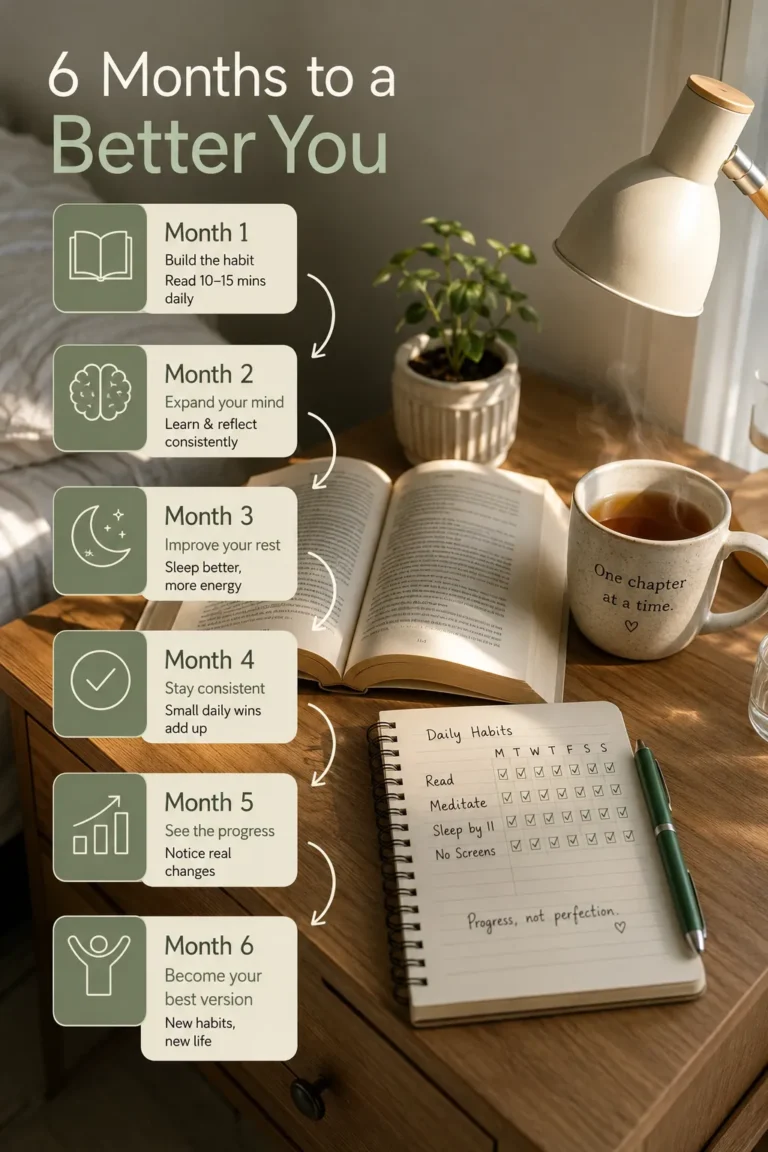
Month 1: Reading felt like homework. I had to remind myself every night. Some nights I only managed 5 pages, and I let that be okay.
Month 2: Something shifted. I stopped checking how many pages were left and started actually caring what happened in the story. I finished my first book.
Month 3: I noticed I was reaching for my book during boring moments, like waiting in a queue, instead of reaching for my phone.
Month 4: My reading speed increased naturally. Ten pages that used to take 20 minutes now took 12, without me trying to read faster.
Month 5: Friends started noticing I had new opinions and new stories to share, mostly things I had picked up from books.
Month 6: Reading no longer felt like a task on a checklist. It felt like the calmest part of my entire day.
Nothing about this journey was dramatic. It was quiet, slow, and steady, which is exactly why it worked.
The Science Behind Why Reading Rewires Your Brain
I am not a neuroscientist, but I got curious about why this tiny habit felt so powerful. So I looked into it.
Here is what I learned, explained in simple words.
Your brain has something called neuroplasticity. This just means your brain can build new connections and pathways at any age, based on what you repeatedly do.
When you read daily, even in small chunks, you are training your brain to focus for longer. You are exercising memory, imagination, and vocabulary. It is like a gym workout, except the muscle is your attention span.
Reading also lowers stress. When you focus on a story, your brain gets a short break from constant notifications and multitasking. That break matters more than most people realize.
This is exactly why a consistent reading habit is one of the simplest forms of self improvement you can practice, without spending money or joining a gym.
Step-by-Step: How I Built a Reading Habit That Actually Lasted
If you want to copy this reading habit for self improvement, here is exactly what I did, step by step.
Step 1: Pick a stupidly small goal
Do not say “I will read for an hour.” Say “I will read 10 pages.” Small goals do not scare your brain. Big goals do.
Step 2: Choose a book you actually enjoy
Skip the “impressive” books for now. Pick something fun, easy, or genuinely interesting to you. A habit only survives if you enjoy the process.
Step 3: Attach it to something you already do
I read right after brushing my teeth at night. This is called habit stacking. You attach a new habit to an old one so your brain does not forget it.
Step 4: Keep the book visible
Out of sight really is out of mind. I kept my book on my pillow, not in a drawer. Every night, it was staring at me.
Step 5: Track it, but keep it simple
I used a plain notes app. Just a checkmark for every day I hit my 10 pages. Seeing the streak grow became strangely addictive, in a good way.
Step 6: Never miss twice
Some days I only read 3 pages. Some days I missed completely. The rule that saved me was simple: never miss two days in a row.
What Changed in My Life After 6 Months of Daily Reading
This is the part people ask me about the most.
- My focus improved. I could sit through a work task without needing my phone every five minutes.
- My sleep got better. Reading before bed replaced scrolling, and my mind actually calmed down instead of getting more alert.
- My vocabulary grew. I noticed myself using words I had only read, not heard before.
- My mood felt steadier. Fiction especially gave me a break from constant overthinking.
- My confidence in conversations grew. Non-fiction books gave me new ideas to talk about, which made me feel less boring at dinner tables.
None of this happened overnight. It happened slowly, in the background, while I was just trying to read 10 pages a day.
Common Mistakes People Make When Starting a Reading Habit
I made almost all of these before I found what worked.
- Starting with a huge, difficult book to “prove” something
- Setting a goal of one hour a day, then quitting after three days
- Only reading self-help books and getting bored
- Feeling guilty on days you miss, then giving up completely
- Comparing your reading speed to other people online
If you avoid these mistakes, your reading habit for self improvement has a much higher chance of actually lasting past January.
Best Types of Books for Building a Daily Reading Habit
If you are just starting out, genre matters more than people admit.
- Short story collections, so you get quick wins
- Simple, gripping fiction with short chapters
- Light non-fiction on a topic you are already curious about
- Books under 250 pages, so finishing feels realistic
Save the long, dense classics for later. Right now, your only job is to build the habit, not impress anyone.
Simple Tools That Made This Reading Habit Easier
You do not need fancy apps to build a reading habit for self improvement, but a few small tools helped me stay consistent.
- A physical bookmark, so opening the book takes zero effort
- A basic notes app to log pages read, nothing complicated
- A small reading light, so late-night reading does not disturb anyone
- An audiobook app for days I was too tired to read text, since listening still counts
The goal is to remove every possible excuse standing between you and page one.
How This Reading Habit Compares to Other Self Improvement Habits
I have tried gym routines, journaling, meditation, and cold showers. Most of them needed real willpower every single day.
Reading 10 pages a day was different. It needed almost no willpower because the goal was so small it felt easier to do than to skip.
That is really the biggest lesson from this whole experiment. The best self improvement habit is not the most intense one. It is the one small enough that your future self will actually keep doing it.
Your Turn: Start Your Own 10-Page Reading Challenge
Here is a simple challenge if you want to try this yourself.
Pick one book today. Read 10 pages tonight. Just 10. Do it again tomorrow.
Do not aim for a year of reading. Aim for tomorrow. Then the day after that.
If you already tried this, tell me in the comments which book you are starting with. I would genuinely love to know.
Summary
Reading 10 pages a day sounds too small to matter. It is not.
Over 6 months, this tiny reading habit improved my focus, sleep, vocabulary, and mood, without needing willpower or big life changes.
The formula is simple: pick a small goal, choose books you enjoy, stack the habit onto something you already do, and never miss two days in a row.
Conclusion
You do not need to read faster. You do not need to read more books than your friends. You just need to start, and keep starting, one small session at a time.
If a person who once could not finish a single book can read 11 books in 6 months just by committing to 10 pages a day, so can you.
Pick up a book tonight. Read 10 pages. That is genuinely the whole secret.
Frequently Asked Questions
Is reading 10 pages a day actually enough to see results?
Yes. Ten pages a day adds up to roughly 3,650 pages a year, which is around 12 to 15 average books. Consistency matters far more than speed.
How long does it take to build a reading habit?
Most people start feeling it become automatic somewhere between 4 to 8 weeks, as long as you do not skip more than one day in a row.
What if I miss a day of reading?
Just continue the next day. One missed day does not break a habit. Two missed days in a row is where habits usually fall apart.
Is reading before bed better than reading in the morning?
Both work. Choose whichever time you are least likely to skip. For most people, right before sleep works best because there is less competition from other tasks.
Can this reading habit help with anxiety or overthinking?
Many readers, including myself, notice reduced overthinking simply because focused reading gives the mind a break from repetitive thoughts. It is not a replacement for professional support if anxiety feels heavy, but it can genuinely help as a daily calming habit.
Do audiobooks count toward a daily reading habit?
Yes. The goal is consistent exposure to books and ideas, not the exact format. If audiobooks help you stay consistent, they count fully toward your reading habit for self improvement.