Two years ago, I had a load of laundry sitting in my washing machine for three days. Not because I was busy. I just kept telling myself, “I’ll do it later.” Sound familiar?
If you’re reading this, you probably have your own version of that laundry. Maybe it’s an email you’ve been avoiding. Maybe it’s a workout you keep skipping. Or maybe it’s that one project sitting on your to-do list for weeks.
I get it. I lived there for years.
Then I found one small trick called the 2-minute rule. It changed how I work, how I feel about tasks, and honestly, how I feel about myself. In this post, I’ll show you exactly how the 2-minute rule works, how I used it to stop procrastination, and how you can use it too, starting today.
No fluff. No complicated systems. Just one simple rule you can start using in the next two minutes.
Table of Contents
What Is the 2-Minute Rule? (Simple Explanation)
The 2-minute rule is simple.
If a task takes less than two minutes, do it right now. Don’t write it down. Don’t plan it. Just do it.
There’s a second version of this rule too, and it’s the one that helped me the most. It comes from habit coaches and productivity writers. It says this: if you’re avoiding a task, tell yourself you’ll only do it for two minutes. That’s it. Just two minutes.
Your brain doesn’t resist small things. It resists big, scary, unclear things. When you shrink a task down to two minutes, your brain stops fighting you.
This is the real secret behind using the 2-minute rule to stop procrastination. It’s not about finishing the task. It’s about starting it.
Why We Procrastinate (The Real Reason)
Most people think procrastination means you’re lazy. That’s not true.
Procrastination usually happens because your brain is trying to avoid discomfort. Big tasks feel heavy. Unclear tasks feel scary. And your brain would rather feel comfortable now than deal with stress later.
This is sometimes called task aversion. It’s a real behavioral pattern, not a character flaw.
Here are common reasons people procrastinate:
- The task feels too big or too vague
- You’re afraid of doing it wrong
- You don’t know where to start
- You’re mentally tired or overloaded
- The task is boring, so your brain looks for a quick dopamine hit elsewhere, like your phone
Once I understood this, I stopped blaming myself. I just needed a tool that worked with my brain, not against it. That’s exactly what the 2-minute rule to stop procrastination does.
My Story: How I Discovered The 2-Minute Rule
I was stuck in a procrastination loop for years. I made a to-do list every morning. By night, half of it was still sitting there, staring back at me.
I tried strict schedules. I tried productivity apps. I even tried waking up at 5 a.m. like every productivity guru suggests. None of it worked for long.
One day, I read about the 2-minute rule in a book on habits. I was skeptical. It felt too simple to fix something as heavy as procrastination.
So I tested it. I had an article I needed to write. I’d been avoiding it for four days. I told myself, “Just open the document and write for two minutes.”
I did. And here’s what surprised me: after two minutes, I didn’t want to stop.
That happened again and again. With workouts. With emails. With chores I’d been dodging for weeks. The 2-minute rule didn’t make the task easier. It made starting easier. And starting is most of the battle with procrastination.
How to Use the 2-Minute Rule to Stop Procrastination (Step-by-Step)
Here’s exactly how I use this rule every day. Follow these steps and you’ll notice a difference in your first week.
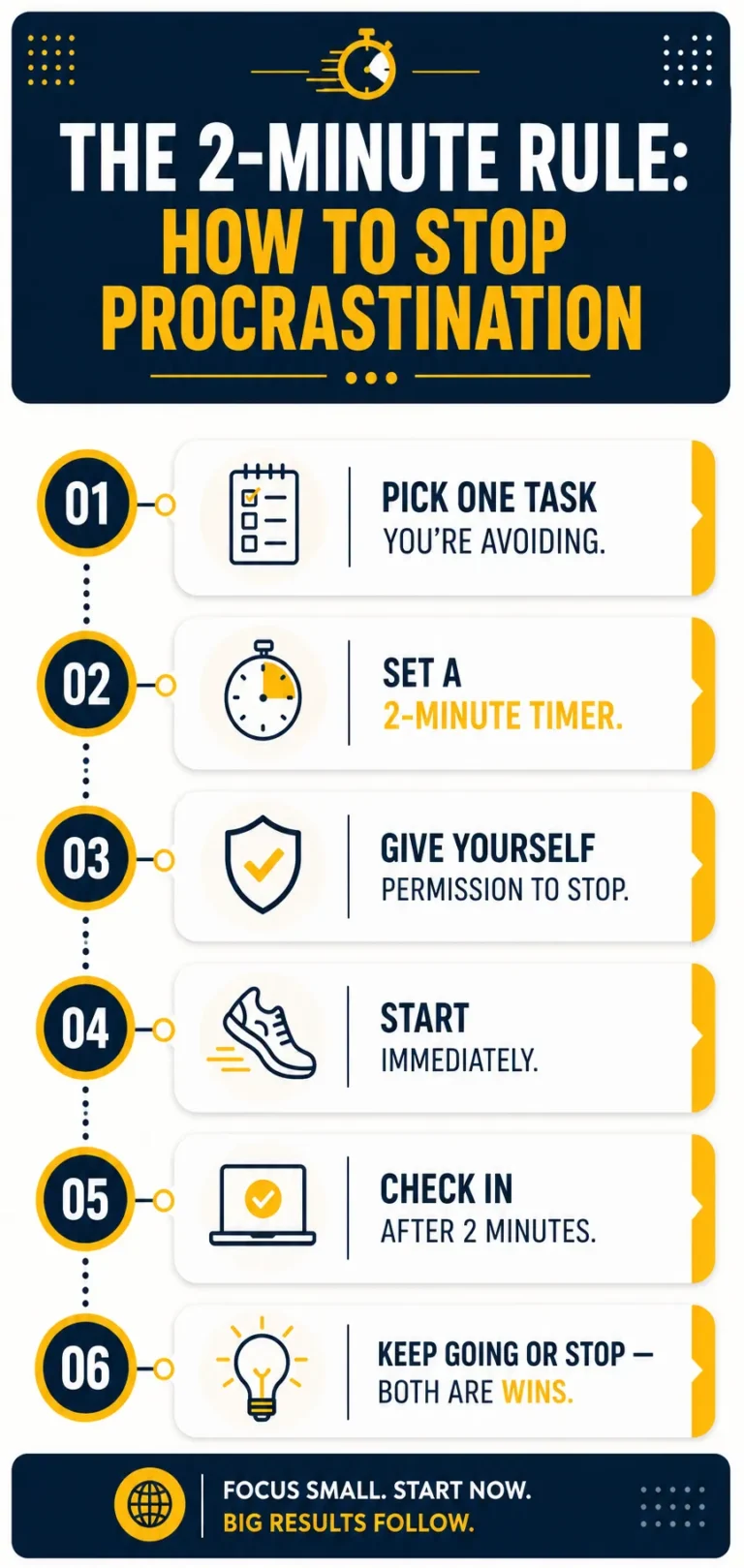
Step 1: Pick one task you’re avoiding Choose just one. Not five. One task you’ve been putting off for a while.
Step 2: Set a timer for two minutes Use your phone. Nothing fancy needed.
Step 3: Give yourself permission to stop after two minutes This part matters. Let your brain know it can quit. This removes the pressure.
Step 4: Start the task the moment the timer begins Don’t plan. Don’t organize your desk first. Just start.
Step 5: Check in after two minutes Ask yourself, “Do I want to keep going?” Most of the time, you will.
Step 6: If you don’t want to continue, stop That’s okay. You still made progress. That’s a real win.
This simple loop is the whole method. No complicated apps. No expensive courses. Just a timer and a decision to start small.
Real-Life Examples of the 2-Minute Rule in Action
An example makes things click faster than an explanation. Here are situations where this rule works wonders.
- Avoiding the gym? Tell yourself you’ll just put on your shoes and walk for two minutes. Most people end up finishing the workout anyway.
- Avoiding a work project? Open the file and write one line, even a bad one, for two minutes.
- Avoiding cleaning? Set a timer and clean just one small area, like your desk or one shelf.
- Avoiding a hard email or conversation? Write just the first two sentences.
- Avoiding studying? Read one page. Just one.
None of these examples ask you to finish anything. They only ask you to begin. And beginning is where procrastination usually wins. This time, you win instead.
2-Minute Rule vs Other Popular Productivity Techniques
You may have heard of other methods like the Pomodoro technique or “eat the frog.” Here’s how the 2-minute rule compares.
The Pomodoro technique asks you to work in 25-minute blocks. That’s great once you’ve already started, but 25 minutes can feel scary if you’re stuck in procrastination mode.
“Eat the frog” tells you to do your hardest task first thing in the morning. It’s solid advice, but it doesn’t solve the actual problem of not wanting to start.
The 2-minute rule is different. It’s the smallest possible commitment. It doesn’t ask for motivation, energy, or a full block of time. It only asks for two minutes. That’s why it works so well as a first step, and you can even pair it with Pomodoro once you’re moving.
Common Mistakes People Make With This Rule
I made a few mistakes when I first started. You might make them too, so here’s what to watch for.
Mistake 1: Choosing a task that’s too big for two minutes If a task can’t even begin in two minutes, break it into smaller pieces first.
Mistake 2: Forcing yourself to keep going every single time The rule works because it feels safe to stop. If you force yourself to continue every time, your brain stops trusting the rule.
Mistake 3: Using it for everything at once Start with one or two tasks a day. Trying to fix your whole routine in one afternoon leads to burnout.
Mistake 4: Skipping the timer The timer creates a clear boundary. Without it, two minutes can quietly become twenty. That’s fine sometimes, but the boundary is what removes fear at the start.
Bonus Tips to Make the 2-Minute Rule Stick
Want this to become a real habit instead of a one-time trick? Try these.
- Pair it with something you already do Right after your morning coffee, do your two minutes. This is called habit stacking, and it works well with this rule.
- Keep a small win list Every time you finish a two-minute session, write it down. Seeing your progress builds motivation.
- Use it first thing in the morning Your willpower is usually highest early in the day. Use the rule before your brain gets tired.
- Celebrate the small stuff Did your two minutes? That’s a win. Treat it like one.
Is the 2-Minute Rule Backed By Science?
Yes, and this part matters.
Behavioral researchers have long studied why people avoid starting tasks. Once a person begins something, motivation naturally increases. This is related to what’s known as the Zeigarnik effect, where unfinished tasks stay in our minds and quietly pull us to continue them.
The 2-minute rule works because it lowers the barrier to starting. It doesn’t require motivation. It only requires two minutes of action. Action creates momentum, not the other way around.
This is why “wait until I feel motivated” almost never works, but “just start for two minutes” almost always does.
There’s also a simple idea called activation energy, borrowed from science class. It takes more energy to start moving than to keep moving once you’re already going. A car uses more fuel to start than to cruise. Your brain works the same way. The 2-minute rule exists purely to cover that first burst of energy, so the rest of the task feels lighter.
Who Benefits Most From the 2-Minute Rule?
This method isn’t only for people who call themselves “chronic procrastinators.” It helps a wide range of people, including:
- Students who freeze up before starting assignments
- Remote workers who struggle with self-discipline at home
- Busy parents who keep pushing personal goals to “someday”
- Anyone dealing with low motivation, mental fatigue, or overwhelm
- People who’ve tried strict routines before and burned out
If you’ve ever said “I’ll start Monday” and then Monday came and went, this rule is for you. It doesn’t ask you to change your personality. It just asks for two minutes of honesty with yourself.
How the 2-Minute Rule Helps With Anxiety and Overwhelm
Procrastination and anxiety often travel together. When a task feels overwhelming, your brain treats it like a threat and looks for an escape.
The 2-minute rule quietly breaks that cycle. Because the commitment is so small, your brain doesn’t sound the alarm. There’s nothing to fear about two minutes.
Over time, this builds something even more valuable than productivity. It builds self-trust. Every time you follow through on a tiny promise to yourself, you prove that you can rely on your own word. That’s a habit worth keeping, far beyond just getting tasks done.
Summary
The 2-minute rule is one of the simplest ways to stop procrastination. Instead of forcing yourself to finish a task, you only commit to starting it for two minutes. This removes fear, lowers resistance, and builds momentum naturally. Most of the time, once you start, you keep going.
Conclusion
Procrastination isn’t about being lazy. It’s about your brain avoiding discomfort. The 2-minute rule works because it tricks your brain into starting, and starting is the hardest part.
I used this rule to fix years of procrastination, and I still use it today. It’s simple, it’s free, and it works.
So here’s your challenge. Pick one task you’ve been avoiding. Set a timer for two minutes. Start right now.
Tell me in the comments which task you tried the 2-minute rule on today. I’d love to hear how it worked for you.
Frequently Asked Questions
What is the 2-minute rule for procrastination?
It means committing to just two minutes of a task you’re avoiding. This lowers resistance and helps you start.
Who created the 2-minute rule?
The task-management version comes from David Allen’s book, “Getting Things Done.” The habit-focused version, aimed at beating procrastination, is widely taught by habit coaches and productivity writers today.
Does the 2-minute rule really work?
Yes, for most people. It works because it removes the pressure to finish and only asks you to begin.
Can I use the 2-minute rule for big projects?
Yes. Break the big project into one tiny first action, then apply the two-minute rule to that action alone.
How long does it take to see results?
Many people notice a shift in how they feel about tasks within the first few days of trying it.
Is the 2-minute rule the same as the 5-second rule?
They’re similar cousins. The 5-second rule asks you to act within five seconds before you talk yourself out of it. The 2-minute rule asks you to act for two minutes once you’ve started. Many people use both together.
What if I still don’t want to start after setting the timer?
That’s normal at first. Try shrinking the task even further, or simply place yourself near the task, like sitting at your desk, without any pressure to begin yet.