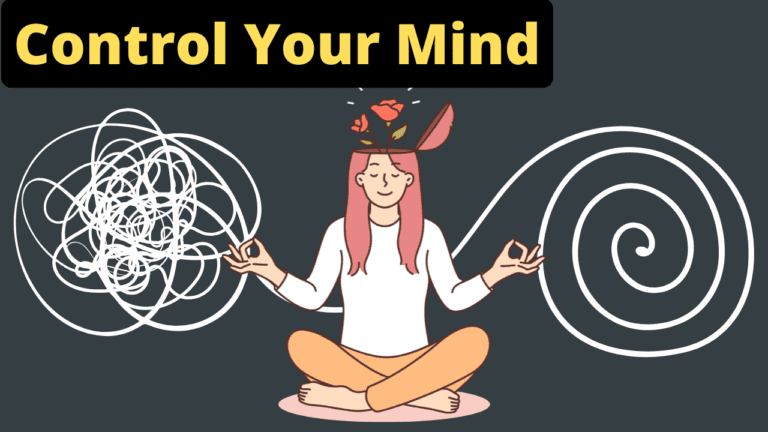
You wake up. You had big plans yesterday. Today, you feel nothing.
No drive. No spark. Just a heavy feeling that says “not today.”
If this sounds like you, you are not lazy. You are not broken. You are just waiting for motivation that may never come on its own.
Here is the truth nobody tells you: motivation is not something you find. It is something you build. And the real skill that changes your life is not motivation at all. It is self discipline.
In this guide, you will learn how to build self discipline even when your motivation is at zero. We will go step by step, in plain simple language, so you can start today, not “someday.”
Table of Contents
What Self Discipline Really Means
Self discipline is the ability to do what needs to be done, even when you don’t feel like doing it.
That’s it. No magic. No secret formula.
Motivated people act because they feel like it. Disciplined people act because they decided to, no matter how they feel.
This one shift is the real answer to how to build self discipline. You stop waiting for the “right mood” and start acting on autopilot.
Think about brushing your teeth. You don’t feel excited about it every morning. You just do it. That is discipline in its simplest form. You can build that same automatic behavior around anything, workouts, work, studying, or eating healthy.
Why You Have Zero Motivation Right Now
Before we fix the problem, let’s understand it.
Motivation runs on dopamine, a brain chemical linked to reward. When a task feels boring, hard, or has no instant reward, your brain simply refuses to release that spark.
This is why:
You feel motivated to watch a new show but not to open your laptop for work.
You feel excited to start a diet on Monday but lose steam by Wednesday.
You scroll your phone for hours but can’t read one page of a book.
Your brain is not against you. It is just wired to chase quick rewards and avoid effort. Once you understand this, you stop blaming yourself and start building a system that works with your brain, not against it.
This is the real starting point for anyone searching how to build self discipline when you have no motivation.
How to Build Self Discipline Step by Step
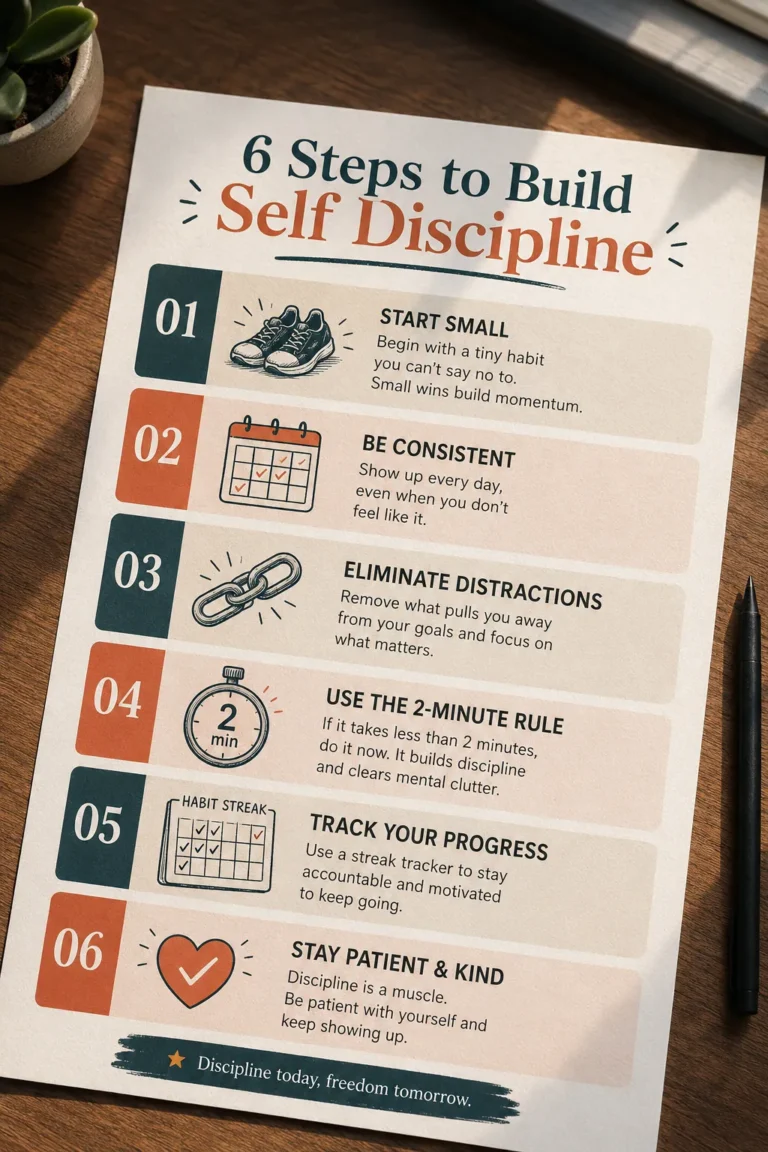
This is the part that actually changes things. Follow these steps in order. Don’t skip step one, even if it feels too easy.
Step 1: Start Absurdly Small
Most people fail at discipline because they aim too high, too fast.
They want to go from zero workouts to one hour daily. From zero savings to a strict budget overnight. That plan is designed to fail.
Instead, shrink the goal until it feels almost silly.
Want to read more? Commit to one page a day.
Want to exercise? Commit to five push-ups a day.
Want to write? Commit to two lines a day.
This is one of the most powerful low motivation productivity hacks that top psychologists and coaches recommend. Small steps don’t scare your brain, so it doesn’t resist.
Step 2: Attach the New Habit to an Old One
This is called habit stacking, and it is one of the simplest self discipline tips for beginners.
Pick a habit you already do every day without thinking, like brushing your teeth or making coffee. Attach your new habit right after it.
Example: “After I pour my morning coffee, I will write two lines in my journal.”
Your brain uses the old habit as a trigger for the new one. Over time, it becomes automatic, just like your coffee routine.
Step 3: Remove Friction Before It Starts
Discipline is easier when the path is easy.
Want to work out in the morning? Sleep in your gym clothes.
Want to eat healthy? Keep junk food out of the house.
Want to study? Keep your books open on the desk, not packed away.
Every extra step between you and the action is a chance for your brain to quit. Remove as many steps as possible.
Step 4: Use the Two Minute Rule
If a task feels too heavy to start, tell yourself you only need to do it for two minutes.
Two minutes of exercise. Two minutes of cleaning. Two minutes of writing.
This trick works because starting is the hardest part, not finishing. Once you begin, momentum usually carries you further than two minutes.
This is one of the best mental discipline exercises for people who feel stuck before they even begin.
Step 5: Track Your Streak, Not Your Mood
Don’t ask yourself “do I feel like doing this today?”
Ask yourself “did I do it yesterday?”
Keep a simple habit tracker. A calendar with X marks works fine. Once you see a streak building, breaking it will feel worse than the effort of continuing.
This single habit is one of the most underrated ways how to stay disciplined without motivation.
Step 6: Forgive the Miss and Restart Fast
You will miss a day. Everyone does.
The people who build real discipline are not the ones who never fail. They are the ones who don’t let one missed day turn into one missed month.
Miss a day, feel okay about it, and restart the very next day. No guilt spiral. No “I’ll start next Monday.” Just restart.
Daily Habits That Build Self Discipline Fast
If you want quick wins alongside the steps above, add these daily habits to build self discipline into your routine.
Wake up at the same time every day, even on weekends.
Make your bed right after waking up. It’s a small win that trains your brain for bigger ones.
Write down three tasks the night before, so you don’t waste morning energy deciding what to do.
Avoid your phone for the first thirty minutes of the day.
Move your body for at least five minutes, even if it’s just stretching.
None of these feel dramatic. That is exactly why they work. Discipline is built in boring, quiet moments, not big dramatic bursts of willpower.
A Real Example: Small Steps Beating Zero Motivation
Think of someone who wants to get fit but hates the gym.
On day one, they don’t go for a run. They just put on their shoes and stand outside for two minutes.
That’s it. No run. No sweat. Just shoes and two minutes.
Day two, they do the same thing, but this time they walk to the end of the street.
Day seven, walking feels normal, so they add a short jog.
By week four, they are running without forcing themselves, because the habit already exists in their routine.
Nobody in this story felt “motivated” on day one. They simply made the first step so small that skipping it felt more awkward than doing it.
This is exactly how real self discipline gets built in everyday life, not through dramatic willpower, but through tiny, repeatable actions that quietly turn into identity.
You can apply this same pattern to anything, a business idea, a skill you want to learn, or a habit you want to break. Shrink the first step until there is no excuse left to avoid it.
Self Discipline vs Motivation: Know the Difference
Many people confuse these two words, but they are not the same thing.
Motivation is a feeling. It comes and goes based on your mood, energy, and environment. You cannot fully control it.
Self discipline is a skill. It is built through repetition, structure, and small consistent choices. You can absolutely control it.
Waiting for motivation is like waiting for good weather to start a business. Discipline is building an indoor setup so the weather doesn’t matter anymore.
Once this idea clicks, you stop chasing motivation and start building systems. That mindset shift is the real long term answer to how to build self discipline.
Common Mistakes That Kill Discipline
Avoid these traps if you want your discipline to actually last.
Relying on willpower alone. Willpower gets tired by the end of the day, just like a muscle. Systems and habits don’t get tired.
Setting goals that are too big, too soon. This leads to burnout within a week.
All or nothing thinking. Missing one day does not erase your progress. Quitting completely does.
Comparing your pace to someone else’s highlight reel online. Your discipline journey is yours alone.
Ignoring rest. Discipline without recovery leads to breakdowns, not breakthroughs.
How to Stay Disciplined for the Long Run
Short bursts of discipline are easy. Long term discipline needs one more ingredient: identity.
Instead of saying “I am trying to exercise,” say “I am someone who shows up for my workouts.”
Instead of saying “I am trying to save money,” say “I am someone who manages money wisely.”
This shift matters because behavior naturally follows identity. When discipline becomes part of who you are, not just something you are forcing yourself to do, it stops feeling exhausting.
Review your small wins every week. Seeing your own progress on paper builds real confidence, and confidence fuels more discipline, creating a positive cycle that keeps growing.
Summary
Motivation is a feeling. Discipline is a system.
Start small, almost too small to fail.
Stack new habits onto old ones you already do daily.
Remove friction so the right choice is the easy choice.
Use the two-minute rule when you feel stuck.
Track your streak, not your mood.
Forgive missed days and restart quickly, without guilt.
Build daily habits that don’t rely on big bursts of energy.
Shift from “trying” to “identity” for lasting change.
Final Thoughts
You don’t need to feel ready to become disciplined. You just need to start, in the smallest way possible, today.
Every person who seems naturally disciplined once stood exactly where you are now, with zero motivation and a long road ahead. The only difference is they started small and kept showing up.
Pick one step from this guide. Just one. Do it today, even if it takes two minutes.
That one small action is where your self discipline truly begins.
If this guide helped you, save it, share it with someone who needs it, and come back to it whenever your motivation runs low. That’s exactly what it’s here for.
Frequently Asked Questions
How can I build self discipline when I have zero motivation?
Start with a task so small it feels effortless, attach it to an existing habit, and track your streak daily instead of waiting to feel motivated.
Is self discipline a skill or a personality trait?
It is a skill. Anyone can build it with small, repeated actions over time, regardless of personality type.
How long does it take to build self discipline?
Most people notice a real shift in three to four weeks of consistent small habits, though full identity change often takes a few months.
What is the fastest way to get disciplined overnight?
There is no true overnight fix, but using the two-minute rule today is the fastest way to build momentum right now.
Can self discipline be built without relying on willpower?
Yes. In fact, the strongest form of discipline relies on habits, routines, and small daily systems rather than willpower, since willpower naturally fades as the day goes on.