
Have you ever caught yourself saying, “I’m just not a math person” or “I could never do that”?
If yes, you’re not alone. Most of us say things like this without even thinking twice.
But here’s the truth. Those small words shape how you think, act, and grow. They come from something called a fixed mindset.
The good news? You can change it. In this blog, you’ll learn the 8 clear signs of a fixed mindset. And more importantly, you’ll learn how to develop growth mindset habits that actually stick, not just for a day, but for life.
Let’s dive in.
Table of Contents
What Is a Fixed Mindset? (Quick Explainer)
Psychologist Carol Dweck spent years studying how people learn and respond to challenges. Her research gave us two simple terms: fixed mindset and growth mindset.
A fixed mindset means you believe your talent, intelligence, and abilities are set in stone. You either have it, or you don’t. End of story.
A growth mindset means you believe skills can be built. Through effort, practice, and the right daily habits, anyone can improve at almost anything.
Sounds simple, right? But here’s the twist. Most people carry both mindsets, just in different parts of life. You might feel confident at work but completely stuck when it comes to fitness, money, or relationships.
That’s exactly why learning how to develop growth mindset habits matters so much. It’s not about becoming a new person overnight. It’s about small, repeatable shifts that add up over time.
Now, let’s look at the signs.
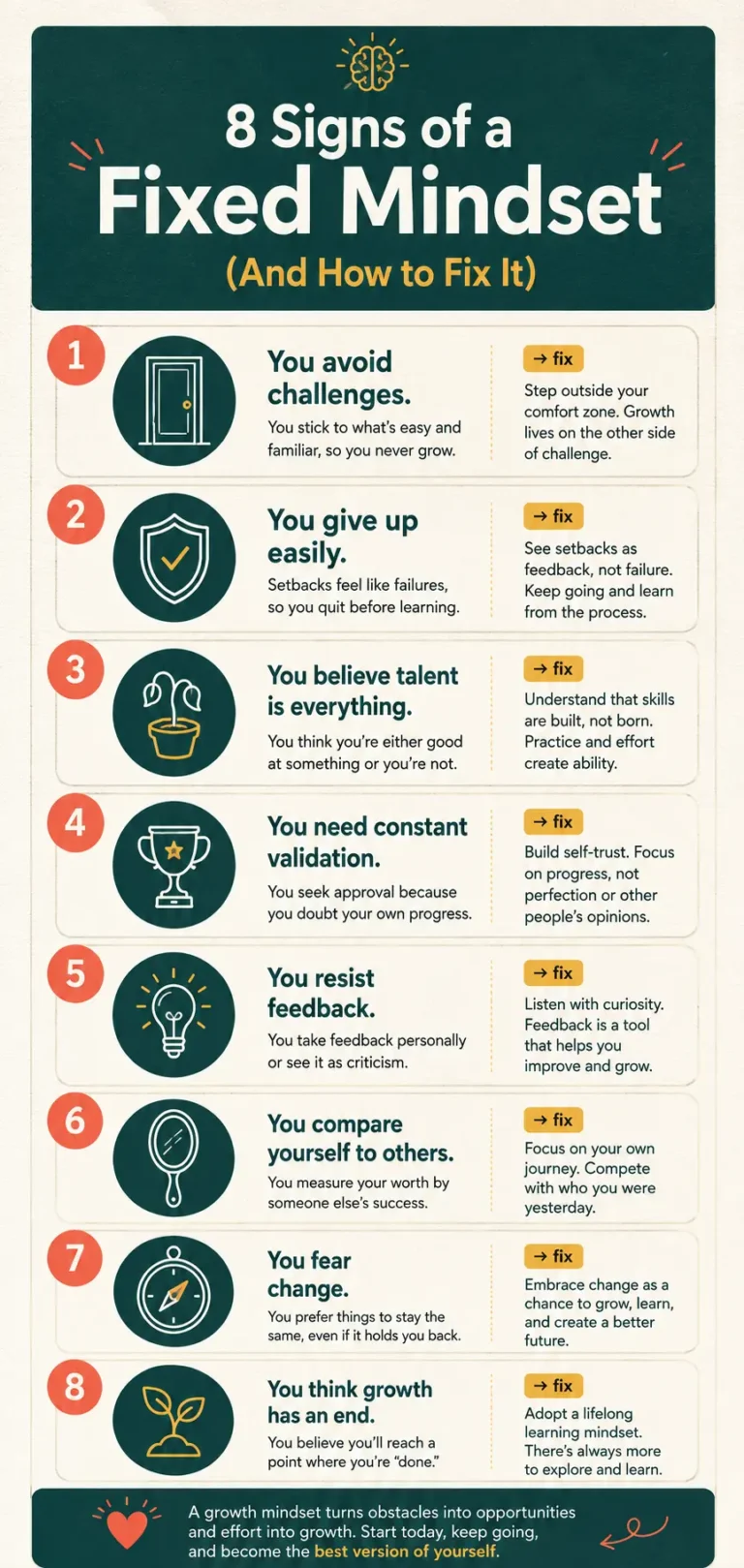
8 Signs You Have a Fixed Mindset
1. You Avoid Challenges
Do you skip tasks that feel hard? Do you stick only to what you already know how to do?
This is one of the clearest signs of a fixed mindset. When you avoid challenges, you protect your ego in the short term. But you also stop growing in the long term.
Think about it this way. A closed door never lets in new air. A closed mind works the same way.
The fix: Pick one small challenge this week. Something slightly outside your comfort zone. Not scary, just a little uncomfortable. That’s where growth begins.
2. You Take Feedback Personally
Fixed mindset thinkers hear feedback as an attack. “You made a mistake here” feels like “You are a failure.”
Growth mindset thinkers hear the exact same feedback as useful data. It’s not personal. It’s information they can use.
The fix: Next time someone points out a mistake, pause before reacting. Ask yourself, “What can I learn from this?” instead of “Why are they against me?” This one shift changes everything.
3. You Give Up Easily
When something feels hard, do you quit fast? Fixed mindset says, “If I’m struggling, I must not be good at this.”
Growth mindset says, “If I’m struggling, I’m actually learning something new.”
Struggle isn’t a red flag. It’s usually a sign that real learning is happening.
The fix: Set yourself a simple rule. Try any new skill for at least 21 days before deciding if it’s “not for you.” Most people quit right before things start clicking.
4. You Feel Threatened By Other People’s Success
Do you feel a small pinch of jealousy when a friend gets a promotion or hits a goal? That’s a quiet fixed mindset warning sign.
It usually means you see success as limited, like there’s only so much of it to go around. But success isn’t a pizza with a fixed number of slices.
The fix: Start celebrating other people’s wins out loud. Say “congrats” and actually mean it. This small habit trains your brain to see success as something unlimited, not something to compete over.
5. You Believe Talent Is Everything
“She’s just naturally smart.” “He was born with it.”
These thoughts sound harmless. But they quietly reinforce a fixed mindset belief: that effort matters less than natural talent.
The fix: Look closer at the story behind any “talented” person you admire. You’ll almost always find years of quiet practice hiding behind the talent everyone sees.
6. You Fear Failure More Than You Want Success
Fixed mindset thinkers often play it safe. Not because they lack ambition, but because failing feels too painful to risk.
This fear quietly keeps you stuck in the same job, same habits, same routines, year after year.
The fix: Reframe failure in your head. It’s not the opposite of success. It’s simply a required step on the way to success.
7. You Stick To What You’re “Good At”
Comfort feels safe. But staying in your lane for your entire life limits how much you can actually grow.
If you only ever do what you’re already good at, you never give yourself the chance to become good at something new.
The fix: Pick one new skill to learn this month, purely for fun. No pressure to be great at it. Just enjoy being a beginner again.
8. You Say “I’m Not Good At This” And Stop There
This is probably the most common sign of all. And it’s sneaky, because it genuinely feels true in the moment.
But the full, honest sentence is actually: “I’m not good at this yet.”
The fix: Add the word “yet” to every limiting sentence you catch yourself saying. It’s a tiny word. But it quietly rewires how your brain treats the sentence.
Which of these signs felt a little too familiar? You’re not stuck with them. Keep reading, because the next part is where things actually shift.
How To Develop Growth Mindset Habits (Step-by-Step)
Now for the part you came here for. Knowing the signs is step one. Building real, lasting habits is step two.
Here is a simple, step-by-step guide on how to develop growth mindset habits that don’t fade away after a week.
Step 1: Notice Your Fixed Mindset Triggers
You can’t change what you don’t notice first.
For one week, simply track the moments when you think or say something fixed. Write it down in your notes app. No judgment, just awareness. This alone will surprise you.
Step 2: Replace “Can’t” With “Can’t Yet”
This tiny language shift is one of the most powerful growth mindset habits you can build.
Every time you catch a fixed thought, quietly add “yet” to the end.
“I can’t run 5 km” becomes “I can’t run 5 km yet.” Same sentence, completely different feeling.
Step 3: Set Learning Goals, Not Just Performance Goals
Performance goals are about winning or looking good in front of others. Learning goals are about actually growing as a person.
Instead of “I want to get an A on this test,” try “I want to truly understand this topic.” The grade tends to follow anyway.
Step 4: Build a Daily Reflection Habit
Spend just 5 minutes each night before bed. Ask yourself three simple questions:
- What did I learn today?
- What mistake actually taught me something?
- What will I try a little differently tomorrow?
This one small daily habit quietly builds strong growth mindset muscles over time.
Step 5: Surround Yourself With Growth-Minded People
Mindset is contagious, whether we like it or not. If the people around you avoid challenges, you’ll slowly start avoiding them too.
Follow mentors, communities, or even social accounts that value effort and learning over raw natural talent.
Step 6: Celebrate Effort, Not Just Results
Praise yourself for trying, not only for winning.
Did you show up to the gym even on a low-motivation day? That’s a real win. Celebrate it exactly like you’d celebrate a big result.
Step 7: Read About Growth Mindset Regularly
Reading books, blogs like this one, or short articles keeps the concept fresh and active in your mind.
Small, regular reminders are what actually build long-term growth mindset habits, not one big motivational burst that fades in three days.
Bookmark this page and come back to this checklist whenever your motivation dips. That’s exactly what it’s here for.
Bonus: Simple Daily Growth Mindset Habit Checklist
Use this short checklist every morning or evening. It only takes a minute to run through.
- Say “yet” instead of “can’t”
- Try one small hard thing today
- Reflect for 5 minutes before bed
- Celebrate one effort, not just one result
- Read or listen to something growth-focused
Print it, save it, or screenshot it. Small consistent checks build big long-term change.
Summary
- A fixed mindset believes talent and ability are set in stone. A growth mindset believes skills can be built through effort.
- The 8 signs of a fixed mindset are: avoiding challenges, taking feedback personally, giving up easily, feeling threatened by others’ success, believing talent matters more than effort, fearing failure, sticking only to what you’re good at, and stopping at “I’m not good at this.”
- You can develop growth mindset habits with small, repeatable steps: notice your triggers, change your language, set learning goals, reflect daily, surround yourself with growth-minded people, celebrate effort, and read about it regularly.
Conclusion
A mindset shift doesn’t happen in one single day. But real progress happens with every small step you take.
Notice your fixed thoughts today. Add “yet” to that one sentence you catch yourself saying the most. That, right there, is how to develop growth mindset habits that actually last, one tiny shift at a time.
Which sign from this list felt closest to home for you? Drop it in the comments below. And if this helped you even a little, share it with someone who needs to read it too.
Frequently Asked Questions
How long does it take to develop growth mindset habits?
Most people notice small shifts within a few weeks. But a real, lasting mindset change usually takes around 3 to 6 months of consistent practice.
Can adults change from a fixed mindset to a growth mindset?
Yes, absolutely. Mindset isn’t fixed by age. Anyone, at any stage of life, can build growth mindset habits with the right daily practice.
What is the fastest way to fix a fixed mindset?
Start small. Change your language first, add the word “yet” to limiting sentences, then slowly build in a daily reflection habit.
Is a growth mindset the same as being positive all the time?
No. A growth mindset isn’t about forcing fake positivity. It’s about believing your abilities can improve through effort, even during hard or frustrating moments.