Have you ever looked at the clock at 9 PM and thought, “Where did my whole day go?”
You wanted to finish that project. You wanted to clean the house. You wanted to read a few pages of that book. But somehow, the day slipped away and you did none of it.
If this sounds like you, you are not alone.
A few years ago, I used to end most days feeling tired but empty. I was busy all day, yet nothing important got done. It took me a long time to realize the problem was not my schedule. It was my habits.
Once I fixed a few small things, my days changed completely. I got more done in less time, and I felt calmer too.
The good news is, you can stop wasting time and be more productive starting today. You don’t need expensive apps, courses, or a personality change. You just need a few simple, honest changes.
In this blog, I will show you real, simple, and proven ways to stop wasting time and be productive every day. These are not random tips copied from the internet. These are steps that actually work in daily life, even on your busiest days.
Let’s get started.
Table of Contents
Why Do We Keep Wasting Time Every Day?
Before we fix the problem, we need to understand it.
Most people don’t waste time on purpose. It happens quietly, in small pieces, until the whole day disappears.
Here are the biggest reasons people lose time without even noticing:
- Checking phone notifications every few minutes
- Jumping between tasks without finishing any one of them
- Starting the day with no clear plan
- Feeling tired but pushing through instead of resting properly
- Doing “busy work” instead of important work
- Saying yes to everything, even things that don’t matter
Each of these looks small on its own. But together, they quietly eat hours out of your day.
Here is the honest truth: you don’t have a time problem. You have a focus and planning problem. Time management tips only work once you fix this root cause first.
Once you understand this, everything else becomes much easier.
The Real Cost of Wasting Time (It’s More Than You Think)
Wasting time doesn’t just cost you a few hours. It costs you something much bigger.
It costs you your goals. Your energy. Your peace of mind.
Think about it this way. If you waste just two hours every day on things that don’t matter, that adds up to 14 hours a week. Over a month, that is almost 60 hours. That is more than one full week of your life, gone.
Now imagine using those same hours to learn a new skill, grow your business, exercise, or simply spend time with people you love.
This is exactly why learning how to stop wasting time and be more productive is not just a small productivity tip. It is a life-changing habit that pays off for years.
Ready to take back your time? Let’s move on to the real, practical steps.
How to Stop Wasting Time and Be More Productive: Step-by-Step Guide
This is the part you came here for. Follow these steps in order, and don’t skip any of them. Each one builds on the last.
Step 1: Track Where Your Time Actually Goes
You cannot fix a problem you don’t measure.
For just one day, write down what you do every hour. Be honest, even about the time spent scrolling social media or watching random videos.
Most people are genuinely shocked when they see the real numbers written down.
This one simple habit is the true first step to stop wasting time and be more productive, because it shows you the truth instead of your guess.
Step 2: Pick One Main Priority Each Day
Don’t start your morning with ten different goals in your head. Start with just one.
Ask yourself a simple question: “If I finish only ONE thing today, what should it be?”
Do that one task first, before you check your phone, emails, or messages.
This single habit alone can double how much you get done in a day, because your best energy goes toward what actually matters.
Step 3: Use Time Blocking Instead of a Simple To-Do List
To-do lists feel good to write. But they don’t force you to actually act on them.
Time blocking is different. You assign a fixed time slot to each task on your calendar, just like a meeting.
For example, a simple time block could look like this:
- 9:00–10:30 AM: Deep, focused work on your main project
- 10:30–10:45 AM: Short break
- 10:45–11:30 AM: Emails and quick messages
- 11:30–12:30 PM: Second priority task
This method removes confusion from your day. You always know exactly what to do next, so there is no time wasted deciding.
Step 4: Remove Small Distractions Before They Start
Distractions don’t wait until you’re ready to deal with them. So you must be ready for them in advance.
Try these simple, low-effort tricks:
- Turn off phone notifications during work hours
- Keep your phone in another room while you work
- Close extra browser tabs on your computer
- Let people around you know not to disturb you for a set time
Small changes like these protect your focus far better than relying on willpower alone. Willpower gets tired. Systems don’t.
Step 5: Take Real Breaks, Not Scroll Breaks
This step surprises a lot of people, but it makes a huge difference.
Scrolling social media is not a real break. It actually tires your brain more than it rests it.
Instead, try a genuine break like:
- Walking for five minutes
- Simple stretching
- Drinking a glass of water
- Just looking outside a window for a minute
These real breaks refresh your mind. Scroll breaks quietly drain it, even though they feel relaxing at the moment.
Step 6: Try the Pomodoro Technique for Deep Focus
If you struggle to stay focused for long periods, this simple time management method helps a lot.
Here’s how it works:
- Work with full focus for 25 minutes
- Take a five-minute real break
- Repeat this cycle four times
- After four rounds, take a longer 15 to 20 minute break
This technique trains your brain to focus in short, manageable bursts. It is one of the most beginner-friendly ways to stop wasting time and be more productive without feeling burned out.
Step 7: Review Your Day Every Night
Before you sleep, spend just five minutes reviewing your day.
Ask yourself these three simple questions:
- What worked well today?
- What wasted my time today?
- What can I do better tomorrow?
This small nightly habit builds self-awareness. And self-awareness is the quiet secret behind almost every productive person you admire.
Simple Daily Habits to Be More Productive Every Day
Along with the steps above, these small daily habits make a real difference over time:
- Wake up at the same time every day
- Drink water first thing in the morning
- Avoid checking your phone in the first 30 minutes after waking up
- Eat light meals to avoid feeling sleepy during work
- Keep your workspace clean and clutter-free
- Say no to tasks that don’t truly matter
- Celebrate small wins instead of only chasing big ones
None of these habits are difficult by themselves. But together, they quietly build a productive, low-stress lifestyle.
Try adding just one new habit this week. Don’t try all of them at once. Small, steady steps beat a big burst of motivation that fades in three days.
Common Time-Wasting Mistakes to Avoid
Even people who genuinely try hard to be productive fall into these common traps:
- Multitasking, which feels productive but actually slows you down
- Waiting for “motivation” instead of simply starting
- Overplanning your day instead of doing the actual work
- Comparing your progress to other people’s highlight reels
- Working long hours without proper rest
- Ignoring sleep to “find more time”
Avoiding these mistakes is just as important as building good new habits. Sometimes, removing one bad habit helps more than adding five new ones.
Why Most Productivity Advice Doesn’t Work Long-Term
Most productivity tips fail for one simple reason: people try to change everything at once.
They buy a planner, download five apps, wake up at 5 AM, and quit sugar, all in the same week. This never lasts.
The steps in this blog work because they are simple, realistic, and easy to repeat daily. Real productivity is not about doing more. It’s about doing the right things, consistently, without burning out.
Start small. Stay consistent. That is the real formula to stop wasting time and be more productive every single day.
Summary
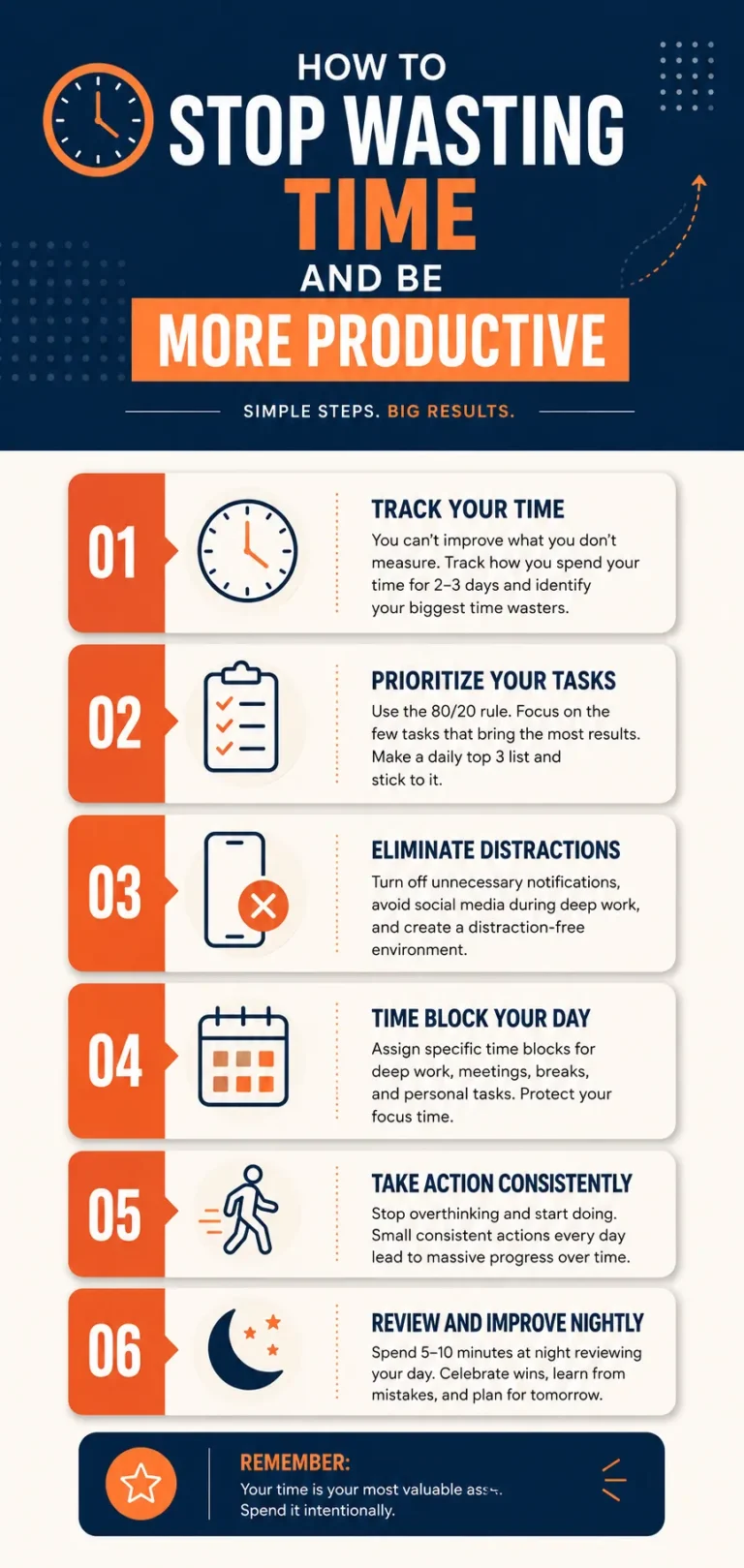
Let’s quickly recap everything we covered in this guide:
- Wasting time usually happens in small, unnoticed moments, not big ones
- Tracking your time honestly shows you the real picture
- One clear daily priority sharpens your focus instantly
- Time blocking removes daily confusion and decision fatigue
- Removing small distractions protects your energy better than willpower
- Real breaks refresh your mind far better than scrolling does
- The Pomodoro technique helps you focus in short, easy bursts
- Reviewing your day every night builds long-term self-awareness
Conclusion
You don’t need a perfect system to stop wasting time and be more productive. You just need to start with one small, honest step today.
Pick just one tip from this blog. Try it for the next seven days. Notice how different your days start to feel.
Small changes, repeated daily, quietly create big results over time. That is how real, lasting productivity is built, not through one big overnight change.
If this blog helped you even a little, save it for later and share it with someone who genuinely needs it too.
Stop Wasting Time Be More Productive.
What is the one habit you will start today? Let me know in the comments below.
Frequently Asked Questions
What is the fastest way to stop wasting time?
Track your time for just one full day. This simple exercise shows you exactly where your hours are actually going.
How can I be more productive every day without feeling burned out?
Focus on one main task daily, take real breaks, get enough sleep, and avoid multitasking.
Why do I waste time even when I really want to be productive?
This usually happens because of unclear priorities, constant phone distractions, or simple tiredness. Fixing the root cause matters more than trying harder.
Can small daily habits really improve productivity?
Yes, absolutely. Small daily habits build up quietly over time and create lasting, long-term change, unlike short bursts of motivation.
How long does it take to build a productive daily routine?
Most people notice real improvement within two to three weeks of staying consistent with even one or two habits from this guide.