Do you ever feel like life keeps throwing punches, and you barely have time to breathe before the next one lands?
You’re not alone. Stress, overthinking, and emotional burnout have become normal for most people today. But there’s a 2,000-year-old solution that still works better than half the “productivity hacks” online.
It’s called Stoicism.
In this post, we’ll break down five simple stoic habits for mental strength that anyone can start today. No fluff, no complicated philosophy talk. Just real habits used by ancient thinkers — and now backed by modern psychology — to build unshakeable inner strength.
By the end, you’ll have a clear, step-by-step plan to build mental toughness like a Stoic, even if you’ve never read a philosophy book in your life.
Table of Contents
What Is Stoicism, Really?
Stoicism is an ancient Greek philosophy that teaches you how to control your reactions, not your circumstances.
It was practiced by emperors, slaves, and soldiers alike — people like Marcus Aurelius, Epictetus, and Seneca. They didn’t have easy lives. Wars, betrayal, loss, illness — they faced it all. Yet they built a mindset so strong that modern therapists still study it today.
That’s the core idea behind stoic habits for mental strength: you can’t always control what happens to you, but you can always control how you respond.
Sounds simple. It’s not always easy. But it works.
Why Stoic Habits Build Real Mental Strength
Most self-help advice tells you to “think positive.” Stoicism is different. It doesn’t ask you to ignore problems. It teaches you to face them calmly, with clarity instead of panic.
This is why stoic mindset training is quietly becoming one of the most searched self-improvement topics online. People are tired of fake positivity. They want real emotional resilience techniques that actually hold up during hard times.
Here’s what daily stoic practices can help you with:
Lower anxiety and overthinking
Better emotional control under pressure
Stronger self-discipline
Less fear of failure or judgment
A calmer, more focused mind
Now let’s get into the five habits.
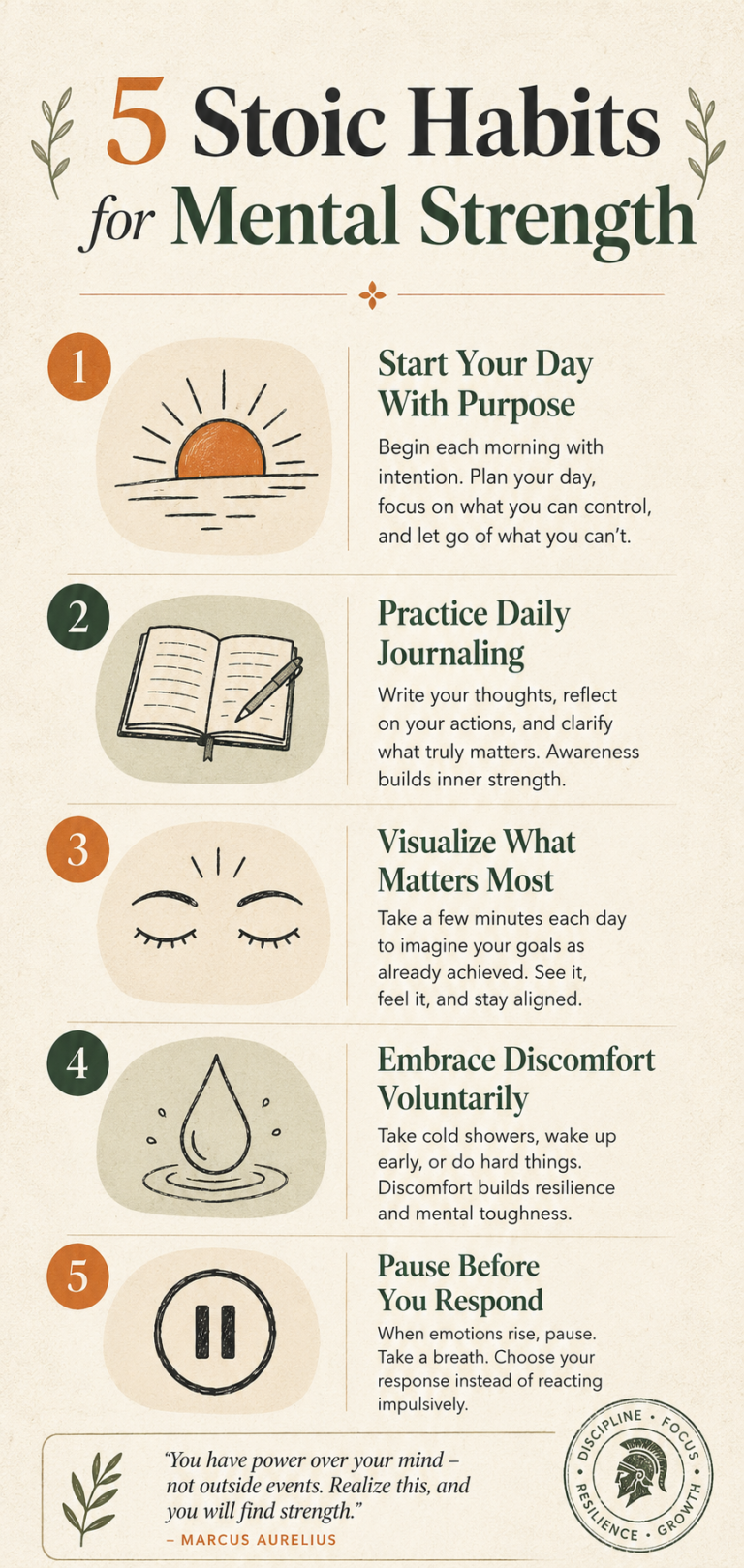
1. Practice the Dichotomy of Control Every Morning
This is the foundation of stoic philosophy, and it’s the easiest habit to start with.
Every morning, before checking your phone, ask yourself one question: “What can I actually control today?”
You can control your effort, your attitude, your words, and your actions. You cannot control other people’s opinions, traffic, the weather, or what your boss says in a meeting.
How to practice it, step by step:
Step 1: Take a notebook or your phone notes app.
Step 2: Write down two columns — “In My Control” and “Not In My Control.”
Step 3: List today’s biggest worry under the correct column.
Step 4: If it’s not in your control, consciously let it go and focus only on your response.
This simple stoic exercise takes less than three minutes, but it rewires how your brain handles stress. Try it tomorrow morning and notice how much lighter your day feels.
2. Journal Like Marcus Aurelius (Evening Reflection)
Marcus Aurelius, the Roman emperor, kept a private journal just for himself. It wasn’t meant to be published. It was raw, honest self-talk to process his day and sharpen his mind.
That journal is now one of the most powerful tools for building mental strength through self-reflection.
How to start your own stoic journal:
Step 1: Every night, grab a notebook.
Step 2: Answer three questions honestly: What did I do well today? Where did I let my emotions control me? What will I do differently tomorrow?
Step 3: Keep entries short. Two or three lines is enough.
Step 4: Don’t judge yourself. Just observe.
This habit builds something psychologists call self-awareness, one of the strongest predictors of emotional resilience. Do this for 21 days straight, and you’ll notice patterns in your behavior you never saw before.
3. Practice Negative Visualization (Premeditatio Malorum)
This sounds intense, but stick with it. It’s one of the most powerful stoic techniques for staying calm under pressure.
The idea is simple: occasionally imagine losing something you value — your job, your health, a relationship. Not to scare yourself, but to appreciate what you have and prepare your mind for setbacks before they happen.
How to practice negative visualization safely:
Step 1: Pick one thing you’re grateful for — your health, a person, your income.
Step 2: Spend 60 seconds imagining life without it.
Step 3: Notice the gratitude that rushes in afterward.
Step 4: Ask yourself, “If this happened, how would I cope?” Write down one honest answer.
This isn’t about fear. It’s mental armor. People who practice this stoic habit for mental strength report feeling far less anxious when real setbacks actually happen, because their mind has already rehearsed handling it.
4. Embrace Voluntary Discomfort
Modern life is built around comfort. Warm showers, soft beds, instant food delivery. But comfort quietly makes the mind weaker over time.
Stoics used to voluntarily choose small discomforts — cold weather, simple meals, walking instead of riding — to train their willpower and reduce their fear of hardship.
How to build this habit gradually:
Step 1: Start small. Take a 30-second cold shower.
Step 2: Skip one comfort this week — your daily snack, extra scrolling, or the elevator.
Step 3: Notice the mental resistance. Sit with it instead of avoiding it.
Step 4: Slowly increase the challenge as it gets easier.
This is one of the most underrated daily stoic practices for building self-discipline and mental toughness. It teaches your brain that discomfort isn’t dangerous — it’s just uncomfortable. And that difference changes everything.
5. Respond, Don’t React (Pause Before You Speak)
This is the habit that changes relationships, careers, and mental peace almost overnight.
Stoics believed that between an event and your reaction, there’s a tiny gap. Most people never use that gap. They react instantly, out of anger, fear, or frustration. Stoics train themselves to pause inside that gap and choose their response instead.
How to practice this simple stoic exercise for anxiety and anger:
Step 1: The next time someone upsets you, pause for five seconds before replying.
Step 2: Take one slow breath during that pause.
Step 3: Ask yourself, “Will this reaction help me or hurt me?”
Step 4: Respond calmly, even if it’s just “Let me think about this.”
This single habit is one of the fastest ways to build emotional resilience. It stops regret before it starts, and people around you will notice the change in how grounded you feel.
How to Start Building These Stoic Habits Today
You don’t need to master all five habits at once. That’s how people quit in week one.
Instead, pick just one habit from this list. Practice it daily for the next seven days. Once it feels natural, add the next one.
Small, consistent stoic habits for mental strength compound over time, just like saving money. You won’t feel a huge difference on day one. But by day thirty, you’ll notice you’re calmer, sharper, and harder to shake than before.
Start tonight. Open a notebook. Write down one thing you can control tomorrow. That’s it. That’s the first step toward becoming mentally unbreakable.
Quick Summary
Stoicism teaches you to control your response, not your circumstances.
Practice the dichotomy of control every morning to reduce anxiety.
Journal every night like Marcus Aurelius to build self-awareness.
Use negative visualization to prepare your mind for setbacks.
Embrace small discomforts to strengthen willpower and discipline.
Pause before reacting to build long-term emotional resilience.
Final Thoughts
Becoming mentally unbreakable isn’t about ignoring pain or pretending everything’s fine. It’s about building a mind strong enough to face reality without falling apart.
These five stoic habits for mental strength aren’t ancient theory. They’re practical tools, tested for over two thousand years, and still working today because human nature hasn’t changed.
Pick one habit. Start today. Your future self will thank you.
If this helped you, save this post so you can come back to it, and share it with someone who needs a little more mental strength this week.
Frequently Asked Questions
What are stoic habits for mental strength?
They are simple daily practices, like journaling, controlled breathing, and self-reflection, based on ancient stoic philosophy. They train your mind to stay calm and focused during stress instead of reacting emotionally.
Can stoicism really help with anxiety and overthinking?
Yes. Many stoic techniques, like the dichotomy of control and evening journaling, are similar to methods used in modern cognitive behavioral therapy. They help you separate real problems from imagined ones.
How long does it take to build a stoic mindset?
Most people notice small shifts within one to two weeks of daily practice. Lasting change usually takes around 30 to 60 days of consistent habit-building.
Is stoicism about hiding or suppressing your emotions?
No, and this is a common myth. Stoicism doesn’t ask you to suppress feelings. It teaches you to observe your emotions calmly before deciding how to act on them.
What is the easiest stoic habit for a complete beginner?
Start with the morning dichotomy of control exercise. It takes under three minutes and requires no special tools, just a notebook or your phone.