Imagine waking up at 9 AM. No boss. No office. No team to manage. Just you, your laptop, and an AI tool doing the heavy lifting while money comes in.
Sounds too good to be true?
It is not. And thousands of solo entrepreneurs are doing exactly this right now.
Building a one-person AI business is not science fiction anymore. It is happening in real time. People with zero technical background are using AI tools to run full businesses alone, from content creation agencies to AI-powered consulting services.
If you have zero organic traffic, zero followers, and zero experience, this guide is written for you.
Let us start from scratch, step by step.
Table of Contents
What Is a One-Person AI Business?
A one-person AI business is a solo-run business where you use AI tools to replace tasks that would normally require a full team.
Think about it this way. Ten years ago, running a content agency needed writers, editors, designers, and social media managers. Today, one person with the right AI stack can do all of that alone and still serve 10 to 20 clients every month.
That is the power of building an AI-powered solo business.
You become the CEO, the strategist, and the delivery team, but AI does the repetitive work. You just guide it, review it, and deliver it.
This is not about replacing your job overnight. This is about using AI as your unfair advantage.
Why Now Is the Best Time to Start an AI Business as a Solo Founder
The timing has never been better, and here is why.
AI tools are cheap. ChatGPT, Claude, Midjourney, and dozens of others charge less than a Netflix subscription. You can run an entire business on under $100 per month in tools.
Businesses are desperate. Every small business owner knows they need AI help but very few know how to use it. That gap is your opportunity.
The market is still early. Most people are still consuming content about AI instead of actually building businesses with it. You can be the person who acts while others scroll.
Low competition in local markets. Big AI agencies are chasing Fortune 500 companies. Local and mid-sized businesses in your city have almost no one helping them. That is a goldmine hiding in plain sight.
Remote-first world. Your clients can be anywhere. Your business can run from any country. All you need is a laptop and a reliable internet connection.
Step 1: Pick the Right One-Person AI Business Model
This is the most important decision you will make. The wrong model wastes months of your life. The right model gets you your first paying client within weeks.
Here are the best AI business models for solo founders in 2025.
- AI Content Writing Service — You write blog posts, social media content, and email newsletters using AI tools like ChatGPT or Claude. You edit, refine, and deliver polished content. Clients pay $300 to $2,000 per month for this.
- AI Video Editing and Short-Form Content — Tools like Descript, Opus Clip, and CapCut AI let you turn long videos into dozens of short clips. Businesses creating YouTube content or podcasts will pay you well for this.
- AI Social Media Management — You use AI to plan, write, and schedule social media posts for small businesses. One person can easily manage 5 to 8 clients with the right tools.
- AI Automation and Workflow Setup — This is the highest paying model. You use tools like Make, Zapier, and n8n to build AI automations for businesses. Businesses pay $500 to $5,000 per project just to automate repetitive tasks.
- AI-Powered SEO Services — Using tools like Surfer SEO, Semrush, and AI writers, you help clients rank on Google. SEO retainers average $500 to $2,500 per month per client.
- AI Chatbot Building — You build custom chatbots for business websites using tools like Voiceflow, Botpress, or ManyChat. One chatbot project can pay $500 to $3,000.
Pick one. Just one. Start there.
Do not try to do three things at once. The biggest mistake solo founders make is spreading too thin before they make their first dollar.
Step 2: Choose Your AI Tools Stack
You do not need 20 tools. You need 4 to 6 tools that work together.
Here is a simple AI tools stack for a one-person AI business:
- For content and writing: ChatGPT Plus or Claude Pro. These are your main brains for writing, editing, and ideation.
- For visuals and design: Canva AI or Adobe Firefly. Create graphics, thumbnails, and social posts in minutes.
- For video content: Descript or Opus Clip. Record, edit, and repurpose video without any video editing skills.
- For automation: Make (formerly Integromat) or Zapier. Connect your tools and automate repetitive client work.
- For SEO research: Ubersuggest or Semrush. Find keywords, track rankings, and plan content for yourself and clients.
- For project management: Notion AI or Trello. Manage client tasks, deadlines, and deliverables without getting overwhelmed.
Total monthly cost for this stack? Roughly $80 to $150 per month.
Your first paying client will cover that cost completely.
Step 3: Find Your First Client for Your Solo AI Business
This is where most beginners freeze. They set up everything, learn the tools, then do nothing because finding clients feels scary.
Here is the truth. Your first client does not come from a perfect website or a big following. It comes from a direct conversation.
[1] Start with your existing network. Think of 10 to 15 business owners you already know. Local restaurant owners, gym owners, dentists, real estate agents, coaches. These people need content, social media, SEO, or automation help right now.
Message them directly. Not with a sales pitch. With a genuine offer.
Something like: “Hey [Name], I have been learning AI tools that can help businesses like yours save time on content and marketing. I would love to help you for free for 30 days and show you what is possible. Want to try it?”
Free work upfront feels scary. But it gives you a testimonial, a case study, and in most cases, a paid client afterward.
[2] Use LinkedIn. A one-person AI business can grow fast on LinkedIn. Post about what you are learning, share small wins, and show examples of your work. Decision-makers actively look for AI help on LinkedIn right now.
[3] Join Facebook Groups and Reddit communities. Business owner groups, entrepreneur forums, and niche communities are full of people asking for help. Show up, help for free, and let people come to you.
[4] Cold email for AI automation services. If you are building AI automations, cold email works very well. Find local business owners on Google Maps. Send 20 short, personalized emails per day. Even a 3% reply rate gives you conversations.
Ready to take your first step? Pick your service from Step 1, identify 10 businesses in your area that could need it, and send one message today. That is literally all you need to start.
Step 4: Price Your AI Business Services the Right Way
Pricing is where solo founders leave thousands of dollars on the table.
Most beginners charge too little because they feel like imposters. They think, “I am just using AI tools, not doing real work.” That mindset will keep you broke.
Here is the reality. You are not selling AI tool usage. You are selling time saved, results delivered, and stress removed from your client’s life. That has very real value.
- For content writing services, start at $500 per month for 8 blog posts. Raise to $800 once you have two or three happy clients.
- For social media management with AI, charge $400 to $700 per month per client.
- For AI automation builds, charge project-based fees. Start at $500 per project. As you get faster and better, charge $1,500 to $3,000 per project.
- For SEO services, monthly retainers of $750 to $1,500 are realistic within your first year.
Do not charge hourly. Charge per project or per month. When AI makes you 5x faster, hourly pricing punishes your efficiency.
Step 5: Deliver Results That Keep Clients Coming Back
Getting clients is only half the battle. Keeping them is where real income comes from.
Retainer clients are the goal. One client paying you $800 every month is worth more than 10 one-time projects.
To keep clients long-term, do these three things consistently.
- Communicate clearly and often. Send a weekly update even when nothing major happened. Clients love knowing you are on top of things. A simple message saying “Here is what I worked on this week and what is planned for next week” builds enormous trust.
- Show results, not just work. Do not send a client 10 blog posts and say “here you go.” Show them how many views those posts got. Show website traffic. Show social media reach. People pay for outcomes, not outputs.
- Keep learning and improving. AI tools are evolving every month. Stay ahead by spending 30 minutes daily learning what is new. Share those updates with your clients. You become indispensable when you are always ahead of the curve.
Step 6: Scale Your One-Person AI Business Without Hiring
The beauty of a one-person AI business is that you can scale without employees.
Here is how solo founders scale to $5,000 to $15,000 per month without a team.
- Build systems and templates. Every client project should have a repeatable process. Create templates for onboarding, content briefs, reporting, and delivery. The more systematized your work, the faster you can serve more clients.
- Increase prices as you grow. Every 3 months, raise your rates slightly. Going from $500 to $750 per client is not a big jump for your clients but it is a 50% income increase for you.
- Add related services to existing clients. A client already paying you for blog content might also need social media content. A client paying you for social media might also need email marketing. Upsell thoughtfully, not aggressively.
- Create digital products for passive income. Once you understand your niche well, create a course, an ebook, or a template pack. Sell it on Gumroad or Teachable. This adds income without adding client work hours.
- Automate your own business operations. Use the same AI automations you build for clients to run your own invoicing, client onboarding, and reporting. You should be spending your time on high-value work, not admin tasks.
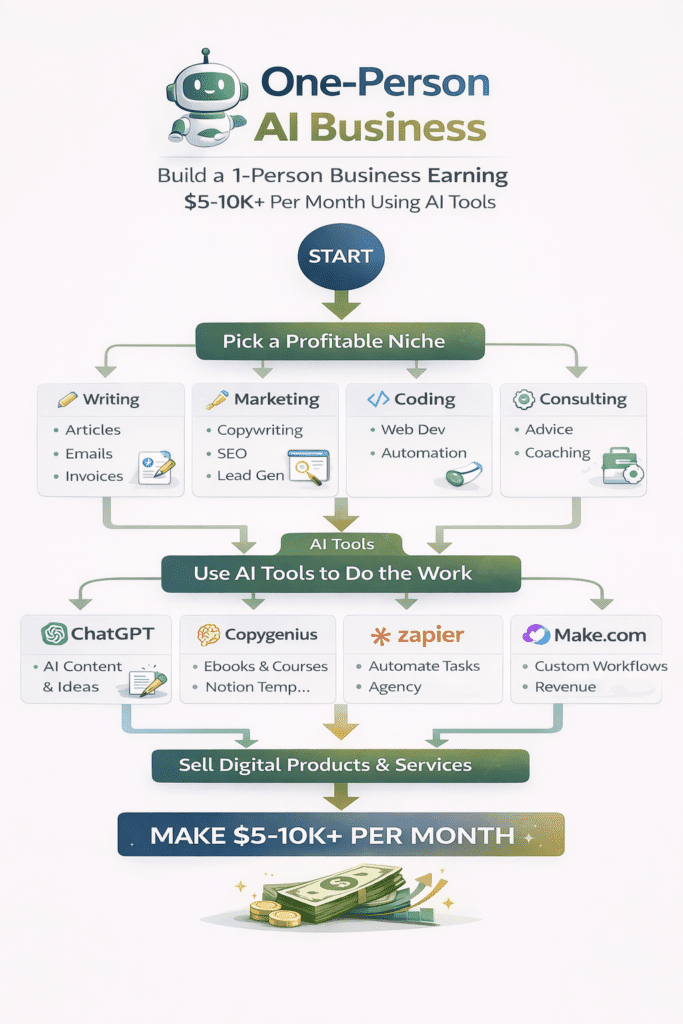
What AI Tools Actually Make a One-Person AI Business Work?
Let me give you a deeper look at tools that solo founders use to deliver real results.
- ChatGPT Plus remains the most versatile tool for writing, research, strategy, and idea generation. If you use only one tool, make it this one.
- Claude by Anthropic is excellent for long-form writing, document analysis, and tasks requiring nuanced understanding. Many freelancers use it as their second AI brain.
- Midjourney or Leonardo AI create stunning images for clients who need custom visuals. Social media agencies rely heavily on these.
- Descript lets you edit podcasts and videos using text. Delete words from a transcript and the video edits itself. This is game-changing for video content services.
- Notion AI helps you manage client work, create SOPs, and build internal knowledge bases that make you faster over time.
- Make (formerly Integromat) connects hundreds of apps and lets you build complex automations without writing code. This tool alone can become an entire business model.
Common Mistakes to Avoid When Building a Solo AI Business
Learning from mistakes is important. Learning from other people’s mistakes is smarter.
Mistake 1: Waiting until everything is perfect. You do not need a website, a logo, or a business card to get your first client. You need to have a conversation and make an offer. Start before you feel ready.
Mistake 2: Chasing too many niches. “I help all businesses with all AI things” is not a business. “I help real estate agents get more leads using AI-powered social media content” is a business. Be specific.
Mistake 3: Using AI without human review. AI makes mistakes. It can hallucinate facts, write generic content, and miss the tone your client needs. Always review and edit AI output before delivering it. Your reputation depends on quality.
Mistake 4: Ignoring your own SEO and online presence. If you want clients to find you online, you need a basic website and some content showing your expertise. You do not need to go viral. You just need to exist online in a way that builds trust.
Mistake 5: Not tracking income and expenses. Even a one-person AI business is a real business. Track every payment. Track every expense. Use simple tools like Wave or QuickBooks Self-Employed from day one.
How Long Does It Take to Make Money With a One-Person AI Business?
This is the question everyone wants answered honestly.
With consistent effort, here is a realistic timeline.
First 30 days: Your service is defined, your tools are set up, and your first outreach campaign is running. You may land one free client or one small paid project.
60 to 90 days: With active outreach and learning from early feedback, landing one to two paying clients is very achievable. That puts you at $500 to $1,500 per month.
Month six: With three to five retainer clients and a refined service, $3,000 to $6,000 per month is realistic.
Month twelve: Solo AI founders who stay consistent regularly report $5,000 to $12,000 per month from client work alone.
These numbers are not magic. They come from showing up consistently, delivering great work, and not quitting when it feels slow.
How to Get Found on Google as a One-Person AI Business
If you want organic traffic, you need content. Not just any content, but content that answers what your ideal clients are actually searching for.
Here are long-tail keywords that can help a solo AI business website rank on Google:
- how to start an AI business with no experience
- best AI tools for freelancers in 2025
- one person AI business ideas that make money
- how to use AI to run a business alone
- AI automation services for small businesses
- how to make money with AI tools as a beginner
- solo entrepreneur AI business guide
- AI freelance business ideas for students
- how to get clients for AI services
- AI content writing service for small businesses
Write one blog post targeting one keyword. Publish consistently, even once or twice a month. Over time, these posts compound and bring clients to you without paid ads.
This is how your website goes from zero traffic to a steady stream of inbound leads.
A Example of What a One-Person AI Business Can Look Like
Here is a realistic picture of what this looks like in the real world.
Sarah is a 28-year-old marketing coordinator who spent three months learning AI tools in the evenings. She decided to offer AI-powered email marketing to e-commerce brands.
She reached out to 15 small online stores she followed on Instagram. Three responded. She offered one month free. One converted to a $600 per month retainer.
Three months later, she had four clients paying her $600 each. That is $2,400 per month on top of her salary.
Six months later, she quit her job. She now has eight clients. Her monthly revenue is just under $6,000.
She works roughly 25 hours per week. The rest of her time is her own.
This is not a fantasy. This is what consistent, focused action looks like for a one-person AI business.
Want results like this? Start by picking ONE service from this guide. Commit to it for 90 days. Talk to 5 potential clients this week. That is the entire strategy.
Summary
Here is everything covered in this guide, in a quick recap:
A one-person AI business uses AI tools to deliver real services to real clients without needing a full team.
The best models for beginners are AI content writing, social media management, SEO services, AI automation, and chatbot building.
Your tools stack needs only 4 to 6 tools and costs $80 to $150 per month to run.
Get your first client through your existing network, LinkedIn, or cold email. Offer free work upfront to earn your first testimonial.
Price by project or monthly retainer, never by the hour.
Keep clients long-term by communicating clearly, showing measurable results, and continuously improving your skills.
Scale by building systems, raising prices over time, upselling existing clients, and creating digital products for passive income.
Most common mistakes are waiting too long to start, serving too many niches at once, not reviewing AI output before delivery, and not building any online presence.
Realistic income targets: $1,500 per month by month three, $5,000 to $6,000 by month six, $10,000 or more by the end of year one with consistent effort.
Conclusion
Building a one-person AI business from scratch is one of the most exciting opportunities available right now.
You do not need a degree. You do not need investors. You do not need a team. You need consistency, the right tools, and the courage to reach out to your first potential client.
The people who will look back five years from now and say “I wish I started earlier” are the ones reading this today but not taking action.
Do not be that person.
Pick your service model. Set up your tools. Send your first outreach message today. Not tomorrow. Today.
Every big AI business started with one small step taken before the founder felt ready.
Your time is now.