Let me ask you something honest.
How many skills have you started learning — and then quietly quit?
Maybe it was coding. Maybe guitar. Maybe a new language. Or even public speaking.
You started with full energy. You watched a few YouTube videos. You bought a course. And then… life happened. You lost the pace. Progress slowed down. And you told yourself, “Maybe I am just not the kind of person who learns fast.”
Here is the truth: the problem was never your brain. The problem was your learning method.
And right now, in 2025, there is a smarter way to learn — one that cuts your learning time in half, keeps you on track, and gives you real, usable skills faster than any traditional method ever could.
That method? Using AI to learn any skill.
And in this blog, I am going to show you exactly how to do it — step by step — even if you have never used an AI tool before.
Let’s get into it.
Table of Contents
Why Traditional Learning Is Broken (And Most People Don’t Know It)
Here is something most people do not talk about.
The way we were taught to learn is slow. Painfully slow.
Think about it. In school, you had 30 students in one class. The teacher moved at one speed. If you were ahead, you got bored. If you fell behind, you got lost. Nobody customized anything for you.
Online courses are not much better. You pay ₹5,000 or $50 for a course. You get 40 hours of video. You maybe watch 10 hours. Then life gets busy, and the course sits in your dashboard untouched.
Books are great — but most books are not designed for active skill building. They give you information. They do not test you, correct you, or push you.
The result? Most people spend months trying to learn something — and end up with only surface-level knowledge.
This is not your fault. It is a system problem.
And AI fixes this system problem at the root level.
What Does “Use AI to Learn Any Skill” Actually Mean?
Before we go into the steps, let’s make sure we are on the same page.
When we say “use AI to learn any skill,” we do not mean asking ChatGPT one question and calling it a day.
We are talking about building a full learning system using AI tools — where AI acts as your personal tutor, study partner, quiz master, feedback coach, and accountability buddy.
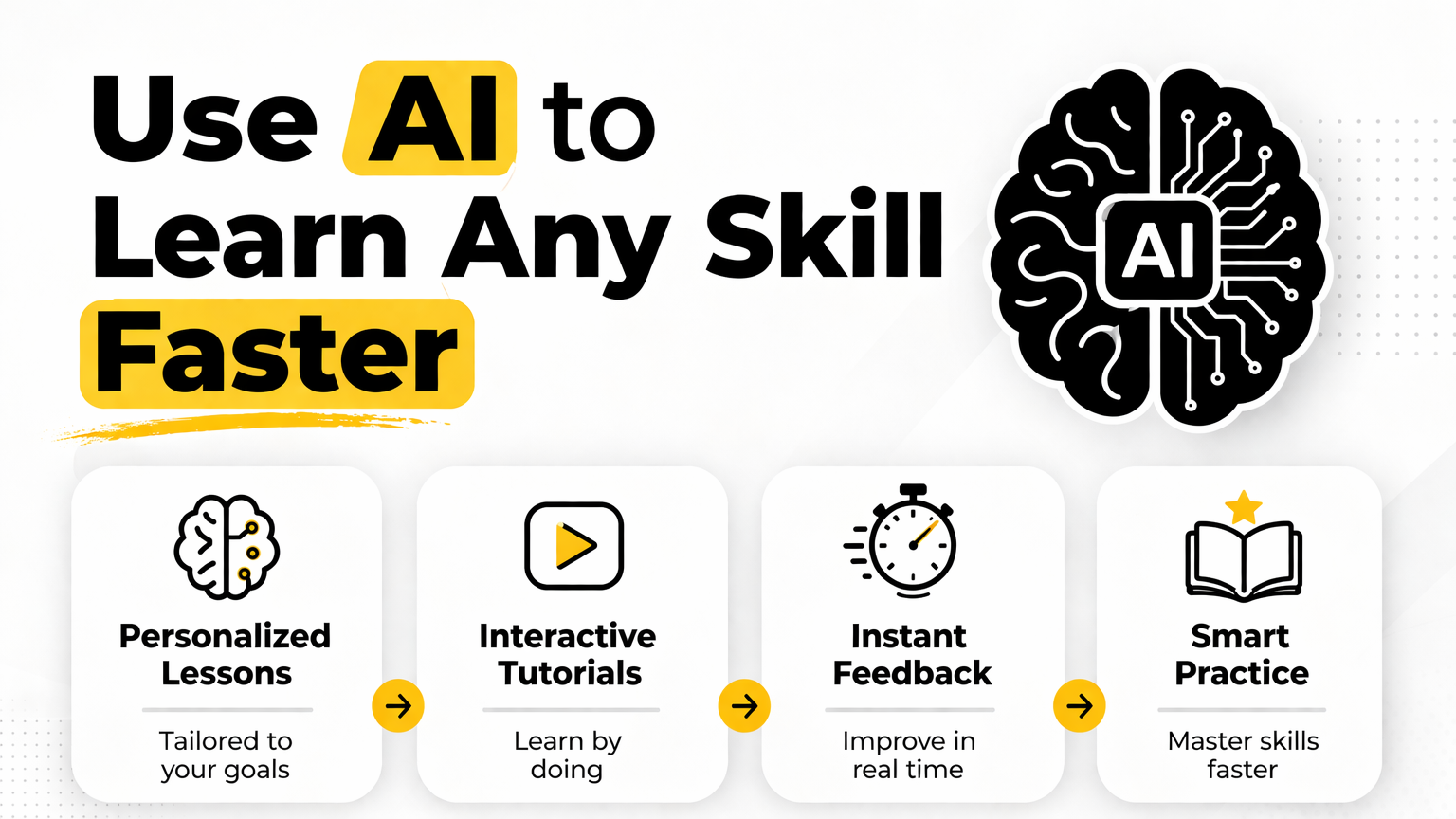
This kind of AI-powered learning is personalized. It moves at your pace. It explains things the way you understand. It tests you on what you find hard. And it gives you feedback that a YouTube video never could.
Think of it as having a private tutor available 24 hours a day, 7 days a week — for free or almost free.
That is the power of using AI for self-improvement and skill development.
The 3X Faster Learning Formula (Using AI)
Here is the simple formula behind learning 3X faster with AI:
Right Input + Active Practice + Smart Feedback = Faster Results
AI helps you at every single stage of this formula.
Let us walk through each step, one by one.
Step 1 — Tell AI Exactly What You Want to Learn (And Be Specific)
This is where most people go wrong.
They open ChatGPT and type: “How do I learn Python?”
And they get a generic answer that feels overwhelming.
The fix is simple: be specific.
Instead of asking “How do I learn Python,” try this:
“I am a complete beginner. I want to learn Python so I can build simple web scraping scripts. I have 30 minutes every day. Create a 30-day learning plan for me with daily tasks.”
That one change transforms AI from a search engine into a personal tutor.
Here is why this works. When you give AI context — your level, your goal, your time — it creates a plan that fits you. Not a plan for every person on earth. A plan for you.
Try this today: Pick one skill you want to learn. Write three sentences about who you are, what your goal is, and how much time you have per day. Paste that into ChatGPT or Claude and ask it to create a personalized learning roadmap.
You will be genuinely surprised by what comes out.
Long-tail keyword tip: This method works whether you want to use AI to learn coding for beginners, use AI to learn a new language in 30 days, or use AI to learn digital marketing from scratch.
Step 2 — Use AI to Break Any Skill Into Tiny, Learnable Pieces
One of the biggest reasons people quit learning is overwhelm.
You look at a skill and think: “This is too much. I will never learn all of this.”
That feeling is real. But it is wrong.
Any skill — no matter how complex — can be broken down into small, simple pieces. And AI is incredibly good at doing this for you.
This approach is called chunking, and it is one of the most research-backed learning strategies in the world.
Here is how to use AI for chunking:
Go to ChatGPT or Claude. Type something like:
“Break down the skill of [skill name] into 10 bite-sized sub-skills that a beginner should learn in order. Explain each one in two to three sentences.”
What you get back is a clear, logical sequence. No more confusion about where to start. No more jumping around. Just a clean path from point A to point B.
Let’s say you want to learn video editing. Instead of watching random YouTube tutorials, AI will show you the exact sequence:
- Learn how to import and organize clips
- Understand the timeline and basic cuts
- Learn transitions and effects
- Add and sync audio
- Color correct your footage
- Export in the right format
Now that feels doable. Right?
Each of these sub-skills takes just a few hours to learn. And when you combine them, you have a real, usable skill.
This is the power of using AI for skill development — it removes the overwhelm and gives you a clear path.
Step 3 — Ask AI to Explain Concepts in Your Own Language
Have you ever read something five times and still not understood it?
That is not a sign of low intelligence. That is a sign that the explanation was not written for you.
Traditional learning materials are written for an “average” person. But you are not average. You have your own background, your own way of thinking, and your own level of prior knowledge.
AI can explain the same concept in ten different ways until one clicks for you.
Here are some powerful prompts to use:
“Explain [concept] to me like I am 12 years old.”
“I understand [related concept]. Now explain [new concept] using that as a comparison.”
“Give me a real-life example of [concept] from daily life in India.” (or wherever you live)
“What is the most common misunderstanding beginners have about [concept]?”
These prompts make AI go beyond textbook definitions. They force AI to connect new knowledge to what you already know — and that is exactly how fast learning works.
This technique alone can cut your learning time in half.
Real example: Imagine learning about compound interest. A textbook says “interest is calculated on the principal and accumulated interest.” That feels dry. But when you ask AI: “Explain compound interest using a chai stall that reinvests its profits every month,” suddenly it clicks. You see it. You feel it. You remember it.
That is the magic of personalized AI explanation.
Step 4 — Use AI to Create Practice Exercises Just for You
Here is a truth about skill learning: reading alone does not build a skill.
Practice builds skills. Always.
But here is the problem. Most courses give you generic exercises that may or may not match your level. They are not designed for where you are today.
AI fixes this perfectly.
You can ask AI to generate custom practice exercises based on exactly where you are right now. And you can ask it to make them harder or easier based on your feedback.
Here are some prompts you can use right now:
For coding: “Give me 5 beginner Python exercises that focus only on loops and conditionals. After each one, tell me the answer and explain it.”
For writing: “Give me 3 writing prompts that will help me practice clear, simple communication. Then review my writing when I submit it.”
For a language: “Give me 10 Hindi sentences to translate into English, starting from very easy and getting slightly harder. Correct my answers.”
For public speaking: “Give me 5 two-minute speaking topics. Then help me structure each answer into intro, three points, and conclusion.”
This is active learning at its best. You are not passively watching videos. You are doing, making mistakes, getting corrected, and improving.
That is exactly how humans learn fastest.
And with AI, you have an endless supply of fresh, custom practice material — available any time you open your laptop or phone.
Step 5 — Make AI Your 24/7 Feedback Machine
Feedback is the fastest shortcut to skill improvement.
Think about athletes. The ones who improve fastest are not the ones who practice the most. They are the ones who get the best feedback the most often. They know exactly what to fix and why.
Most learners have a huge problem here. They practice — but they have no one to correct them.
AI solves this completely.
You can submit any work to AI — a piece of writing, a line of code, a language translation, a business plan — and get detailed, honest feedback in seconds.
Here is how to get the best feedback from AI:
Do not just say “Is this good?”
Instead, say: “Here is my [work]. Please give me feedback on three things: (1) what I did well, (2) what specific mistakes I made, and (3) what I should practice next to improve.”
This structured feedback prompt forces AI to be specific and helpful. Not just “looks good!” but real, actionable insights.
You can also ask AI to role-play as an expert. For example:
“Act as a senior software engineer reviewing my code. Be honest and specific.”
“Act as a native English speaker reviewing my writing for clarity and grammar.”
“Act as a professional chef reviewing my recipe for technique errors.”
When AI takes on a role, its feedback gets sharper and more useful.
This is one of the most underused AI learning strategies for beginners — and it can give you months of progress in just a few weeks.
Step 6 — Use the Feynman Technique With AI
The Feynman Technique is one of the most powerful learning methods ever created.
The idea is simple: if you truly understand something, you should be able to explain it to a child in plain language.
Most people think they understand something — until they try to explain it.
Here is how to combine the Feynman Technique with AI:
Step A: Learn a new concept.
Step B: Close the material and try to explain that concept to AI in your own words, as if AI is a beginner.
Step C: Ask AI: “Is my explanation accurate? What did I miss or get wrong?”
Step D: Go back, fill the gaps, and try again.
This single method builds deep, lasting understanding faster than any other technique.
And AI is the perfect partner for it — because it never judges you, never loses patience, and is always ready to listen and respond.
This is how you use AI for deep learning, not just surface-level memorization.
Step 7 — Build a Daily AI Learning Routine (Even With Just 20 Minutes)
One of the biggest myths about learning is that you need hours of free time.
You do not.
Research shows that short, consistent practice beats long, occasional sessions — almost every time.
With AI, you can build an incredibly effective 20-minute daily learning habit. Here is a simple structure you can follow:
Minutes 1–5: Ask AI to give you a quick 3-question quiz on what you learned yesterday. This is called spaced repetition, and it locks knowledge into long-term memory.
Minutes 6–15: Learn one new concept or sub-skill. Ask AI to explain it, give you an example, and answer your follow-up questions.
Minutes 16–20: Do one small practice exercise and get feedback from AI.
That’s it. Twenty minutes a day. Done consistently for 30 days, this habit will take you from absolute beginner to someone with real, functional skill.
Most people spend 20 minutes scrolling Instagram. Imagine what happens when you spend that same 20 minutes building a skill with the help of AI.
This is the most practical AI-powered learning strategy for busy professionals and students.
Step 8 — Use Multiple AI Tools Together for Maximum Speed
One AI tool is great. But combining multiple AI tools creates an unstoppable learning system.
Here are the best free and affordable AI tools for skill learning in 2025:
- ChatGPT (OpenAI) — Best for explanations, roadmaps, feedback, and conversation practice. The free version is powerful enough for most learners.
- Claude (Anthropic) — Excellent for longer explanations, essay feedback, and detailed writing coaching. Often gives more nuanced and thoughtful answers.
- Google Gemini — Good for research, summarizing articles, and combining web search with AI explanation.
- Notion AI — Great for organizing your learning notes, creating study guides, and summarizing what you have learned.
- Duolingo and Speak AI — Specifically for language learners. Combine these with ChatGPT for a complete language learning system.
- GitHub Copilot — For coding learners. It suggests code as you type and explains what each line does. Excellent for learning coding through real practice.
- Khanmigo (Khan Academy) — A kid-friendly and student-friendly AI tutor that is excellent for academic subjects.
You do not need to use all of these at once. Pick two or three that match your learning goal and start there.
The key insight here is that different AI tools have different strengths. Mixing them gives you a richer, faster learning experience than sticking to just one.
Step 9 — Use AI to Find and Fix Your Specific Weak Points
Here is something most learners never think about.
They spend equal time on everything. But not everything deserves equal time.
The fastest learners focus their energy on their weak points — the specific gaps that are holding them back right now.
AI can help you find these weak points quickly.
Here is a simple method. After studying for a week, ask AI:
“Based on what I have told you about my learning so far, what do you think my three biggest gaps or weaknesses are in [skill]? What should I focus on this week to fix them?”
Or ask AI to give you a diagnostic quiz:
“Give me a 10-question quiz on [skill/topic]. After I answer, tell me exactly which areas I got wrong and what they reveal about my weaknesses.”
This targeted approach to skill building with AI saves you from spending hours practicing things you are already good at — and focuses your limited time on the areas that will give you the biggest jump in skill.
This is one of the most powerful but rarely talked about AI learning strategies for professionals and serious learners.
Step 10 — Use AI to Stay Accountable and Track Your Progress
Learning is easy to start. Hard to continue.
Life interrupts. Motivation drops. One skipped day becomes one skipped week.
AI can help you stay accountable in ways that are surprisingly effective.
Here is how:
At the start of each week, tell AI your learning goal for that week. Be specific. “I will learn how to write basic SQL queries and complete 10 practice problems.”
At the end of each day, report back to AI what you actually did. Just a few sentences.
Ask AI to give you an end-of-week review. Did you hit your goals? Where did you fall short? What should you adjust for next week?
This is not just about information. It is about creating a system of light accountability that keeps you moving.
You can also ask AI to help you solve the most common obstacle in your learning journey:
“I keep losing motivation after the first week. What specific mindset shifts or habit changes can help me stay consistent with learning [skill]?”
AI gives you practical, personalized strategies — not generic advice.
Long-term, consistent learners build skills that change their careers and lives. And AI can be the system that helps you become one of those learners.
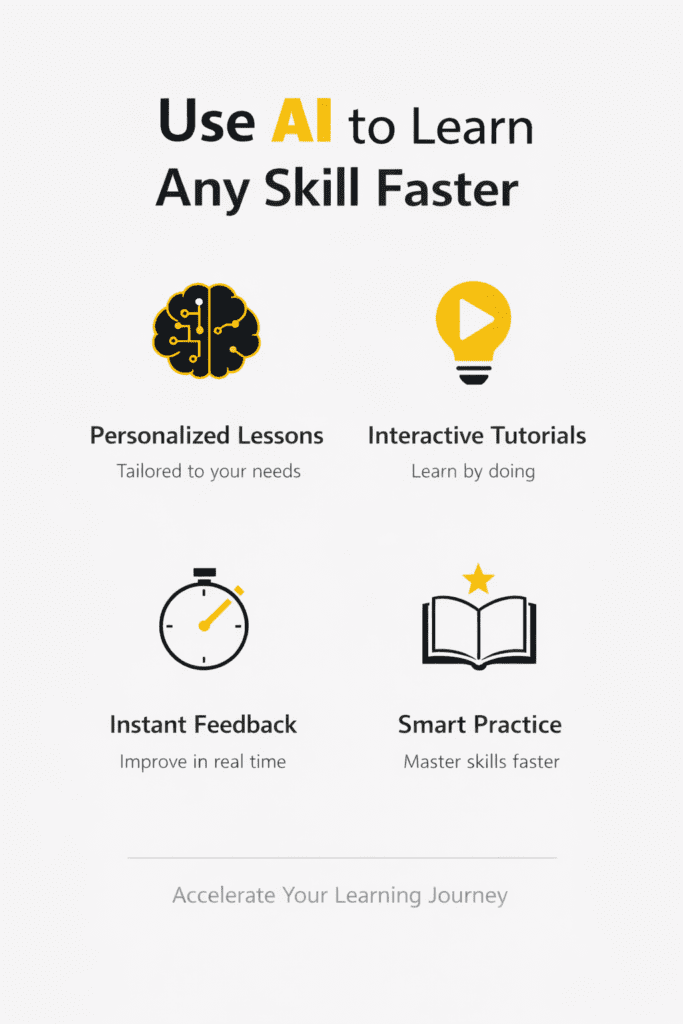
Real Skills You Can Learn 3X Faster Using AI Right Now
Let’s make this concrete.
Here are some specific skills where using AI as a learning tool gives you a massive speed advantage in 2025:
- Coding and programming — AI can explain code, write code, debug your mistakes, and create exercises. This is perhaps the single best use case for AI in skill learning right now. You can use AI to learn coding for beginners in a fraction of the traditional time.
- English communication — AI corrects your grammar, improves your vocabulary, gives you writing feedback, and even simulates conversations. People across India are using AI to dramatically improve their spoken and written English in just weeks.
- Digital marketing — AI can teach you SEO, social media strategy, email marketing, and content creation. It can also help you practice by reviewing your actual campaigns and posts.
- Graphic design — AI tools like Canva AI and Adobe Firefly are making design learning faster than ever. Combined with AI explanation and feedback, even total beginners can develop a design eye quickly.
- Data analysis — Learning Excel, Python for data, or SQL has never been faster. AI can explain formulas, debug your code, and walk you through real datasets step by step.
- Content writing and copywriting — AI can review your writing, suggest improvements, teach you persuasion frameworks, and help you practice writing in different styles.
- Business and entrepreneurship — AI can simulate business scenarios, help you analyze case studies, teach you financial concepts, and even help you build your first business plan.
- Foreign languages — Use AI to practice conversation, get translations explained, learn grammar rules with examples, and receive pronunciation feedback.
The list goes on. In 2025, there is almost no skill where AI cannot significantly speed up your learning journey.
Common Mistakes to Avoid When Using AI to Learn
Yes, AI is powerful. But there are ways to use it wrong.
Avoid these mistakes:
Mistake 1 — Being too passive. Just asking AI questions and reading the answers is not enough. You must practice. You must do. You must get feedback. AI is a tool, not a magic pill.
Mistake 2 — Using vague prompts. “Teach me marketing” will give you a useless answer. Be specific. Give context. State your goal.
Mistake 3 — Skipping review. Many learners learn something new each day but never review what they learned before. Use AI to quiz you on past material. Spaced repetition is key.
Mistake 4 — Relying on AI 100% of the time. AI is your assistant, not your only teacher. Read books. Watch expert videos. Practice in the real world. AI works best when it is one part of a bigger learning system.
Mistake 5 — Giving up when AI gives a wrong answer. AI is not perfect. It makes mistakes. When something feels off, ask AI to double-check its answer. Cross-reference with trusted sources. Treat AI like a very smart friend who sometimes gets things wrong.
Avoiding these five mistakes will put you miles ahead of the average learner.
How to Get Started Today (Even If You Are a Beginner)
Reading this blog is great. But reading alone does not build a skill.
Here is a simple action plan to get started today:
Action 1: Choose one skill you want to learn in the next 30 days. Write it down.
Action 2: Open ChatGPT or Claude (both have free versions). Write this prompt: “I am a complete beginner at [skill]. My goal is [specific outcome]. I have [X] minutes per day. Create a 30-day step-by-step learning plan for me.”
Action 3: Start Day 1 today. Do not wait until Monday. Do not wait until you have more time. Start now, even if it is just 15 minutes.
Action 4: Come back tomorrow and do Day 2. Then Day 3. The momentum builds fast.
Action 5: After one week, write a short reflection. What did you learn? What is still confusing? Ask AI to help you fill the gaps.
That is it. That is the entire plan. It is simple. But simple done consistently is what produces extraordinary results.
Why AI-Powered Learning Is the Future (And Why Starting Now Gives You a Big Advantage)
Here is something worth thinking about.
The people who learn how to use AI as a learning tool today will be years ahead of those who figure it out later.
Skills are power. They open doors. They create income. They give you options in life.
And right now, AI has made the path to building skills shorter, cheaper, and more accessible than at any other point in human history.
You do not need an expensive coaching program. You do not need to live in a big city. You do not need a college degree.
You need a device, an internet connection, and the discipline to show up every day.
People from small towns across India, Africa, Southeast Asia, and everywhere else in the world are using AI to learn coding, start freelance businesses, and build careers that would have been impossible without technology.
This is a real window of opportunity. And it is open right now.
Summary
Let’s quickly recap what we covered in this blog:
The traditional way of learning is slow, generic, and built for the average person — not for you.
AI changes this by giving you personalized explanations, custom practice, real-time feedback, and a learning plan that fits your goals and schedule.
The 10-step method to use AI to learn any skill 3X faster includes: starting with a specific, detailed prompt, breaking the skill into small chunks, getting AI to explain concepts in your language, using AI to create custom practice exercises, treating AI as your personal feedback machine, applying the Feynman Technique with AI support, building a short daily learning habit, combining multiple AI tools for different purposes, finding and fixing your weak points with targeted AI quizzes, and using AI to stay accountable and track your weekly progress.
The biggest skills to learn with AI right now include coding, English communication, digital marketing, data analysis, content writing, business skills, and foreign languages.
Avoid common mistakes like being passive, using vague prompts, or skipping review.
And most importantly — start today. Not tomorrow. Today.
Conclusion
You just spent a few minutes reading this blog. That means something.
It means you want to grow. You want to learn. You want more from life.
And the good news is: you now have everything you need to take that first real step.
AI is not a shortcut that bypasses hard work. It is a tool that makes your hard work go further. It helps you learn the right things, in the right order, with the right feedback — so you stop wasting time and start seeing real progress.
The skills you build in the next 30 days using AI could genuinely change the direction of your next 3 years.
So close this tab, open ChatGPT or Claude, and write that first prompt.
Your 3X faster learning journey starts right now.
Did you find this blog helpful? Share it with a friend who wants to learn a skill but does not know where to start. And if you have questions about how to use AI to learn any specific skill, drop them in the comments — I read every one.