Imagine this. You wake up one morning and decide today is the day you stop watching others get hired for high-paying AI jobs. You have no projects, no portfolio, and no idea where to start. But 30 days later, you have a full AI portfolio that gets you interview calls.
Sounds too good to be true?
It is not. And this guide will show you exactly how to do it.
Whether you are a student, a career switcher, or a developer who wants to step into the AI world, this AI portfolio strategy guide is written just for you. No fluff. No complicated jargon. Just a simple, clear, step-by-step plan that works.
Let us get started.
Table of Contents
What Is an AI Portfolio Strategy and Why Does It Matter
An AI portfolio strategy is a planned approach to building and showcasing AI projects that prove your skills to employers, clients, or collaborators.
Think of it like a job interview that happens before you even walk through the door.
Recruiters are no longer impressed by resumes alone. They want to see what you have actually built. An AI portfolio gives them proof. It shows that you can take an idea, use AI tools, and deliver a working product.
The problem is that most people build their portfolio the wrong way. They pick random projects, spend months on them, and end up with nothing useful to show.
That is where a proper AI portfolio strategy for beginners comes in. It helps you pick the right projects, finish them fast, and present them in a way that gets attention.
Who Should Follow This AI Portfolio Strategy
This guide is for you if:
You are a beginner who wants to start building with AI tools but does not know where to begin. You are a developer who wants to add AI skills to your existing resume. You are a student looking for a way to stand out in a tough job market. You are a freelancer who wants to offer AI-powered services. You are someone who wants to build AI side projects that can grow into a business.
You do not need to be an expert. You just need to follow the plan.
The Core Idea: Use AI to Build AI Projects
Here is the part that surprises most people.
You do not need to be an AI researcher to build AI projects. You can use AI tools like ChatGPT, Claude, GitHub Copilot, and others to help you plan, code, and ship your projects faster than ever before.
This is the real secret behind a successful AI project portfolio strategy. You use AI to help you build AI. You cut your development time in half. You learn while you build. And you end up with real projects that actually work.
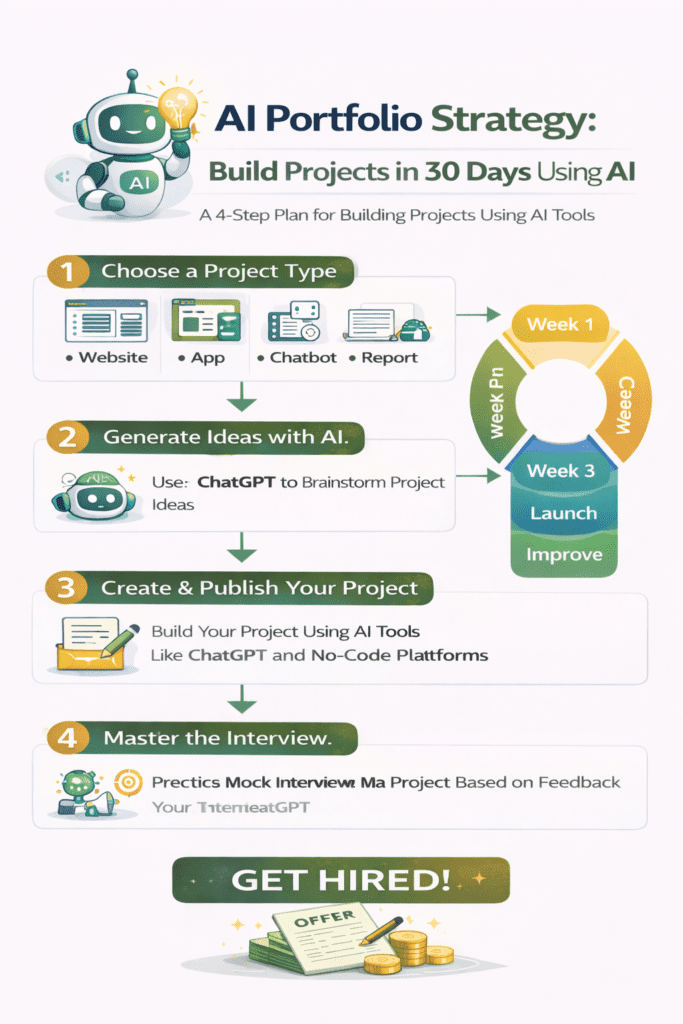
Let us break the 30 days down week by week.
Week 1: Plan Your AI Portfolio Strategy (Days 1 to 7)
The first week is all about planning. Do not skip this. Planning is what separates people who finish their portfolio from those who never do.
Step 1: Pick Your Niche
AI is a big field. You cannot do everything. Pick one niche that excites you and matches what you want to do for work or business.
Here are some ideas to get you thinking. Natural language processing and text tools. AI image generation and editing tools. AI chatbots for customer service. AI tools for content creators and marketers. AI tools for healthcare or education. AI-powered data analysis and dashboards.
Picking a niche helps you build projects that are related. Related projects show depth. Depth builds trust with employers and clients.
Step 2: Research What Employers Actually Want
Go to LinkedIn and look at job posts for AI roles. Look at what tools and skills they ask for. Write them down.
Common skills in demand right now include Python, OpenAI API, LangChain, Hugging Face, vector databases, and prompt engineering. These are your building blocks.
This research will directly shape your AI portfolio project ideas for beginners.
Step 3: Choose Three Projects
Three projects are the sweet spot. One project is not enough to prove consistency. Five projects in 30 days is too rushed.
Three well-done projects beat ten half-finished ones every single time.
Here is a simple formula to pick your three projects. One project to show technical skill. One project to show real-world problem solving. One project to show creativity or business thinking.
Step 4: Set Up Your Tools
Install Python and VS Code if you have not already. Create accounts on OpenAI, Hugging Face, and GitHub. Set up a free account on Vercel or Streamlit for hosting your projects online.
This setup takes about one day. Do it on Day 1 so you are ready to build from Day 2.
Week 2: Build Your First AI Project (Days 8 to 14)
Now the real work begins. This is where most people feel nervous. Push through it. The first project is always the hardest.
Step 5: Start With an AI Text Tool
For your first project, build something that uses a language model. This is the easiest starting point and the most in-demand skill.
Here are some beginner-friendly ideas. An AI blog post generator. A resume review tool that gives feedback. A customer support chatbot for a small business. An AI tool that summarizes long articles in seconds.
These are real tools that real people use. They are also easy enough to build in one week.
Step 6: Use AI to Help You Code
Open ChatGPT or Claude and describe what you want to build. Ask it to help you write the code step by step. You will be amazed at how fast you can go.
This is not cheating. This is how developers work in 2025 and beyond. Using AI to code faster is itself a skill that employers love.
Pro Tip: Always read the code that AI generates. Understand what it does. This is how you actually learn. And when an interviewer asks you about your project, you need to be able to explain it.
Step 7: Host It Online
A project that lives only on your laptop is invisible. Host it so anyone can use it.
Streamlit is perfect for Python-based AI apps. It takes less than 30 minutes to deploy your first app. Once it is online, you have a live link you can share with recruiters, on LinkedIn, and in your portfolio.
This one step changes everything. A live project feels real. It shows initiative. It builds credibility.
Week 3: Build Projects Two and Three (Days 15 to 21)
By now you have built one project and survived. Your confidence is up. Your speed is higher. Use that momentum.
Step 8: Build a More Complex Project
Your second project should push you a bit harder. This is where you show real-world problem solving.
Some great options for a how to build an AI portfolio in 30 days second project include an AI-powered data analyzer that takes a CSV file and gives insights, a tool that uses image recognition to classify photos, a RAG-based chatbot that answers questions from a PDF document, or an AI writing assistant with a clean user interface.
Pick something that solves a real problem. The closer your project is to something people actually need, the more impressive it looks.
Step 9: Document Everything
This is one of the most overlooked parts of building an AI portfolio. Documentation is what turns a project into a portfolio piece.
For each project, write a README file on GitHub that explains what the project does, why you built it, what tools and technologies you used, how to run it locally, and what you learned while building it.
This documentation shows that you can communicate clearly. That is a skill almost as valuable as coding.
Step 10: Build Your Third Project With a Business Angle
Your third project should show that you understand how AI creates value for people or businesses.
Think about this. Can you build an AI tool that automates something boring? Can you create an AI-powered report generator for a small business? Can you build a simple AI product that could actually be sold?
This business angle makes your portfolio stand out from the thousands of generic beginner portfolios out there. It shows you are not just learning AI. You are thinking about how to use it to solve problems.
Week 4: Polish, Publish, and Promote (Days 22 to 30)
You have three projects. Now it is time to package them into something that gets you noticed.
Step 11: Create Your Portfolio Website
You need one place online where everything lives together. This does not have to be fancy.
A simple portfolio website can be built in a day using tools like GitHub Pages, Notion, or Framer. Your portfolio site should have your name and a one-line description of what you do, links to all three projects with screenshots, a short bio that explains your background and your goals, and a way to contact you.
Keep it clean. Keep it simple. Let your work do the talking.
Step 12: Write About Your Projects on LinkedIn
LinkedIn is still the best place to get noticed in tech. Write three posts, one for each project. Share what you built, why you built it, what you learned, and include a link to the live project.
Do not overthink these posts. Write like you are texting a friend about something exciting you built. That natural voice performs better than stiff professional writing.
AI portfolio strategy for job seekers advice: Tag tools and companies you used in your posts. Use relevant hashtags. Engage with comments. This is how you build visibility from zero.
Step 13: Add Your Portfolio to Your Resume and GitHub
Update your GitHub profile with a pinned repositories section that shows all three projects. Update your resume to include a link to your portfolio site. Add a portfolio section to your LinkedIn profile.
You want people to find your work no matter which door they enter through.
Step 14: Start Applying and Reaching Out
By Day 28 you should be applying for jobs, internships, or freelance gigs. You now have something real to show. Use that.
When you reach out to people or apply to positions, lead with your portfolio. Say something like: “I recently built three AI projects in 30 days. Here is a link to my portfolio. I would love to contribute to your team.”
That kind of message gets responses. Most applicants send a resume and hope for the best. You are showing results upfront.
The Best AI Tools to Build Your Portfolio Faster
Here is a quick look at the tools that will save you the most time during this 30-day journey.
- ChatGPT and Claude are your coding assistants. Use them to write code, debug errors, and plan your app logic.
- GitHub Copilot works inside VS Code and helps you write code line by line. It is like having a senior developer sitting next to you at all times.
- Hugging Face gives you access to thousands of pre-trained AI models for free. You can add image recognition, text generation, or translation to your projects without training a model from scratch.
- LangChain helps you build apps that connect AI models to real data sources like PDFs, databases, and websites.
- Streamlit lets you turn a Python script into a working web app in minutes. No frontend experience needed.
- Vercel is great if you want to build a more polished portfolio website.
These tools are what make a step-by-step AI portfolio building guide actually achievable in 30 days.
Common Mistakes People Make With Their AI Portfolio
Let us talk about what not to do. These mistakes can cost you weeks of time and a lot of frustration.
Mistake 1: Picking projects that are too complex. Start simple. A working simple project beats a broken complex one every time. You can always add features later.
Mistake 2: Not finishing projects. Half a project is worth nothing. Always ship. Even if it is not perfect. Done beats perfect when you are building a portfolio from scratch.
Mistake 3: Not explaining your projects clearly. If someone visits your portfolio and cannot understand what your project does in 10 seconds, they move on. Write clear, simple descriptions.
Mistake 4: Building only for learning, not for showing. Every project you build should be presentable. That means it should be hosted online, documented on GitHub, and described in plain language.
Mistake 5: Waiting until everything is perfect. There is never a perfect moment. Start now. Fix and improve as you go. The feedback you get from real people is more valuable than any amount of solo polishing.
How to Make Your AI Portfolio Rank in Google and AI Search
If you are a freelancer or entrepreneur who wants clients to find you through search, this section is important.
Create a personal website with a blog. Write articles about the projects you build. Use terms like how to build AI portfolio projects, best AI tools for beginners, and AI portfolio examples for developers in your content.
Answer real questions that your target audience searches for. For example, write posts like “How I built an AI chatbot in one week” or “What I learned building three AI projects in 30 days.”
This kind of content gets indexed by Google and also gets referenced by AI tools like ChatGPT when someone asks for portfolio advice. That means your name and work can appear in AI-generated answers too.
This is called GEO or Generative Engine Optimization. It is the new frontier of getting discovered online.
What a Good AI Portfolio Looks Like in 2025
Let us paint a picture. Here is what a strong AI portfolio looks like.
Project 1 is a live AI chatbot built with Python, LangChain, and OpenAI API. It is hosted on Streamlit. It answers questions about a specific topic using RAG. The GitHub repo has a detailed README with screenshots.
Project 2 is an AI image classifier that identifies products from photos. It uses a Hugging Face model. It is deployed as a web app. The code is clean and well-commented.
Project 3 is an AI content marketing tool that generates social media captions from a product description. It has a simple and clean UI. It solves a real problem for small business owners.
All three projects are linked from a portfolio website. There are three LinkedIn posts about each project that each got some engagement. The GitHub profile looks active and organized.
This is not a dream. This is achievable in 30 days with focused effort and the right tools.
AI Portfolio Strategy for Different Career Goals
Your strategy might look slightly different depending on your goal.
If you want a full-time AI job, focus on projects that use the exact tools mentioned in job postings. Make your GitHub activity look strong. Add a clear call to action on your portfolio saying you are open to work.
If you want freelance clients, focus on AI tools that solve business problems. Show ROI. Show that your tools save time or make money. Add a contact form to your portfolio and price your services clearly.
If you want to build an AI startup or product, focus on projects that solve real pain points. Talk to potential users. Get feedback. Use your portfolio as a landing page to collect early signups.
If you are a student, focus on academic applications of AI. Build tools related to your field of study. This shows unique insight that general developers do not have.
How to Stay Motivated During the 30 Days
Let us be honest. Thirty days is a long time to stay focused on one goal. Here is how to keep going when it gets hard.
Share your progress publicly every week. Post on LinkedIn, Twitter, or any community. Public accountability is a powerful force.
Join an online community of developers or AI learners. When you see others building and shipping, you feel motivated to do the same.
Remind yourself why you started. Write it down on Day 1. Read it on the days when you want to quit.
Celebrate small wins. Deployed your first app? That deserves a moment of celebration. Finished your GitHub README? That is progress. Every small win builds momentum.
Summary
Here is everything in one place so you can refer back to it easily.
Week 1 is about planning. Pick your niche, research the job market, choose three projects, and set up your tools.
Week 2 is about building your first project. Start with an AI text tool, use AI to help you code, and host it online.
Week 3 is about building projects two and three. Go slightly more complex, document everything, and add a business angle to your third project.
Week 4 is about packaging and promoting. Build a portfolio website, write LinkedIn posts, update your resume and GitHub, and start applying.
The tools you need are ChatGPT or Claude, GitHub Copilot, Hugging Face, LangChain, Streamlit, and Vercel.
The mistakes to avoid are picking overly complex projects, not finishing, poor documentation, and waiting for perfection.
Conclusion
Here is the truth that most people ignore.
You do not need to wait until you feel ready. You do not need a computer science degree. You do not need years of experience. You need a plan, the right tools, and 30 days of consistent effort.
The AI portfolio strategy in this guide is not theoretical. It is a practical, week-by-week plan that anyone can follow. Beginners have used approaches like this to land their first AI job. Freelancers have used it to attract paying clients. Entrepreneurs have used it to validate product ideas.
The AI job market is growing fast. Companies are hiring. Clients are looking for AI help. The window of opportunity is open right now.
Your 30 days start today.
Build something. Ship it. Show the world what you made. That is how careers are launched. That is how skills become income. That is how you go from zero portfolio to real opportunities in just one month.
Now stop reading and start building.