I used to open my laptop every morning with big plans. By the end of the day, I had ten tabs open, three notifications blinking, and almost nothing done. Sound familiar?
That was me, about eighteen months ago. I was missing deadlines, losing clients, and honestly, losing confidence in myself too. Then I found something that changed everything: the deep work method for productivity.
This isn’t a theory I read once and forgot. This is what actually happened when I put the deep work method for productivity into practice, day after day, project after project. And by the end of this post, you’ll know exactly how to do it too.
Table of Contents
What Is Deep Work? (In Simple Words)
Deep work simply means working on one task, with zero distractions, for a fixed period of time. No phone. No email. No quick YouTube “break.” Just you and the task in front of you.
The term was made popular by author Cal Newport. But you don’t need to read an entire book to understand it. You just need this one line: deep work is the opposite of busy work.
Shallow work is replying to emails, sitting in unnecessary meetings, and scrolling through Slack. Deep work is the real, focused effort that actually moves your projects forward. It’s the difference between looking busy and being productive.
Once I understood this difference, everything about how I worked started to change.
The Science Behind Why the Deep Work Method for Productivity Works
You don’t need a psychology degree to understand this, but it helps to know it’s not just a “feel good” idea.
Every time you switch tasks, your brain needs time to refocus. Researchers call this “attention residue.” Part of your mind is still stuck on the last task, even after you’ve moved to a new one.
This is exactly why checking your phone for “just one second” during work costs you more than one second. Your focus takes minutes to fully come back after every small interruption.
Deep work removes this problem completely. When you protect one block of time for one task, there’s no switching, no residue, and no wasted mental energy. Your brain simply works better.
This is also why deep work feels different from regular work. Many people describe reaching a “flow state,” where time seems to disappear and the work almost feels easy. That state only shows up when distractions are gone.
My Turning Point: Why I Started the Deep Work Method for Productivity
I was freelancing, juggling five clients at once. I thought multitasking made me efficient. It didn’t. It just made me tired and scattered.
One Friday night, I missed a client deadline for the third time that month. I lost that client. That hurt — not just my income, but my reputation.
That weekend, I searched for a way out of the chaos. That’s when I came across the deep work method for productivity. I decided to give it a real shot, not for one day, but for a full month. What happened next genuinely surprised me.
The Deep Work Method for Productivity: Step-by-Step
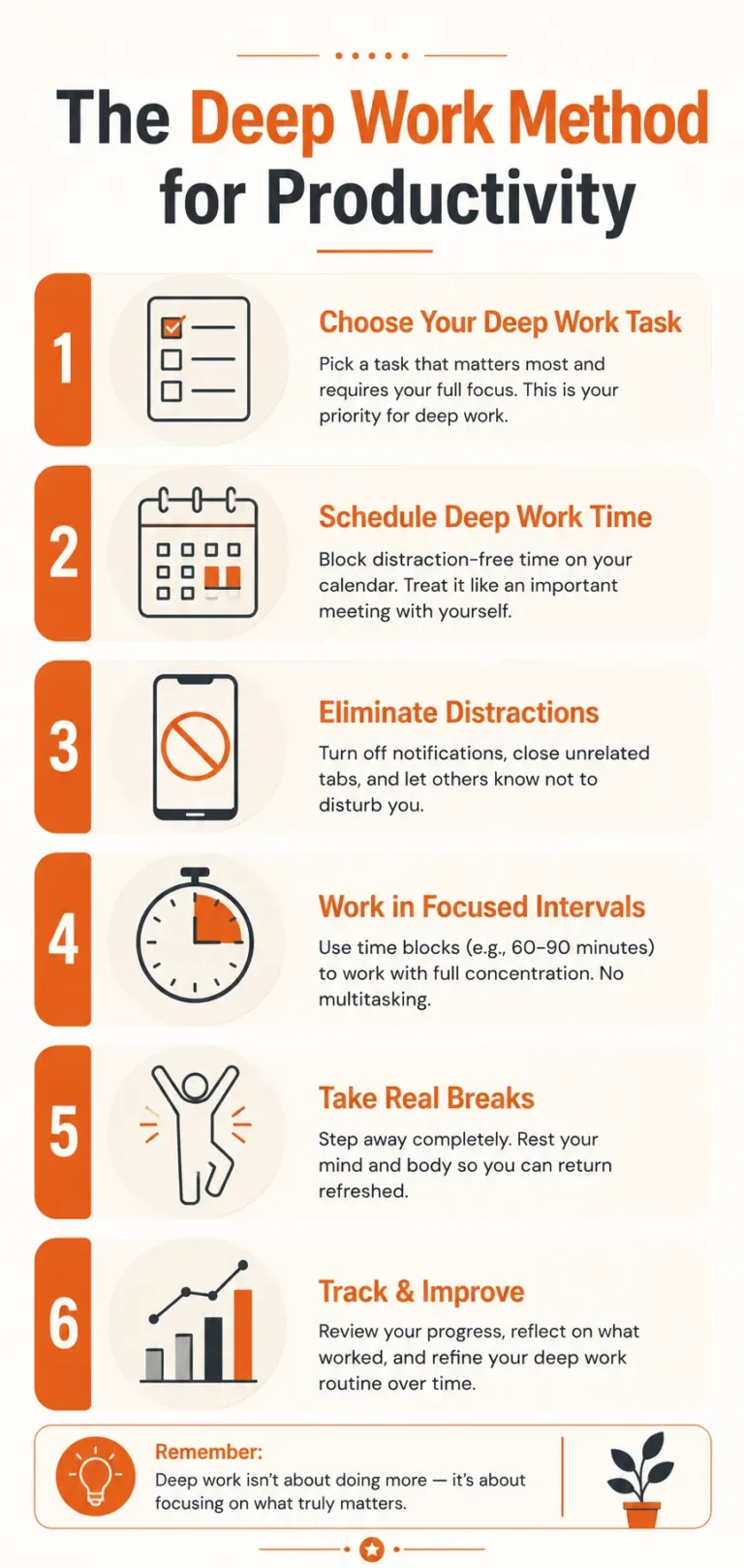
Here’s the exact process I followed. If you’re starting from zero, follow these steps in order.
Step 1: Pick One Task, Not Five
Before you sit down to work, choose only one task. Not your whole to-do list. One task. This single change alone fixes half the distraction problem.
Step 2: Block Your Calendar Like It’s a Meeting With Your Boss
Open your calendar and block time for deep work, just like you would for an important meeting. Treat it as non-negotiable. If you wouldn’t skip a client call, don’t skip this either.
Step 3: Remove Every Distraction Before You Start
Put your phone in another room. Turn off notifications. Close every browser tab that isn’t related to the task. This is the hardest step, and also the most important one.
Step 4: Set a Timer for 60 to 90 Minutes
Our brains can only hold deep focus for so long. Sixty to ninety minutes is the sweet spot for most people. Set a timer and commit to working until it rings.
Step 5: Take a Real Break After Each Session
Step away from your screen. Walk around. Stretch. Don’t scroll your phone during this break, or your brain won’t actually rest. This step prevents the burnout that stops most people from continuing.
Step 6: Track Your Deep Work Hours Every Day
Write down how many deep work sessions you completed each day. This small habit builds accountability, and it feels great to watch the numbers grow.
Try this for just five days. Don’t skip a single step. I promise you’ll notice a difference by day three.
How Deep Work Helped Me Finish Projects Faster
Within the first week, I finished a project that had been sitting on my to-do list for over a month.
In my first full month of using the deep work method for productivity, I completed 40% more projects than the month before. That’s not an exaggeration. I tracked every single hour, so I have the numbers to prove it.
The strange part? I wasn’t working longer hours. I was working the same number of hours, just without the constant distractions pulling me away. That’s the real power of deep work: it’s not about doing more hours, it’s about doing better hours.
How Deep Work Helped Me Earn More Money
Here’s where it gets interesting.
Because I delivered work faster and with better quality, I raised my rates by 30%. Clients didn’t just accept it — some of them thanked me for finally being reliable.
Word spread. New clients started reaching out because previous clients recommended me. Faster turnaround plus better quality equals more trust. More trust equals more money.
And here’s the part that still gives me goosebumps: the same client who left me after I missed those deadlines? She came back three months later, asking to work with me again. That’s when I understood that the deep work method for productivity wasn’t just a personal habit. It was a business strategy hiding in plain sight.
Common Mistakes People Make With Deep Work (Avoid These)
I made almost all of these mistakes before I got it right.
- Trying to do 8 hours of deep work on day one and burning out by noon.
- Checking the phone “just for a second,” which turns into twenty minutes.
- Not physically removing distractions before starting.
- Trying to multitask during a deep work session instead of single-tasking.
- Skipping breaks and wondering why focus disappears by session three.
Avoid these, and you’ll move faster than most people who try this method and quietly give up.
Deep Work Techniques That Actually Work for Beginners
If you’re just starting out, these simple techniques for beginners make it much easier to stick with deep work:
- Time blocking: schedule your deep work sessions the same time every day so it becomes a habit.
- The 90/20 split: 90 minutes of focused work, followed by a 20-minute real break.
- Digital detox before sessions: keep your phone in another room, not just on silent.
- The single-tasking rule: one tab, one task, one goal per session.
- Environment design: a clean desk and a quiet space train your brain to focus faster.
None of these need expensive tools or apps. They only need consistency.
Deep Work for Freelancers, Remote Workers, and Students
A deep work routine for freelancers looks different from one for a full-time employee, but the core idea stays the same.
If you’re a freelancer, block your best hours of the day, usually morning, for your highest-paying client’s work. Save shallow tasks like invoicing for later in the day.
If you’re working remotely, deep work protects you from the constant pull of home distractions and endless team chats. Even 90 minutes of true focus can outperform a full distracted day.
If you’re a student, deep work for studying means closing your phone, picking one subject, and using short deep sessions instead of long, tired study marathons. Your grades will thank you.
Whatever your situation, the best time to do deep work is whenever you have the fewest distractions and the most mental energy. For most people, that’s early morning.
Summary
Here’s everything in one quick recap:
- Deep work means single-tasking with zero distractions for a fixed time block.
- It’s different from shallow work like emails and meetings.
- Follow the six-step process: pick one task, block your calendar, remove distractions, set a timer, take real breaks, and track your progress.
- Deep work helped me finish 40% more projects in one month.
- It also helped me raise my rates and win back lost clients.
- Avoid common mistakes like overdoing it on day one or skipping breaks.
- Freelancers, remote workers, and students can all adapt this method to their own routine.
Conclusion
The deep work method for productivity isn’t a trendy hack. It’s a simple, repeatable system that changed how I finish projects and how much I earn from my work.
You don’t need a perfect morning routine or expensive productivity apps to start. You just need one task, one hour, and zero distractions.
Try it tomorrow morning. Just one session. Then come back and tell me how it went in the comments. I’d genuinely love to know if it worked for you the way it worked for me.
Frequently Asked Questions
What is the deep work method for productivity?
It’s a focused work approach where you work on a single task, without any distractions, for a set block of time, instead of multitasking or working in short, interrupted bursts.
How long should a deep work session last?
Most beginners do well with 60 to 90 minute sessions, followed by a short, screen-free break.
Can deep work really help you earn more money?
Yes. Faster, higher-quality output builds trust with clients and employers, which often leads to better rates, more referrals, and repeat business.
Is deep work only for creative professionals?
No. Deep work helps anyone who needs to think clearly and produce quality output, including students, developers, marketers, writers, and business owners.
How do I start deep work if I have a full-time job?
Start small. Block just one 60-minute session a day, ideally before your inbox gets busy, and build from there.