Ever feel like Monday hits you before you’ve even had your coffee?
You’re not alone. Life gets messy. Plans fall apart. By Friday, you’re wondering where the whole week went.
This is exactly why a weekly reset routine works so well for productivity. It’s not about being perfect. It’s about giving yourself a fresh start, every single week, without the overwhelm.
In this guide, you’ll learn a simple, realistic weekly reset routine that you can actually stick to. No fluff. No 5-hour Pinterest-style planning sessions. Just a system that works, even on your busiest weeks.
Let’s get into it.
Table of Contents
What Is a Weekly Reset Routine (And Why It Works So Well)
A weekly reset is a short block of time you set aside to tidy up your space, your schedule, and your mind before the new week begins.
Think of it as hitting the refresh button on your life.
People who follow a weekly reset routine for productivity often say they feel calmer, more in control, and less likely to forget important tasks. It’s a small habit with a big payoff.
Here’s the simple truth: your brain can’t focus on today if it’s still stuck thinking about yesterday’s mess. A weekly reset clears that mental clutter so you can actually get things done.
It also helps with:
- Reducing daily stress and decision fatigue
- Feeling more organized without over-scheduling
- Building consistency instead of relying on motivation
- Creating time for rest, not just work
Think about the last time you started a week already feeling behind. Maybe the laundry piled up, your inbox had 60 unread emails, and you had no idea what was for dinner on Tuesday. That heavy, scattered feeling is exactly what a weekly reset routine is designed to fix.
You don’t need to overhaul your whole life. You just need one small block of time, used the right way, every single week.
Sounds good, right? But here’s where most people go wrong.
Why Most Weekly Reset Routines Fail (And How Yours Won’t)
You’ve probably tried this before. You made a big plan. You bought a fancy planner. You lasted two weeks.
So what happened?
Most weekly reset routines fail because they’re too complicated. People try to overhaul their entire life in one Sunday afternoon. That’s not sustainable, and honestly, it’s exhausting just thinking about it.
The second reason? No fixed time. If your reset routine doesn’t have a set day and time, it becomes a “someday” task. And someday rarely comes.
The fix is simple: keep it short, keep it consistent, and keep it realistic. A 30-minute reset done every week beats a 3-hour reset done once a month.
When Should You Do Your Weekly Reset?
There’s no single right answer here, but most people find success with one of these two options:
Sunday evening – This helps you walk into Monday feeling prepared instead of panicked.
Friday afternoon – This lets you close out the work week and enjoy your weekend without loose ends nagging at you.
Try both and see what feels natural. The best time is simply the time you’ll actually show up for.
The Step-By-Step Weekly Reset Routine That Actually Works
This is the part you came for. Below is a simple, beginner-friendly weekly reset checklist you can follow every single week.
Step 1: Clear Your Physical Space
Start with your surroundings. A messy space quietly drains your energy, even if you don’t notice it.
Spend 10 minutes tidying your desk, bedroom, or wherever you spend the most time. Put things back where they belong. Throw away the trash. Wipe down surfaces.
You’ll be surprised how much lighter you feel after this one small step.
Step 2: Do a Brain Dump
Grab a notebook or open a blank note on your phone. Write down everything on your mind. Tasks, worries, ideas, random thoughts, all of it.
This is one of the most underrated productivity habits out there. Getting things out of your head and onto paper instantly reduces mental clutter.
Don’t organize it yet. Just get it all out.
Step 3: Review Your Calendar
Now look at the week ahead. Check appointments, meetings, deadlines, and events.
Ask yourself:
- What’s non-negotiable this week?
- Where might I run out of time?
- Are there any conflicts I need to fix now?
This five-minute step prevents so many last-minute scrambles later.
Step 4: Pick Your Top 3 Priorities
Here’s where a lot of planning systems go wrong. They try to plan every single hour, and it falls apart by Tuesday.
Instead, pick just three main priorities for the week. These should be the tasks that matter most, not just the ones that feel urgent.
When your week feels chaotic, these three priorities become your anchor.
Step 5: Plan Meals and Groceries
You don’t need a complicated meal plan. Even jotting down five simple dinner ideas saves you from the “what’s for dinner” stress every single night.
Check what you already have. Make a quick grocery list for anything missing. This one step alone can save hours during your week.
Step 6: Clean Up Your Digital Space
Your phone and laptop need a reset too.
Clear out your inbox. Delete apps you don’t use. Organize your desktop files. Close the 47 browser tabs you’ve been ignoring.
A cluttered digital space creates the same mental fog as a messy room.
Step 7: End With Something for Yourself
This step gets skipped the most, and it’s actually the most important one.
Do something small just for you. Make tea. Take a walk. Read a few pages of a book. Light a candle.
A weekly reset routine isn’t only about productivity. It’s also about protecting your energy so you don’t burn out.
How to Actually Stick to Your Weekly Reset Routine
Knowing the steps is easy. Sticking to them long-term is where most people struggle. Here’s how to make it stick.
- Keep it under 30 minutes. If your reset routine takes too long, you’ll dread doing it. Short and simple wins every time.
- Attach it to something you already do. This is called habit stacking. For example, do your reset right after your Sunday coffee or right before your weekly grocery run.
- Use the same checklist every week. Don’t reinvent your routine each time. Repetition builds habit, and habit builds consistency.
- Track your streak. Even a simple checkmark on a calendar can be surprisingly motivating.
- Give yourself grace. Missed a week? That’s fine. Just start again next week. Progress matters more than perfection.
Try this: commit to doing your reset for just four weeks in a row. By week five, it’ll start feeling automatic.
Simple Tools That Make Your Weekly Reset Easier
You don’t need expensive apps or a fancy planner to make this work. But a few simple tools can help:
- A basic notebook or planner for your brain dump
- A digital calendar app for scheduling
- A sticky note on your mirror as a reminder
- A simple checklist you can reuse every week
The goal isn’t to buy more stuff. The goal is to build a routine so simple that you’ll actually follow it.
Mistakes to Avoid With Your Weekly Reset
Even a good routine can fall apart with a few common mistakes. Watch out for these:
- Trying to do too much at once. Your reset routine should feel light, not like another item on your to-do list.
- Skipping it when you’re busy. Ironically, the busiest weeks are exactly when you need a reset the most.
- Comparing your routine to others online. Someone else’s color-coded, hour-by-hour system may not work for your life, and that’s okay.
- Forgetting the “reset” part. This isn’t just about planning. It’s about clearing mental and physical clutter so you feel lighter going into the week.
A Simple Example: What This Looks Like in Real Life
Let’s say it’s Sunday at 6 p.m.
You spend 10 minutes tidying the living room and kitchen counter. You grab a notebook and write down everything on your mind, from “call the dentist” to “finish work presentation.” You glance at your calendar and notice a meeting on Wednesday you’d completely forgotten about.
You pick three priorities for the week: finish the presentation, schedule the dentist appointment, and start a workout routine. You jot down four easy dinner ideas and check what groceries you need. You unsubscribe from a few spam emails cluttering your inbox.
Then you make a cup of tea and watch one episode of your favorite show.
That’s it. Twenty-five minutes, and you’re walking into Monday feeling like you actually have a plan instead of just hoping for the best.
This is what makes a weekly reset routine so powerful. It’s not complicated. It’s just consistent.
Summary
- A weekly reset routine helps clear mental clutter and boosts productivity.
- Most routines fail because they’re too complicated or inconsistent.
- Pick a fixed day, like Sunday evening or Friday afternoon.
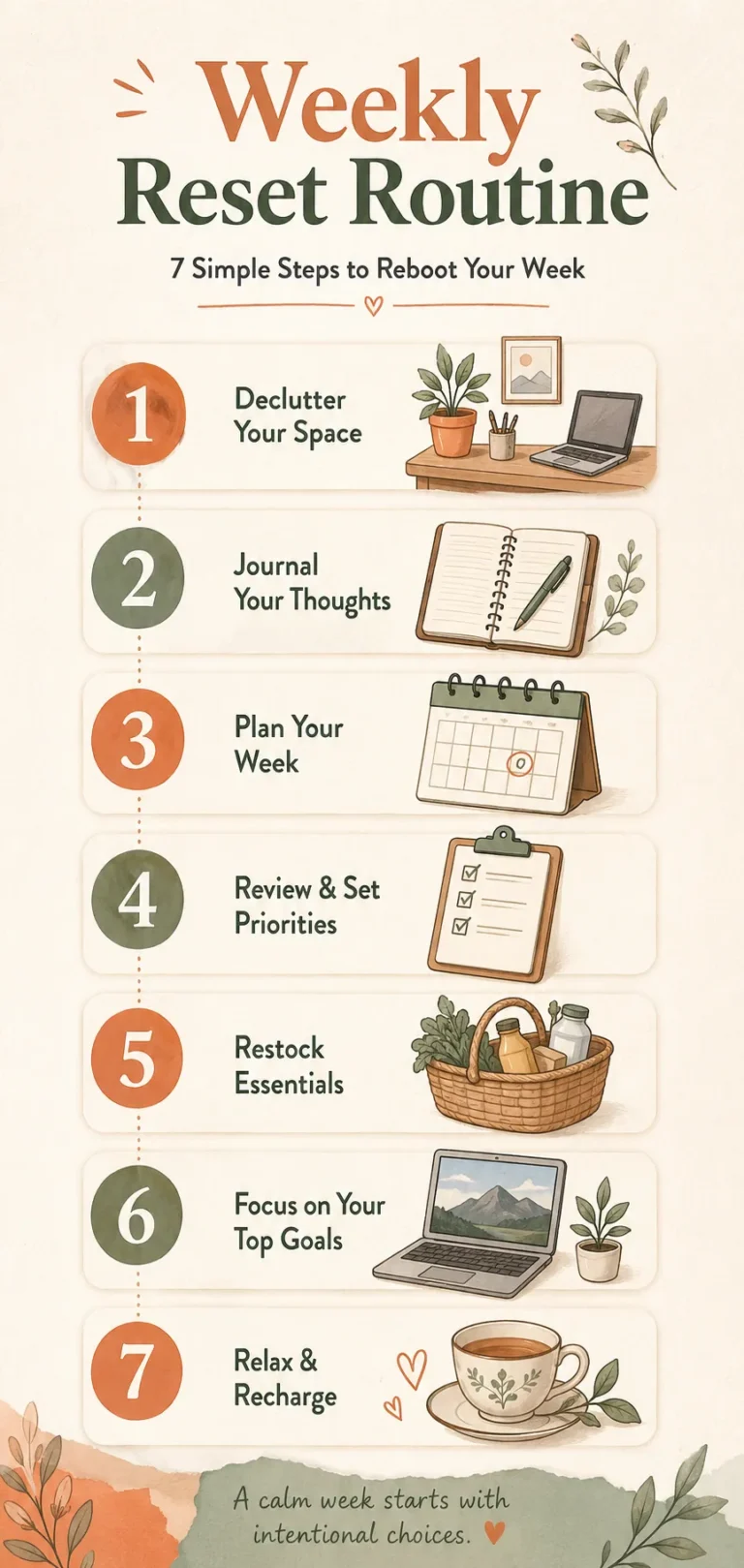
- Follow simple steps: tidy your space, brain dump, check your calendar, set 3 priorities, plan meals, clean your digital space, and do something for yourself.
- Keep the routine short and repeatable to build a lasting habit.
- Progress matters more than perfection.
Final Thoughts
A weekly reset routine isn’t about becoming a different person overnight. It’s about small, simple steps that add up week after week.
Start with just one or two steps from this guide if the full routine feels like too much right now. You can always build from there.
Try it this coming Sunday. Set a 20-minute timer, work through the steps, and notice how much calmer your Monday feels.
Productivity isn’t about doing more every single day. It’s about building small habits, like this weekly reset routine, that quietly make everything else easier. Give it a real shot for one month, and you’ll likely wonder how you ever managed without it.
If this guide helped you, save it for later so you have it ready before your next reset day. Share it with a friend who always feels like their week is running away from them. Your future self will thank you.
Frequently Asked Questions
How long should a weekly reset routine take?
Most people find 20 to 30 minutes is enough. It doesn’t need to be long to be effective.
What day is best for a weekly reset?
Sunday evening or Friday afternoon tend to work best, but any consistent day works fine.
Can a weekly reset really improve productivity?
Yes. It reduces decision fatigue, clears mental clutter, and helps you start each week with clear priorities instead of scrambling.
Do I need a planner for this to work?
No. A notebook, phone notes app, or even a blank sheet of paper works perfectly well.
What if I miss a week?
Just pick it back up the next week. Consistency over time matters far more than never missing a single week.
Is a weekly reset routine the same as a morning or daily routine?
Not quite. A daily routine covers your everyday habits, while a weekly reset routine is a bigger-picture check-in that helps you plan and prepare for the entire week ahead. Many people use both together for the best results.