Let me ask you something.
When was the last time you felt 100% sure your job was safe?
If that question made you pause, you are not alone.
Millions of people right now are quietly scared. They look at the news. They see AI doing things faster, smarter, cheaper. And somewhere deep down, a little voice says… “Am I next?”
Here is the truth nobody wants to say out loud: some jobs will disappear. But that does not mean YOUR career has to.
This blog is your complete, no-fluff future career strategy guide for 2026. You will learn exactly what skills to build, what mindset to carry, and what moves to make — so AI makes you more powerful, not jobless.
Let’s get into it.
Table of Contents
Why “Just Work Hard” Is No Longer Enough
For decades, the advice was simple. Study hard. Get a degree. Work long hours. Climb the ladder.
That advice is outdated.
AI tools like ChatGPT, Gemini, Midjourney, and thousands of others are now doing tasks that used to take humans hours — in seconds. Writing emails. Generating code. Analyzing data. Creating images. Answering customer questions.
If your job mostly involves repeating the same task every day, the risk is real.
But here is what most people miss: AI is not replacing humans. It is replacing humans who do not adapt.
The people who understand this — and act on it now — are going to thrive in ways that feel almost unfair to everyone else.
That is what a smart future career strategy looks like in 2026.
Step 1 — Understand What AI Can and Cannot Do
Before you can AI-proof your career, you need to understand your enemy. Or better said, your tool.
AI is incredibly good at:
- Processing large amounts of data quickly
- Finding patterns in numbers and text
- Doing repetitive, rules-based tasks
- Generating content based on existing information
- Automating workflows that follow clear steps
AI is not good at:
- Real human empathy and emotional connection
- Creative thinking that breaks existing patterns
- Physical tasks in unpredictable environments
- Ethical judgment in complex situations
- Building trust with other human beings
- Leading, inspiring, and motivating people
Your future career strategy starts here. Figure out which parts of your job are pattern-based. Those are at risk. Figure out which parts require human judgment, creativity, or connection. Those are your armor.
Step 2 — Identify Your “Human Edge”
Every person reading this has something AI cannot fully replicate. The problem is most people never stop to identify it.
Ask yourself these questions right now:
What do people come to me for that they cannot get from a Google search?
What skill of mine made someone say “I don’t know what we would do without you”?
What do I understand about people, relationships, or my industry that took years of real-world experience to learn?
That is your human edge. And that is the foundation of your AI-proof career strategy.
For some people, it is empathy. For others, it is industry knowledge. For others, it is the ability to walk into a room and read what is really going on.
Whatever it is — build on it. Deepen it. Make it undeniable.
Step 3 — Learn to Work WITH AI (Not Against It)
Here is one of the most important insights in this entire post.
The people who will lose their jobs to AI are not just the ones doing routine tasks. They are also the ones refusing to learn how AI works.
The biggest job market shift happening right now is this: companies do not want to hire people who fear AI. They want to hire people who can USE AI to do the work of five people.
This is your future career strategy opportunity.
Practical steps to start working with AI today:
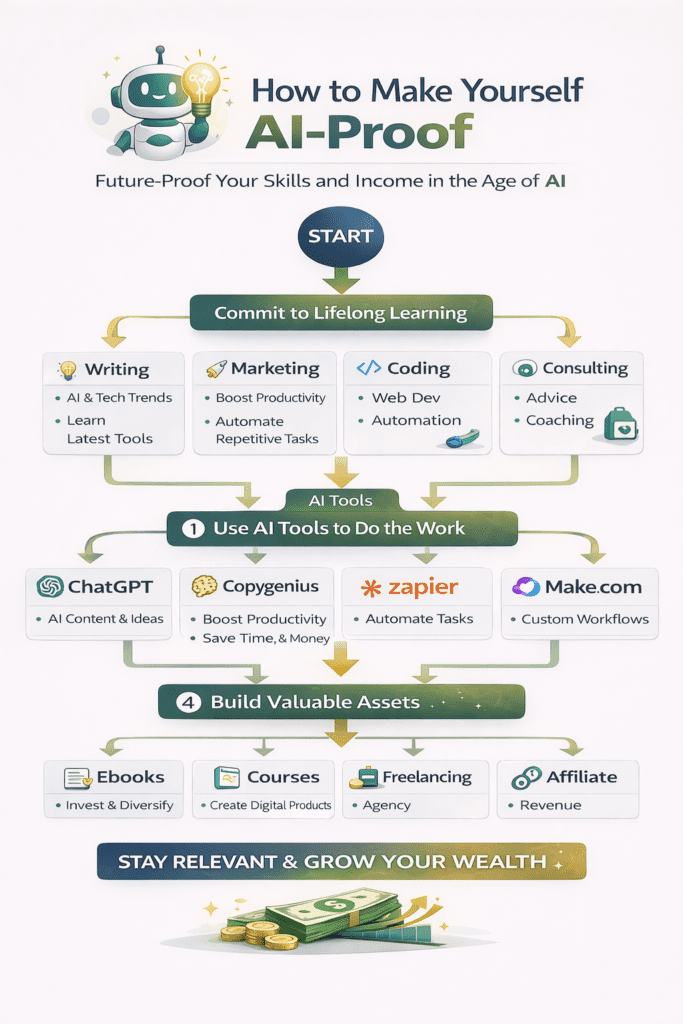
Start using ChatGPT or Claude for your daily work tasks. Use it to draft emails, summarize reports, brainstorm ideas, or plan your week.
Learn prompt engineering basics. This is the skill of knowing how to ask AI the right questions. It sounds simple but it is genuinely powerful. A person who writes good prompts gets 10x better output than someone who does not.
Explore AI tools specific to your industry. If you are in marketing, learn how to use AI for SEO and content. If you are in finance, learn AI-powered analysis tools. If you are in healthcare, explore AI diagnostics tools. Every industry now has AI layers being added. Know your layer.
Being an AI-savvy professional is one of the highest-demand skills for future careers right now. And most people are not learning it. That gap is your advantage.
Step 4 — Double Down on Skills That AI Struggles With
This step is where your future career strategy gets really exciting.
There are certain skills that become MORE valuable the more AI takes over. Think of it this way: when everyone has a calculator, the person who understands math is still more valuable. When everyone has AI, the person who understands people is invaluable.
High-value human skills to develop in 2026:
- Critical Thinking and Problem Solving AI gives answers. Humans ask the right questions. The skill of knowing which problem to solve, and why, is irreplaceable. Practice this by asking “why” more often and challenging assumptions in your work.
- Emotional Intelligence (EQ) EQ is your ability to understand and manage emotions — your own and others. Leaders with high EQ inspire teams, resolve conflicts, and build loyalty. No AI can fake genuine human warmth.
- Communication and Storytelling Anyone can produce information. But turning information into a story that moves people to action? That is a human superpower. Sharpen your writing, speaking, and presentation skills.
- Leadership and Influence The ability to rally people around a vision, earn their trust, and guide them through uncertainty is a top career skill for the future. Invest in leadership training, even if you are not a manager yet.
- Creativity and Original Thinking AI remixes what already exists. True originality — the kind that disrupts industries and creates new categories — still comes from human minds. Feed your creativity. Read widely. Explore outside your industry. Connect unrelated ideas.
- Adaptability The future of work belongs to people who can learn fast, pivot without panic, and thrive in ambiguity. Start building this muscle now by deliberately doing things that stretch you outside your comfort zone.
Step 5 — Build a Personal Brand That AI Cannot Copy
In 2026, your LinkedIn profile is not optional. Your online presence is not a nice-to-have. It is a career safety net.
Here is why.
When AI automates parts of a company, the first people cut are the ones nobody knows. The ones who quietly did their job but never made themselves visible. The ones who never shared what they know.
The people who survive — and thrive — are the ones who have built real reputations.
How to start building your personal brand for future career success:
Start sharing what you know online. Write short posts on LinkedIn about lessons from your work. You do not need to be an expert. You just need to be a step ahead of someone else.
Document your wins. Every time you solve a hard problem, help a client, or lead a project, write it down. Turn those stories into content. This creates proof of your value.
Engage with your industry. Comment on other people’s posts. Join online communities. Show up in conversations. Visibility creates opportunity.
Build an email list or a blog. Platforms like LinkedIn can change their algorithm tomorrow. A blog or email list is yours forever. Even a small, loyal audience is a massive career asset.
Your personal brand is a long-term future career strategy investment. Start small. Start today.
Step 6 — Expand Your Income Streams
This one will feel uncomfortable for some people. But it is necessary.
Relying on one employer in 2026 is a risk. Full stop.
It is not pessimistic to say that. It is just math. Companies are restructuring fast. Automation is eliminating roles. Layoffs are happening even at profitable companies.
The smartest future career strategy is to diversify your income the same way smart investors diversify their portfolio.
Ways to build multiple income streams in 2026:
Freelancing or consulting in your area of expertise. Even a few hours a week on the side can add meaningful income and build new skills and connections.
Teaching what you know. Platforms like Udemy, Gumroad, or even YouTube allow anyone to create a course or tutorial. If you know something valuable, someone will pay to learn it.
Building a niche content platform. A blog, podcast, or YouTube channel around a topic you know deeply can grow into a real income source over time.
Productizing your skills. Can you turn your knowledge into a template, checklist, tool, or system that others can buy? This is called a digital product and it earns money even while you sleep.
You do not need to do all of these. Pick one. Start small. Build it slowly alongside your main job.
Step 7 — Never Stop Learning (Especially NOW)
The half-life of skills is shrinking. Skills that were cutting-edge five years ago are basic today. Skills that are hot today might be automated in three years.
This means lifelong learning is not a suggestion in 2026. It is survival.
But learning does not have to mean going back to school for two years and spending a fortune.
Practical ways to keep learning for your future career strategy:
Spend 20 minutes a day reading about your industry and about AI developments. That is it. Just 20 minutes. Over a year, that is over 120 hours of focused learning.
Take online courses on platforms like Coursera, LinkedIn Learning, or Udemy. Many are free or low cost. Focus on AI tools, data literacy, communication, and leadership.
Find a mentor. Someone who is five years ahead of you in your career path can save you years of trial and error. Reach out to people you admire. Be specific about what you want to learn. Most people will say yes.
Join communities where professionals in your field share knowledge. Discord servers, Slack groups, industry forums, local meetups. Being around motivated, growing people is one of the most underrated career investments.
Learn data basics. You do not need to become a data scientist. But being able to read a chart, understand basic metrics, and talk intelligently about data puts you ahead of most people in any field.
The Jobs That Will Thrive in the AI Era
You might be wondering: what careers are actually safe or growing in 2026?
Here are some fields seeing strong demand right now, even with AI growing fast:
- Healthcare and mental health professionals. AI can assist with diagnosis but cannot replace the human connection in care. Nurses, therapists, doctors, and counselors are still deeply needed.
- Skilled trades. Electricians, plumbers, HVAC technicians, and construction workers do physical work in unpredictable environments. AI cannot install your wiring.
- AI and machine learning professionals. The people building, training, and maintaining AI systems are in explosive demand. If you have technical interest, this is a field worth exploring.
- Educators and coaches. Teaching is deeply human. The best teachers adapt, inspire, and connect with students in ways no algorithm can replicate.
- Creatives with a strategic edge. Designers, writers, and artists who also understand business, marketing, or technology are extraordinarily valuable. Pure output alone gets automated. Strategy and taste do not.
- Sales and relationship-driven roles. High-stakes sales still relies on human trust and rapport. The best salespeople are not replaceable by a chatbot.
- Entrepreneurs and business builders. Building and running a business requires judgment, risk tolerance, leadership, and creativity. These are deeply human activities.
A Warning: The Mindset That Will Kill Your Career
Before we wrap up, there is something you need to hear.
The biggest threat to your future career is not AI.
It is the belief that someone else will figure this out for you.
It is waiting for your company to train you instead of training yourself.
It is staying in a role you know is shrinking because changing feels scary.
It is telling yourself you are too old, too busy, or too set in your ways to learn new things.
The people who thrive in the AI era are not necessarily the most talented. They are the most intentional. They are the ones who decide today — not next year, not after the layoff — to take ownership of their career future.
That decision is available to you right now.
Quick Action Plan: Start Your Future Career Strategy This Week
If you have read this far, you are already ahead of most people. But reading is not enough.
Here is what to do in the next 7 days:
On Day 1, write down your top three human strengths. What do you offer that AI genuinely struggles with?
On Day 2, spend one hour exploring AI tools relevant to your job. Just explore. No pressure to master anything.
On Day 3, update your LinkedIn profile. Make your headline specific. Add your best recent accomplishment.
On Day 4, write one short post or article sharing something useful you know. Publish it on LinkedIn.
On Day 5, identify one new skill to learn this month. Sign up for a free course online.
On Day 6, reach out to one person in your industry for a conversation. A former colleague, a mentor, someone doing work you admire.
On Day 7, review your income. Ask honestly: if my job disappeared tomorrow, how would I survive? Start making a plan.
Small steps. But compounded over months and years, these steps build a career that is genuinely AI-proof.
Summary
Here is everything we covered in this future career strategy guide:
Understanding what AI can and cannot do is the starting point. AI handles patterns and repetition. Humans handle judgment, creativity, and connection.
Your human edge is your greatest career asset. Identify it and build on it relentlessly.
Learning to work with AI — not fear it — makes you dramatically more valuable to any employer or client.
Skills like emotional intelligence, critical thinking, communication, and leadership become more valuable as AI grows, not less.
A personal brand protects your career by making you visible and trusted in your industry.
Diversifying your income reduces your risk and builds resilience in an unpredictable job market.
Lifelong learning is not optional in 2026. Even 20 minutes a day keeps you moving forward.
Mindset is everything. The people who take ownership of their careers today will be the ones leading the next decade.
Conclusion
AI is not going anywhere. And the truth is, you would not want it to. Used well, AI is an incredible multiplier. It handles the boring work. It frees up your time. It makes good workers exceptional.
But it rewards the prepared.
Your future career strategy in 2026 is not about hiding from AI. It is about making yourself so genuinely human, so deeply skilled, so visibly valuable — that no algorithm could ever replace what you bring to the table.
Start today. Not tomorrow. Today.
Your future career is not something that happens to you. It is something you build — one intentional decision at a time.