Let me ask you something honest.
Are you scared that AI might take your job?
You are not alone. Millions of people around the world are asking the same question right now. And honestly, the fear makes sense. AI is writing emails, generating code, creating art, summarizing reports, and doing tasks that used to take humans hours — in just seconds.
But here is the truth nobody talks about enough.
AI vs humans is not a battle you have to lose. In fact, the people who understand this shift early are already setting themselves up to win big. And in this blog, I am going to show you exactly which skills you need to master to stay relevant, grow your career, and even thrive in an AI-powered world.
This is not just another article with generic advice. This is your action plan.
Table of Contents
What Is Really Happening with AI vs Humans Right Now
Before we talk about skills, you need to understand what is actually happening.
AI tools like ChatGPT, Gemini, Claude, and Copilot are not just “smart software.” They are trained on billions of words and can perform tasks that used to be considered uniquely human — writing, analysis, research, customer support, even basic coding.
According to a 2024 McKinsey report, around 30% of work tasks across industries could be automated by 2030. That sounds alarming. But here is the other side: the same report says new jobs and new roles will also be created. The key question is — which side of that shift will you be on?
The AI vs humans debate is not about replacement. It is about evolution. And those who evolve win.
Why Most People Are Getting the AI vs Humans Conversation Wrong
Most articles about AI and jobs will tell you “learn to code” or “use AI tools.” That advice is incomplete.
The real question is not just what AI can do. The real question is what AI cannot do — and how you can become the person who fills that gap.
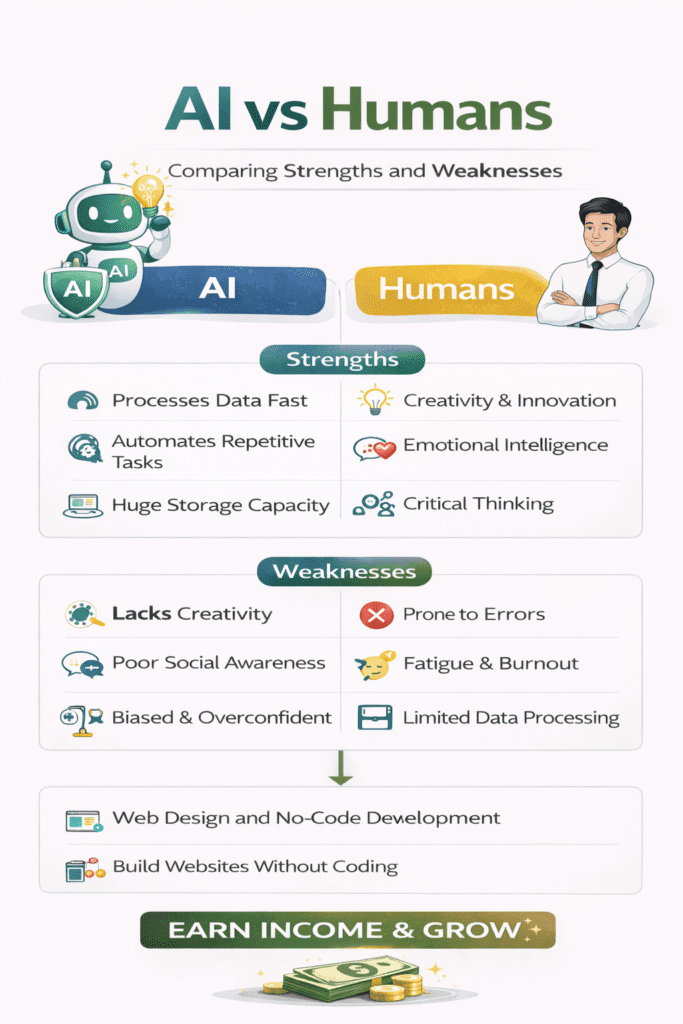
AI is incredibly powerful at pattern recognition, data processing, repetitive tasks, and producing content at scale. But AI struggles with:
- Real human empathy and emotional connection
- Complex ethical decision-making
- Creative thinking that goes beyond existing patterns
- Leadership and inspiring people
- Navigating ambiguous, high-stakes situations
- Understanding nuance in culture, relationships, and context
These are not small gaps. These are massive opportunities for humans who choose to develop the right skills.
10 Skills You Must Master to Stay Relevant in the Age of AI
1: Critical Thinking and Problem Solving
This is the number one skill that separates humans from AI — and always will.
AI gives you answers. But it cannot always tell you which answer is right for your specific situation, your values, and your goals. Critical thinking means you can evaluate information, question assumptions, and make smart decisions even when the data is messy or incomplete.
Here is how to build this skill:
- Start questioning the news you read. Ask — who wrote this? What is their agenda? What evidence supports this?
- Practice breaking down complex problems into smaller parts.
- Read books on logic, reasoning, and decision-making. “Thinking, Fast and Slow” by Daniel Kahneman is a great start.
- Spend 10 minutes a day on a logic puzzle, debate, or case study.
People who think critically will always be needed to review, challenge, and improve AI outputs. No matter how good AI gets, humans with sharp minds will oversee, guide, and make the final call.
2: Emotional Intelligence (EQ)
This one might surprise you.
In a world full of AI, emotional intelligence is becoming one of the most valuable human skills you can have.
Emotional intelligence means understanding your own emotions, reading other people’s feelings, managing conflict, and building strong relationships. AI cannot feel. It cannot sense when a team member is burning out, when a client is about to leave, or when a tough conversation needs a gentle touch.
How to improve your emotional intelligence:
- Practice active listening — when someone talks, focus 100% on them, not on what you will say next.
- Reflect on your emotional reactions every evening. Ask yourself — why did I feel that way? Was it rational?
- Practice empathy by consciously putting yourself in other people’s shoes before reacting.
- Learn to manage stress and stay calm in difficult situations.
Leaders, managers, therapists, teachers, salespeople, and coaches who build strong EQ will be in massive demand as AI handles more routine work.
3: AI Literacy — Learning to Work WITH AI
Here is the skill most people overlook.
You do not need to be an AI engineer. But you do need to understand how AI tools work and how to use them effectively. This is called AI literacy, and it is quickly becoming a baseline expectation in almost every job.
AI literacy means knowing:
- How to write good prompts to get useful AI outputs
- What AI can and cannot do reliably
- How to fact-check and verify AI-generated content
- How to use AI tools to speed up your own work
- Which AI tools are best for which tasks
Step-by-step guide to build AI literacy:
- Step 1 — Start using ChatGPT, Claude, or Gemini in your daily work. Even small tasks like drafting emails or summarizing documents.
- Step 2 — Take a free AI basics course on Coursera, Google, or Microsoft Learn.
- Step 3 — Practice prompt engineering — learn how to ask AI the right questions to get the best results.
- Step 4 — Stay updated. Follow AI news on LinkedIn, YouTube, or newsletters like “The Rundown AI.”
- Step 5 — Use AI to do 20% of your tasks, then use the time saved to develop higher-level skills.
The people who know how to use AI as a tool — not those who fear it or ignore it — will have a massive career advantage.
4: Creativity and Original Thinking
AI can generate content. But AI cannot truly create.
Here is the difference. AI can produce a thousand variations of a logo design. But a human designer understands the brand story, the audience’s psychology, and the cultural moment — and creates something that genuinely moves people.
AI can write a blog post about marketing. But a human writer who has built a business, made mistakes, and learned hard lessons can share insights that feel real, raw, and genuinely useful.
Creativity in the AI age means:
- Coming up with new ideas that connect dots in unexpected ways
- Telling stories that resonate emotionally with real people
- Finding original solutions to problems that have never been solved before
- Asking the questions that nobody thought to ask
How to build creativity:
- Dedicate 20 minutes a day to something creative — writing, drawing, brainstorming, or building.
- Expose yourself to ideas outside your field. Read history, philosophy, science, or art.
- Practice the habit of asking “what if?” questions.
- Keep a notebook of random ideas. The best ideas often come from connecting two unrelated things.
In the AI vs humans competition for jobs, creativity is one of the clearest human advantages.
5: Communication and Storytelling
AI can produce text. But humans communicate.
There is a huge difference. Communication is not just about words. It is about tone, timing, body language, trust, and connection. And storytelling — the ability to make people feel something through a narrative — is a skill that AI simply cannot replicate with true authenticity.
Think about the best presentation you ever saw. The best conversation that changed your mind. The best piece of writing that made you feel understood. Those moments came from humans who knew how to communicate deeply.
To sharpen your communication skills:
- Practice public speaking. Join a Toastmasters club or simply record yourself talking for 5 minutes a day.
- Write every day. Even a journal entry or a short LinkedIn post helps you find your voice.
- Study storytelling. Read books like “Building a StoryBrand” by Donald Miller.
- Learn the art of asking powerful questions — in meetings, in interviews, in relationships.
Great communicators will always be in demand, no matter how advanced AI becomes.
6: Adaptability and Continuous Learning
The world is changing faster than ever. The people who survive — and thrive — are those who can adapt.
This is not just about learning new software. It is about having a growth mindset. It is about being genuinely excited about change rather than terrified of it.
In practical terms, adaptability means:
- Being willing to learn new tools and skills quickly
- Letting go of outdated ways of doing things
- Embracing failure as a teacher, not a judgment
- Staying curious and open to new ideas
How to build adaptability:
- Commit to learning something new every month. It can be a book, a course, a skill, or even a new hobby.
- Put yourself in uncomfortable situations regularly. Discomfort is where growth lives.
- Find a mentor or community where people challenge your thinking.
- Build a daily learning habit — even 20 minutes a day compounds into massive knowledge over a year.
The best way to stay relevant in an AI-powered world is to never stop learning. Period.
7: Leadership and People Management
AI can manage data. AI cannot manage people.
True leadership — the kind that inspires, motivates, coaches, and builds culture — is a deeply human skill. And as AI takes over more operational and analytical tasks, the demand for strong human leaders will only grow.
Leadership in the AI age includes:
- Building psychologically safe teams where people feel valued
- Making ethical decisions when data alone is not enough
- Coaching and mentoring others to grow
- Creating a clear vision and bringing people along on the journey
- Resolving conflict and navigating difficult organizational dynamics
How to develop leadership skills:
- Take on small leadership roles wherever you can — lead a project, mentor a colleague, run a meeting.
- Read leadership books like “Leaders Eat Last” by Simon Sinek.
- Seek feedback on your leadership style and take it seriously.
- Practice making decisions and owning the outcomes, whether good or bad.
Companies are already realizing that the more AI handles execution, the more they need humans who can lead, inspire, and build strong teams. This trend will only accelerate.
8: Data Literacy and Analytical Thinking
You do not need to be a data scientist. But you do need to be data-informed.
In every industry, decisions are increasingly driven by data. The ability to understand data, interpret it correctly, and use it to make smart decisions is becoming a baseline professional skill.
Data literacy means:
- Understanding basic statistics and what they mean
- Reading charts and dashboards without being misled
- Asking the right questions about data before acting on it
- Using tools like Excel, Google Analytics, or Power BI to draw insights
How to build data literacy:
- Start with free resources like Khan Academy’s statistics course or Google’s Data Analytics certificate.
- Practice reading data in your own life — look at your website analytics, your social media metrics, or your personal finance data.
- Learn to question data. Ask — is this sample size large enough? Are there outliers affecting this number? What does this correlation actually mean?
People who can think analytically and understand data will have a massive edge as AI generates more information that humans need to interpret and act on.
9: Ethics and Responsible Thinking
This skill is more important than most people realize.
As AI makes more decisions in healthcare, finance, hiring, and law enforcement, someone has to make sure those decisions are fair, ethical, and human. That someone is you.
AI ethics is one of the fastest-growing fields in the world. Companies, governments, and NGOs urgently need people who can think deeply about the ethical implications of AI systems.
But even if you are not going into AI ethics professionally, ethical thinking matters in every role. It means:
- Recognizing when a decision might unfairly harm someone
- Speaking up when AI outputs seem biased or wrong
- Designing products and processes with human dignity in mind
- Balancing efficiency with fairness
How to develop ethical thinking:
- Study philosophy — even basic ethics courses on Coursera are genuinely useful.
- Practice the habit of asking “who might be harmed by this decision?”
- Follow organizations like the Partnership on AI or the Future of Life Institute to stay informed.
Bring ethical questions into your conversations at work — make it normal to ask “is this the right thing to do?”
10: Specialized Human Expertise
Here is the final — and perhaps most powerful — insight.
The more AI can do generalist tasks, the more valuable deep human expertise becomes.
A doctor who understands AI tools but also has 20 years of clinical intuition is irreplaceable. A lawyer who uses AI for research but has a nuanced understanding of how courts actually work is more valuable than ever. A chef who uses AI for menu optimization but creates dishes that come from a place of culture and soul is untouchable.
Deep expertise — the kind built through years of genuine experience, curiosity, and mastery — is something AI cannot shortcut.
How to build deep expertise:
- Choose your field and go deep. Do not be a generalist in a world where AI is the ultimate generalist.
- Seek out the hardest, most complex problems in your field. The messy problems that do not have clear answers.
- Build a personal reputation and brand around your expertise. Write about it, speak about it, teach it.
Stay connected to a community of experts in your field who push you to grow.
AI vs Humans: What the Future Actually Looks Like
Here is what nobody is saying clearly enough.
The future is not AI replacing humans. The future is humans who use AI outperforming humans who do not.
Think about what happened when calculators were invented. Did mathematicians become obsolete? No. They became more powerful. The calculator removed the burden of manual computation and freed them to solve harder, more interesting problems.
The same thing is happening now — at a much larger scale, much faster.
The people who will struggle are those who:
- Refuse to learn new tools and skills
- Only do tasks that AI can easily replicate
- Wait for someone else to figure this out for them
- The people who will thrive are those who:
- Develop uniquely human skills alongside AI literacy
- Use AI to amplify their existing strengths
- Stay curious, adaptable, and willing to evolve
- Build genuine expertise and human connections that AI cannot replace
A Simple Step-by-Step Plan to Start Right Now
You do not need to do everything at once. Here is a clear, simple plan:
Week 1: Start using one AI tool daily (ChatGPT, Claude, or Gemini). Use it to draft emails, summarize articles, or brainstorm ideas.
Week 2: Pick one human skill from this list that you want to develop. Commit to 20 minutes of practice or learning per day.
Week 3: Take a free online course on AI basics or the skill you chose.
Week 4: Share what you are learning. Write a LinkedIn post, talk to a colleague, or start a journal. Teaching reinforces learning.
Month 2: Add a second skill. Keep building the habit of continuous learning.
Month 3: Audit your current job. Which parts could AI do? Which parts require your uniquely human skills? Start intentionally shifting your time toward the second category.
This is not complicated. It just takes commitment. And the earlier you start, the bigger your advantage.
Who Is Most at Risk in the AI vs Humans Shift
Let us be honest about this.
Jobs most at risk from AI in the next 5–10 years include:
- Basic data entry and processing roles
- Routine customer service tasks
- Simple content writing without specialized expertise
- Basic bookkeeping and accounting tasks
- Standard legal research and document review
- Repetitive manufacturing quality control
Jobs most resilient to AI replacement:
- Roles requiring deep human relationships (therapy, coaching, leadership)
- Highly creative and original work
- Complex ethical and strategic decision-making
- Roles requiring physical dexterity in unpredictable environments
- Jobs requiring cultural and emotional nuance
- Interdisciplinary expertise that combines multiple fields
If your current job falls in the first category, this is not a reason to panic. It is a reason to start building the skills in the second category right now.
How to Make Your Personal Brand Irreplaceable
Here is a bonus insight that most people miss.
In the AI age, your personal brand matters more than ever.
AI cannot replicate your unique story, your specific experience, your voice, and your perspective. Your personal brand — the reputation you build around who you are and what you stand for — is one of the most powerful assets you can develop.
Practical ways to build your personal brand:
- Write regularly on LinkedIn or a personal blog. Share what you know and what you are learning.
- Speak at events, webinars, or podcasts in your industry.
- Build genuine relationships and a strong professional network.
- Be known for something specific and valuable.
- Show your work. Share your process, your thinking, and your results.
People trust people, not algorithms. The more you show up as a real, knowledgeable, and genuine human, the more irreplaceable you become.
Summary
Here is everything we covered, quick and clear:
The AI vs humans debate is not about replacement — it is about who evolves and who does not.
AI is powerful at pattern recognition, data processing, and repetitive tasks — but weak at empathy, creativity, ethics, and complex human judgment.
The 10 skills you must master are: critical thinking, emotional intelligence, AI literacy, creativity, communication, adaptability, leadership, data literacy, ethical thinking, and deep expertise.
Start small — pick one skill, practice 20 minutes a day, and build from there.
Your personal brand and human relationships are assets that AI cannot replicate.
The people who will win are those who use AI as a tool to amplify their human strengths — not those who compete with AI on its own terms.
Conclusion
The AI revolution is not coming. It is already here.
And you have a choice to make.
You can wait and hope it does not affect you. Or you can take action today, build the skills that matter, and position yourself as someone who thrives in this new world.
The gap between those who adapt and those who do not is going to grow wider very fast. The good news? You are reading this. You are thinking about this. That already puts you ahead of most people.
Now take the next step. Pick one skill from this list. Start today. Even 20 minutes matters.
Because in the AI vs humans story, the most powerful thing you can do is choose to be the kind of human that the future needs.
You have got this.