You set a goal. You feel excited. Day one goes great.
Then day three hits. You forget. Life gets busy. And before you know it, your new habit is gone — like it never existed.
Sound familiar?
Most people fail at building habits not because they are lazy. They fail because they rely on memory and motivation. Both run out. Fast.
But what if a smart system could track your habits, remind you at the right time, learn from your patterns, and help you grow — automatically?
That is exactly what an AI habit tracker system does.
And in this guide, you will learn everything about it. What it is, how it works, why it beats traditional methods, and how you can start using one today.
Let’s get into it.
Table of Contents
What Is an AI Habit Tracker System?
An AI habit tracker system is a digital tool powered by artificial intelligence that helps you track, manage, and improve your daily habits.
Unlike a basic to-do list or a simple app where you just tick boxes, an AI system does a lot more.
It studies your behavior. It notices patterns. It sends smart reminders. And it gives you personalized suggestions based on your actual data — not generic advice.
Think of it like having a personal coach in your pocket. One that never sleeps, never judges you, and always knows what you need to work on next.
How Is It Different From a Normal Habit Tracker?
A normal habit tracker just records what you did or didn’t do.
An AI habit tracker system goes several steps further.
It tells you why you missed a habit. It predicts which habits you are likely to skip based on your history. It adjusts your schedule when your life changes. And it helps you build habits that actually stick — not just ones that feel good for a week.
This is the difference between a notebook and a smart assistant.
Why Most People Fail at Building Habits (And How AI Fixes This)
Here is a truth that nobody tells you.
Willpower is not the answer.
Research shows that the average person makes over 35,000 decisions a day. By evening, your brain is tired. That is called decision fatigue. And it is the number one reason your healthy habits die by Thursday.
An automated habit tracking system removes the need for willpower. It creates structure. And structure is what habits actually need to grow.
Here is what AI fixes:
- Forgetting — AI sends smart, timed reminders so you never forget a habit again.
- Inconsistency — AI tracks your streaks and shows you patterns so you can stay on track.
- Lack of feedback — AI gives you weekly insights and progress reports so you always know where you stand.
- Wrong timing — AI learns when you are most productive and schedules habits around your natural energy peaks.
- No accountability — AI uses behavioral psychology to nudge you at the right moment, keeping you honest with yourself.
This is not motivation. This is a system. And systems always beat motivation in the long run.
Top Benefits of Using an AI Habit Tracker System
Let’s talk about the real, tangible benefits you get when you start using an AI-powered habit tracker.
1. Personalized Habit Plans Built for You
No two people are the same. Your sleep schedule, energy levels, job, and goals are unique to you.
An AI habit tracker system builds a personalized plan based on your inputs and behavior. It does not give you a cookie-cutter routine. It gives you your routine.
2. Smart Reminders That Actually Work
Most people ignore generic reminders. We all have a habit of dismissing notifications.
But AI-driven reminders are different. They arrive at the right moment — when you are most likely to act on them. This is called contextual nudging, and it is incredibly powerful.
3. Progress Insights You Can Understand
Data is useless if you cannot read it.
An AI system turns your raw habit data into simple charts, streaks, and weekly summaries. You can see exactly how far you have come — and what needs attention.
This kind of visible progress is one of the biggest motivators in habit formation.
4. Automatic Adjustments When Life Changes
Life does not stay the same. You travel. You get sick. Work gets hectic.
An AI system adapts. It adjusts your habit schedule automatically, without you having to start over. This is one of the biggest reasons people stick with AI trackers longer than traditional ones.
5. Habit Stacking Suggestions
The most powerful habit technique ever discovered is habit stacking — linking a new habit to an existing one.
An AI tracker spots your existing routines and suggests the best places to add new habits. This makes new behaviors feel natural instead of forced.
How an AI Habit Tracker System Actually Works — Step by Step
You are probably wondering — okay, but how does this actually work?
Here is a simple breakdown.
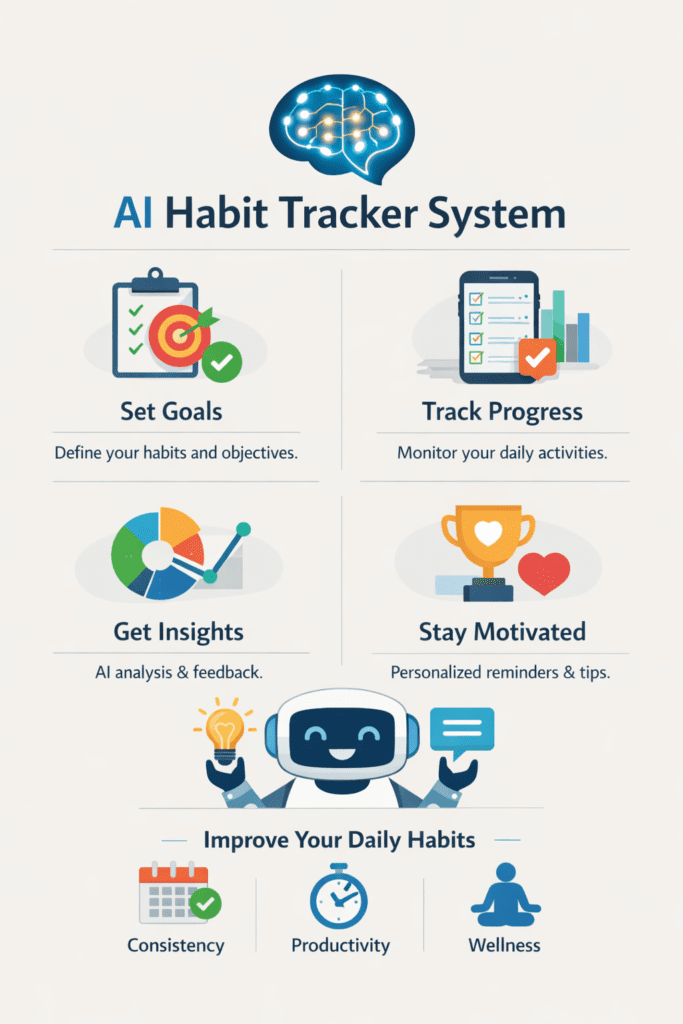
Step 1: You Set Your Goals
You tell the AI what you want to achieve. Lose weight. Read more. Meditate daily. Sleep better. Exercise consistently.
The more specific you are, the better the system works.
Step 2: The AI Builds Your Habit Plan
Based on your goals, schedule, and preferences, the AI creates a realistic daily plan. It breaks big goals into small, manageable daily habits.
Step 3: You Track Every Day
Each day, you log whether you completed each habit. This takes less than two minutes. Most apps let you do it with a single tap.
Step 4: The AI Analyzes Your Patterns
Over time, the AI studies your data. It notices which habits you skip most often. Which times of day you perform best. Which habits you have mastered and which still need work.
Step 5: You Get Smart Feedback
Every week, the AI gives you a report. It highlights your wins. It points out weak spots. And it suggests small changes to help you improve.
Step 6: The System Evolves With You
As you grow, your plan grows with you. The AI increases difficulty gradually, adds new habits at the right time, and keeps your routine fresh and challenging.
This is what makes an AI habit automation system so powerful. It grows with you. Forever.
Best AI Habit Tracker Apps to Try in 2025
There are several strong tools in the market right now. Here are the top options worth knowing about.
[1] Habitica
One of the most fun habit trackers out there. It gamifies your habits, turning them into a role-playing game. You earn rewards for completing tasks. It uses light AI features for reminders and scheduling.
Best for: People who love games and need extra motivation.
[2] Streaks
A clean, minimalist app that uses behavioral data to help you build 12 habits at a time. It integrates with Apple Health and uses smart scheduling.
Best for: iPhone users who like simplicity.
[3] Fabulous
Built on behavioral science from Duke University. Fabulous uses AI to help you build morning and evening routines. It is one of the most science-backed habit apps available.
Best for: People who want research-driven habit plans.
[4] Motion
Not just a habit tracker but a full AI productivity and scheduling tool. Motion uses AI to plan your entire day, including habits, tasks, and meetings.
Best for: Busy professionals who need everything in one place.
[5] Reflect
A newer AI journaling and habit reflection tool that uses natural language processing to help you understand your habits and emotions. It feels like talking to a coach.
Best for: People who like journaling alongside habit tracking.
Each of these tools uses AI in different ways. Try a few and see which one clicks with your lifestyle.
How to Build a Powerful Daily Routine With an AI Habit Tracker System
Ready to actually start? Here is a practical, step-by-step guide to building your first AI-powered daily routine.
Step 1: Identify Your Three Core Habits
Do not start with twenty habits. Start with three.
Pick the three habits that would make the biggest difference in your life right now. Maybe it is waking up at 6am, exercising for 20 minutes, and reading before bed.
Simple. Clear. Actionable.
Step 2: Choose Your AI Habit Tracker App
Pick one app from the list above. Set it up in five minutes. Enter your three habits.
Do not overthink this. The best app is the one you actually use.
Step 3: Set Smart Reminders
Use the app’s reminder feature to set alerts at the right times. If you want to exercise in the morning, set a reminder at 6:30am.
Let the AI learn from how you respond to reminders. Over time, it will optimize the timing automatically.
Step 4: Track Every Day — No Exceptions
This is the most important step.
Track every single day. Even on bad days. Even when you fail. The data you collect on your worst days is just as valuable as your best days.
Consistency in tracking, even when you are not consistent in doing, builds awareness. And awareness is the foundation of change.
Step 5: Review Your Weekly AI Report
Every Sunday, spend five minutes reviewing your AI-generated report.
Look at your completion rates. Notice patterns. Celebrate wins, no matter how small. And identify one thing you want to improve next week.
Step 6: Add One New Habit Every Month
Once your first three habits are solid — around 80% or higher completion — add one new habit.
Not five. Just one.
This slow and steady approach is backed by science. The brain needs time to automate behaviors before you can layer new ones on top.
The Science Behind AI and Habit Formation
This is where it gets really interesting.
Habits are formed through a loop. Cue → Routine → Reward. This was first described by MIT researchers and later made famous by Charles Duhigg in his book The Power of Habit.
AI habit tracker systems are designed around this exact loop.
The cue is the smart reminder. The routine is the habit itself. The reward is the streak, badge, or positive feedback from the app.
AI takes this loop and makes it more powerful by adding data. It learns your personal cues. It reinforces your most effective routines. And it delivers rewards at the exact moment they are most motivating.
This is behavioral science meets machine learning. And the result is a system that works with your brain — not against it.
The Role of Dopamine in AI Habit Tracking
Every time you check off a habit, your brain releases a small hit of dopamine — the feel-good chemical.
AI habit systems are designed to maximize these dopamine hits. Streaks, progress bars, completion sounds, and weekly milestones all trigger dopamine responses.
Over time, your brain begins to crave completing your habits. Not because you are disciplined. But because the system has rewired your reward pathways.
This is not manipulation. This is science working in your favor.
Common Mistakes People Make With AI Habit Trackers (And How to Avoid Them)
Even the best tool can fail if you use it wrong. Here are the most common mistakes to avoid.
Mistake 1: Tracking Too Many Habits at Once
More is not better. Tracking ten habits on day one is a recipe for burnout and quitting.
Start with three. Build momentum. Then grow.
Mistake 2: Ignoring the AI Insights
The AI gives you weekly feedback for a reason. Read it. Act on it. The insights are only useful if you pay attention to them.
Mistake 3: Giving Up After Missing a Day
Missing one day does not break a habit. Missing two days in a row starts a new habit — the habit of quitting.
The research of BJ Fogg, one of the world’s top habit scientists, shows that bouncing back quickly after missing a day is the single most important skill in habit building.
An AI tracker reminds you to get back on track. Let it do its job.
Mistake 4: Setting Unrealistic Habits
If you have never exercised in your life, setting a 60-minute daily workout is not a habit. It is a punishment.
Start small. Embarrassingly small. Five minutes of walking. One page of reading. Ten seconds of meditation.
Let the AI help you scale up gradually.
Mistake 5: Switching Apps Every Week
App-hopping is one of the biggest enemies of habit building. Every time you switch, you lose your data and your streak.
Pick one app. Give it at least 30 days before deciding if it works for you.
AI Habit Tracking for Specific Goals
One of the most exciting things about AI habit tracker systems is how they can be customized for specific life areas.
For Health and Fitness
Track water intake, workouts, sleep, meals, and step counts. AI can sync with your fitness wearable and give you a complete picture of your physical health habits.
Long-tail keywords to explore: best AI habit tracker for fitness goals, AI app to track daily exercise habits, habit tracker that syncs with Apple Watch
For Mental Health and Mindfulness
Track meditation, journaling, gratitude practice, screen time, and mood. AI can detect emotional patterns and suggest when to prioritize self-care.
Long-tail keywords to explore: AI habit app for anxiety and stress, habit tracker for mental wellness, best app to build meditation habit
For Learning and Productivity
Track reading, study sessions, deep work blocks, and skill practice. AI can identify your most productive hours and protect them.
Long-tail keywords to explore: AI daily habit tracker for students, habit tracker app for learning new skills, best AI app for building study habits
For Business and Entrepreneurship
Track content creation, client outreach, lead generation, and skill development. AI helps you stay consistent with the habits that actually grow your business.
Long-tail keywords to explore: best habit tracker for entrepreneurs, AI productivity system for small business owners, automated daily routine tracker for freelancers
How to Choose the Best AI Habit Tracker System for Your Life
With so many options, choosing the right tool can feel overwhelming.
Here is a simple checklist to help you decide.
Ask yourself these questions:
- Does it have smart, customizable reminders?
- Does it give me weekly progress insights?
- Does it work on all my devices (phone, tablet, laptop)?
- Does it integrate with my calendar, health apps, or wearables?
- Does it feel simple and enjoyable to use?
- Does it offer AI-generated suggestions and coaching?
- If a tool checks most of these boxes, it is worth trying.
Also consider your budget. Many excellent AI habit trackers have free versions. Premium plans usually unlock deeper AI insights, more habits, and advanced reporting. Most range from $5 to $15 per month — less than a cup of coffee per week.
The Future of AI Habit Tracking
We are still in the early days of what AI can do for personal growth.
In the next few years, expect AI habit systems to become even more powerful.
Wearables will feed real-time biometric data into your habit tracker, allowing AI to adjust your routine based on your heart rate, stress levels, and sleep quality — automatically.
Natural language AI (like the kind powering ChatGPT) will let you talk to your habit tracker like a coach. You will ask it questions and get personalized advice in real time.
Integration with smart home devices will allow your environment itself to trigger and reward habits — your lights dimming automatically at your target bedtime, your coffee maker starting when your morning workout ends.
The future of AI-powered personal development is deeply personalized, fully automated, and more effective than anything we have ever had before.
And the best part? You can start benefiting from early versions of this technology right now — today — for free.
Summary
Here is everything you need to remember from this guide:
An AI habit tracker system uses artificial intelligence to help you build better habits through smart reminders, personalized plans, and data-driven insights.
It is more powerful than traditional habit trackers because it learns from your behavior, adapts to your life, and gives you feedback that actually helps you improve.
The key to success is starting small, tracking consistently, reading your weekly AI reports, and adding new habits gradually.
Top tools include Habitica, Streaks, Fabulous, Motion, and Reflect.
The science behind AI habit tracking is based on the cue-routine-reward loop, dopamine reinforcement, and behavioral psychology — all proven to work.
Conclusion
Here is the truth.
You do not need more motivation. You do not need another inspirational video or a new journal.
You need a system.
An AI habit tracker system is that system. It does the heavy lifting for you. It remembers what you forget. It learns what you do not know about yourself. And it keeps you moving forward — even on the days when you do not feel like it.
The people who achieve lasting growth are not more disciplined than you. They just have better systems.
And now you know exactly how to build one.
Start today. Pick one app. Enter three habits. Track for 30 days. Then watch your life begin to change.
Your future self is waiting. And with the right AI habit tracker system, that future is closer than you think.