Let me ask you something honest.
When did you last feel like the world was moving faster than you could keep up?
Not slightly faster. Way faster.
That feeling you have right now — that something big is changing and you’re not quite sure what to do about it — that feeling is correct.
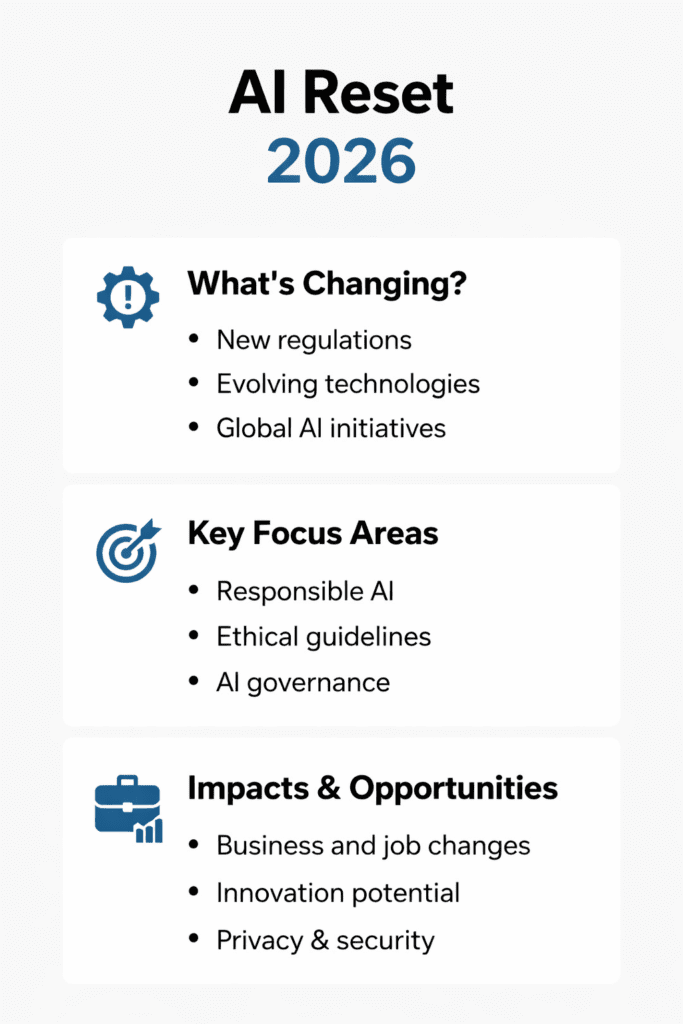
We are right in the middle of what experts are calling the AI Reset.
And 2026 is not just another year in tech. It is the year the line gets drawn.
On one side: people who adapted.
On the other side: people who watched.
This blog will help you get on the right side of that line — no tech degree needed, no jargon, no confusion.
Let’s go.
Table of Contents
What Is the AI Reset? (And Why It Matters More Than You Think)
The AI Reset is not about robots taking over the world.
It’s simpler than that — and honestly, scarier in a real-world way.
The AI Reset is the moment when artificial intelligence stops being a “future thing” and becomes a “right now thing” that affects your job, your income, your business, and your daily life.
Think about what happened when smartphones came out.
People who learned to use them early built apps, started businesses, and grew audiences. People who ignored them fell behind in ways they’re still catching up from.
The AI Reset of 2026 is that moment — but ten times bigger.
AI is now writing emails, designing logos, building websites, writing code, analyzing data, creating videos, answering customer questions, and doing tasks that used to take teams of people.
It’s not coming. It’s already here.
And 2026 is the year companies are making permanent decisions about who they hire, what tools they use, and how they work — with or without you.
Why 2026 Is Different From Every Other Year in AI History
You might be thinking — “AI has been around for years. Why is 2026 so special?”
Great question.
Here’s the truth: AI has been quietly improving in the background since 2020. But something shifted in late 2023 and 2024 that changed everything.
Generative AI became usable by normal people.
Tools like ChatGPT, Gemini, Claude, Midjourney, and hundreds of others became so simple that anyone — your parent, your neighbor, your 14-year-old cousin — could use them without any training.
That’s a big deal.
Because it means the barrier to entry dropped to nearly zero.
Now, in 2026, businesses are no longer asking “should we use AI?” They’re asking “why aren’t you using AI yet?”
Here are some facts that should wake you up:
More than 70% of companies worldwide are now actively integrating AI into their workflows. Job listings that require AI skills have grown by over 300% in the last two years. Freelancers and content creators who use AI tools are earning 2-3x more than those who don’t. Small businesses using AI automation are cutting costs by up to 40%.
This is not a slow trend. This is a shift.
And the AI Reset means the shift is now permanent.
The 3 Types of People in the AI Reset
Here’s something interesting.
In every major technological shift in history, people tend to fall into one of three groups.
Group 1: The Resisters
These are the people who say “AI will never replace human creativity” or “I don’t need AI, I’m good at my job.”
They might be right about some things. But they are dangerously wrong about the big picture.
AI won’t replace humans. But humans who use AI will replace humans who don’t.
That’s the real threat.
Group 2: The Followers
These people are aware of AI. They’ve maybe tried ChatGPT once or twice. They know it’s important but haven’t done anything serious yet.
They’re not behind yet — but they’re about to be.
Group 3: The Adapters
These are the people who took action. They learned the tools. They changed how they work. They’re already seeing the results — more income, less time wasted, better output.
The AI Reset of 2026 is the last window to move from Group 2 to Group 3 without serious consequences.
After this year, the gap between the adapters and the followers will become very hard to close.
How the AI Reset Is Changing Every Industry
This is not a tech-only problem.
The AI Reset is hitting every single industry.
Let me walk you through what’s actually happening right now.
[1] Marketing and Content Creation
AI tools can now write blog posts, social media captions, email campaigns, ad copy, and video scripts in seconds. Companies are using AI to test hundreds of ad variations at once. Content that used to take a team of writers a week now takes one person an hour. If you’re in marketing and not using AI, your output looks slow and expensive.
[2] Education and Learning
AI tutors are now personalizing lessons for individual students. Teachers who use AI tools can create lesson plans, grade papers, and identify struggling students faster than ever. E-learning platforms using AI are growing at record speed. Even corporate training is being reshaped by AI-powered learning tools.
[3] Healthcare and Medicine
AI is diagnosing diseases from scans with accuracy that rivals trained doctors. Drug discovery that used to take decades is being compressed into years. Administrative AI is reducing paperwork for doctors by hours every day. This doesn’t make doctors less important — it makes the ones who use AI far more effective.
[4] Finance and Accounting
AI-powered tools are doing bookkeeping, tax prep, fraud detection, and investment analysis. Small business owners who use AI accounting tools are saving 10+ hours per month. Finance professionals who can’t work alongside AI tools are being replaced by those who can.
[5] Customer Service
AI chatbots now handle 60-70% of customer queries without any human involvement. Companies using AI for support are reducing costs while improving customer satisfaction. This is not the future — this is what’s happening right now in 2026.
[6] Legal and Writing
AI tools are drafting contracts, summarizing legal documents, and doing research that used to take paralegals hours. Writers using AI are producing more content, faster, with fewer errors. The lawyers, writers, and paralegals thriving today are the ones who use AI as a partner.
No matter what you do for work — the AI Reset is touching your industry.
The only question is: are you going to lead the change or be changed by it?
The Real Reason Most People Are Falling Behind in the AI Reset
Let’s be honest about something.
Most people know AI is important. They’ve heard it on podcasts, seen it on LinkedIn, maybe even tried a tool or two.
But they’re still not making progress. Why?
[1] Fear of looking stupid.
Most people are afraid to admit they don’t understand AI. So instead of learning, they just nod and say “yeah, I know about that” — and then do nothing.
[2] Overwhelm.
There are hundreds of AI tools. New ones launch every week. It’s impossible to try everything. So many people try nothing.
[3] Wrong mindset.
People think they need to understand HOW AI works before they can use it. You don’t need to understand how a car engine works to drive a car. You just need to know how to use it well.
[4] No clear starting point.
Everyone talks about AI in the big picture. But nobody tells you step by step what to actually do first.
That’s what we’re going to fix right now.
Step-by-Step: How to Start Your Own AI Reset in 2026
You don’t need to learn everything at once.
You just need to start somewhere real.
Here’s a simple, beginner-friendly plan to start your AI Reset today.
Step 1: Pick One AI Tool and Learn It Well
Don’t try to learn 20 tools. Pick one. The best starting point for most people is ChatGPT (free version works fine to start) or Google Gemini.
Use it every single day for two weeks. Ask it questions. Ask it to help with tasks. Write emails with it. Summarize articles. Get ideas from it.
Just use it. You’ll learn more in 14 days of daily use than in months of reading about it.
Step 2: Identify the 3 Most Time-Consuming Tasks in Your Work
Write down the three things at work or in your business that take the most time.
Is it writing emails? Creating social media posts? Research? Data entry? Customer responses?
Once you know what eats your time, you can find an AI tool that helps with exactly that.
Step 3: Replace One Task With AI
Don’t try to change everything. Just replace ONE task with AI.
If you write 5 emails a day, let AI draft them and you edit. If you write blog posts, let AI create an outline and you fill in your voice. If you do research, let AI summarize the key points and you verify.
One task. One win. Build from there.
Step 4: Learn Prompt Engineering Basics
Prompt engineering sounds technical but it’s really just learning how to ask AI questions the right way.
The better your question, the better the AI’s answer.
Example of a bad prompt: “Write me a blog post.”
Example of a good prompt: “Write a 500-word blog post for small business owners in India about how to use AI to save time on customer service. Use simple language and a friendly tone.”
See the difference? The second prompt gives AI context, audience, topic, length, and tone. The output will be 10 times better.
Learn to write good prompts and you will be ahead of 80% of people using AI right now.
Step 5: Track Your Results
After 30 days of using AI in your work, sit down and look at what changed.
How much time did you save? What quality improvements did you notice? What are you now able to do that you couldn’t before?
Tracking results helps you see real progress — and it motivates you to keep going.
Step 6: Share What You’re Learning
Tell people. Write about it. Post about it. Talk about it.
This is important for two reasons.
First, teaching something makes you understand it better. Second, sharing your AI Reset journey builds your credibility and audience at exactly the time when AI expertise is most valuable.
People are hungry for people who can explain AI in simple terms. Be that person.
The Best AI Tools for Beginners in 2026
You don’t need to spend money to start your AI Reset.
Here are some of the best tools available right now, many of which are free or have free tiers.
[1] ChatGPT by OpenAI — Best for writing, brainstorming, answering questions, and drafting content. The free version is powerful enough for most daily tasks. Great for beginners who want an all-in-one AI assistant.
[2] Google Gemini — Excellent for research, summarizing information, and working within Google’s tools like Docs and Gmail. If you already use Google Workspace, this is a natural starting point.
[3] Claude by Anthropic — Strong at long-form writing, understanding nuance, and giving thoughtful responses. Great for people who need AI that sounds more human.
[4] Canva AI — For anyone who creates visual content. Canva’s AI features let you generate images, edit photos, create social media graphics, and design presentations without any design skill.
[5] Grammarly AI — For writers, marketers, and anyone who sends emails. Goes beyond grammar to help with tone, clarity, and style.
[6] Notion AI — For productivity and note-taking. Helps you organize your thoughts, write project briefs, and summarize meeting notes automatically.
[7] Perplexity AI — A powerful AI search tool that gives you sourced, accurate answers to research questions. Much better than a regular Google search for specific topics.
[8] Descript — For video and audio creators. Can transcribe, edit, and repurpose video content using AI — a game changer for content creators.
You don’t need all of these. Pick one or two that match your work and start there.
AI Reset for Small Business Owners: What You Need to Know
If you run a small business, the AI Reset hits differently.
You’re competing with large companies that have bigger budgets, bigger teams, and more resources. But here’s the good news: AI is a great equalizer.
With the right AI tools, a one-person business can now do the work of a 10-person team.
Here’s where the biggest opportunities are for small businesses right now.
[1] Customer Communication — Use AI chatbots and email tools to respond to customers 24/7 without hiring more staff. Tools like Tidio, Intercom, and even WhatsApp’s AI integrations can handle basic queries automatically.
[2] Content and Marketing — Use AI to write social media posts, blog content, product descriptions, and email newsletters. One person with good AI tools can maintain a full content calendar.
[3] Accounting and Finance — AI-powered accounting software like FreshBooks with AI features or QuickBooks AI can save hours of manual bookkeeping every month.
[4] Hiring and HR — AI tools can help you write job descriptions, screen applications, and even draft offer letters faster than ever.
[5] Customer Research — Use AI to analyze customer reviews, social media comments, and survey responses to understand what your customers actually want.
The small business owners who are using these tools right now are building serious advantages that will be very hard for slower competitors to close.
AI Skills That Will Get You Hired in 2026
Let’s talk careers.
The job market in 2026 is being completely restructured by AI.
Some roles are shrinking. But new roles are also exploding.
And here’s the key insight that most people miss: almost every job is now being redefined to include AI.
It’s not about becoming an “AI expert.” It’s about being good at your existing job AND knowing how to use AI tools to do it better.
That said, here are the most in-demand AI skills right now.
[1] Prompt Engineering — Knowing how to get great outputs from AI tools. Companies are paying serious money for people who can write prompts that consistently produce high-quality results.
[2] AI Content Creation — Using AI to create written, visual, and video content at scale. Marketers, writers, and designers who use AI are producing more and earning more.
[3] AI Data Analysis — Using AI tools to interpret data and generate insights. Even non-technical people can now analyze complex datasets using tools like ChatGPT’s data analysis features.
[4] AI Automation — Using tools like Zapier, Make (formerly Integromat), and n8n to build AI-powered workflows that automate repetitive tasks. No coding required.
[5] AI-Assisted Coding — For developers, tools like GitHub Copilot and Cursor AI make coding faster. For non-developers, AI coding tools are making it possible to build simple apps and automations without knowing how to code.
[6] AI Ethics and Responsibility — As AI becomes more powerful, companies need people who understand its limits, risks, and ethical implications. This is a growing field with very little competition right now.
[7] AI Customer Experience — Designing and managing AI-powered customer journeys. Understanding how AI chatbots work and how to make them more human-friendly.
Even picking one or two of these areas and developing real skill in them will make you significantly more valuable in today’s job market.
The AI Reset and Your Personal Brand
Here is something most people are completely missing.
The AI Reset is not just about work efficiency. It’s also the biggest personal branding opportunity in a generation.
Right now, in 2026, most people are confused about AI.
They hear about it everywhere but feel overwhelmed, left behind, and unsure where to start.
If you are someone who understands AI tools, talks about them clearly, and helps others navigate the confusion — you will build a massive audience.
Think about what happened during the early days of social media. The people who showed others how to use Facebook, Instagram, and YouTube built enormous followings and businesses.
The same thing is happening right now with AI.
People who create content about how to use AI tools — even beginner-level content — are growing their audiences fast.
You don’t need to be an AI engineer. You don’t need a computer science degree.
You just need to be one step ahead of your audience and share what you know.
Start a blog. Start a YouTube channel. Start posting on LinkedIn or Instagram. Talk about your AI Reset journey.
The audience is there. The demand is there. The timing is perfect.
Common Myths About the AI Reset (That Are Holding You Back)
Let’s bust some myths that might be stopping you from acting.
Myth 1: “AI will take my job completely.”
The truth: most jobs will change, not disappear. The jobs that disappear are the ones that can be fully automated — and those are mostly the boring, repetitive parts of jobs anyway. The human parts — creativity, empathy, judgment, relationships — are still irreplaceable.
Myth 2: “I’m not technical enough to use AI.”
The truth: today’s AI tools are designed for non-technical users. If you can type a sentence, you can use AI. The days of needing to code to use AI are over.
Myth 3: “AI-generated content is always obvious and low quality.”
The truth: in 2024 and 2025, AI tools improved dramatically. When used well — with a clear prompt, a human voice, and editing — AI-assisted content can be excellent. The key is using AI as a starting point, not a final draft.
Myth 4: “I can wait and learn this later.”
The truth: the longer you wait, the more ground you lose. The people learning AI skills right now are building a head start that compounds. Every month you wait is a month they are ahead.
Myth 5: “AI is just a trend that will fade.”
The truth: AI is not a trend. It’s a technological infrastructure shift, like the internet itself. You wouldn’t say the internet was a trend. AI is now built into everything — search engines, phones, software, cars, hospitals, schools. It’s not going anywhere.
How the AI Reset Is Changing Google Search (And What It Means for You)
This section is especially important if you run a website, blog, or online business.
Google’s search experience has completely changed in 2025 and 2026.
AI-generated search summaries (called AI Overviews in the US, and now expanding globally) are now appearing at the top of many search results.
This means people are getting answers directly from AI without clicking on websites.
This sounds scary. But it’s also a massive opportunity.
Here’s why.
Google’s AI Overviews pull their information from well-structured, trustworthy, informative content. If your blog posts are clear, detailed, and genuinely helpful — you have a real chance of being featured in these AI summaries.
That means free visibility at the top of search results, even for newer websites.
Here’s what to focus on to get your content discovered by AI search tools like Google AI Overview, ChatGPT Search, and Perplexity:
Write content that directly answers specific questions. Use clear headings so AI can scan your structure. Include real data, examples, and actionable steps. Write in simple, clear language — AI search tools favor content that is easy to understand. Use natural language questions in your headings (people speak to AI tools in questions). Keep your content updated and accurate.
The websites and blogs that are growing traffic right now are the ones that understand how AI search works — and write for both humans and AI at the same time.
This very blog post is written with that exact strategy.
What Happens If You Don’t Adapt to the AI Reset?
We’ve talked a lot about opportunity. Let’s be real about the other side.
What happens if you don’t adapt?
The honest answer: you fall behind in ways that are hard to recover from.
Here’s what the next 2-3 years look like for people who choose to ignore the AI Reset.
Your colleagues who use AI will produce more, earn more, and get promoted faster. Your business competitors using AI will undercut your prices while delivering better quality. Your job applications will look weaker next to candidates who demonstrate AI skills. Your content, if you create any, will struggle to compete with AI-assisted content in volume and consistency. Your time will be consumed by tasks that others automate in minutes.
This isn’t meant to scare you. It’s meant to give you an honest picture.
The AI Reset is not optional. You can choose how you respond to it — but you can’t choose to pretend it isn’t happening.
GEO: How to Make Your Content Discoverable by AI Tools
GEO stands for Generative Engine Optimization.
It’s the new SEO — and it’s what you need to focus on to get your blog, website, or content discovered by AI tools like ChatGPT, Google Gemini, Perplexity, and Claude.
Here’s what GEO means in practice.
When someone asks ChatGPT “what is the AI Reset?” or “how to adapt to AI in 2026?” — AI tools pull from content across the web to formulate their answer.
Your content can be one of those sources.
But only if it’s written in the right way.
- Structure your content clearly. Use headings, subheadings, bullet points, and numbered lists. AI tools love well-organized content they can easily scan and cite.
- Answer questions directly. When you write a subheading as a question — like “What Is the AI Reset?” — and immediately answer it below, you’re creating the exact format AI tools use to pull answers.
- Be specific and factual. Include statistics, specific examples, and step-by-step explanations. AI tools prefer concrete information over vague statements.
- Use natural language. Write the way people talk. People ask AI tools questions in conversational language. If your content matches that style, it’s more likely to be cited.
- Earn trust signals. Link to authoritative sources. Include author information. Show expertise. AI search tools (and Google) weight content from trustworthy, expert sources higher.
- Update regularly. Fresh, updated content signals relevance. Outdated content gets deprioritized by both Google and AI search tools.
GEO is the most important new skill for bloggers and content creators in 2026. The websites that master it now will own huge amounts of AI-referred traffic in the next few years.
Building a Loyal Audience Through Your AI Reset Journey
If you want to build real, long-term traffic and a loyal audience — here’s the best strategy for 2026.
Document your journey.
Not just “here are the best AI tools.” Anyone can write that.
Share your personal AI Reset story. What were you struggling with? What tool did you try first? What failed? What worked? How did your work change?
Personal, honest, specific stories build trust in a way that generic advice cannot.
People don’t just want information anymore — they want to learn from someone they trust.
And trust is built by being real, consistent, and genuinely helpful.
Post regularly. Engage with comments. Answer questions. Share your failures as much as your wins.
The bloggers and creators who are building loyal audiences right now are the ones being themselves while teaching others what they know.
That’s your formula.
Quick Action Checklist: Your AI Reset Starts Today
Here’s a simple checklist to take with you.
Print it. Screenshot it. Do the things on it.
Action 1: Sign up for ChatGPT or Google Gemini today (free).
Action 2: Use it for at least one real task this week — an email, a document, a research question.
Action 3: Identify the most time-consuming repetitive task in your work and find an AI tool that can help.
Action 4: Spend 30 minutes learning about prompt engineering on YouTube.
Action 5: Follow three creators online who talk about practical AI tools for your industry.
Action 6: Share one thing you learned about AI this week — on social media, in a conversation, anywhere.
Action 7: Come back and re-read this blog in 30 days and see how much has changed.
Summary
The AI Reset is the biggest technological shift since the smartphone.
2026 is the year it becomes permanent — and the decisions you make this year will shape your career, business, and income for the next decade.
Here’s what we covered:
The AI Reset is the moment AI moves from “future technology” to “right now reality” affecting every job and industry. 2026 is unique because AI tools are now accessible to everyone, not just engineers. Every industry — from marketing to healthcare to education — is being reshaped. You don’t need to be a tech expert to benefit. You just need to start. A simple step-by-step approach — starting with one tool, one task, one month — is all you need. GEO (Generative Engine Optimization) is the new SEO, and it’s how you get your content found by AI tools. The personal branding opportunity around AI is enormous and wide open. Falling behind is a real risk — but it’s 100% avoidable with action today.
Conclusion
You made it to the end of this blog. And that tells me something about you.
You’re someone who wants to understand what’s really happening — not just hear about it in passing.
You’re someone who takes information seriously.
That’s exactly the kind of person who succeeds in an AI Reset.
The world is not slowing down. AI is not going away. 2026 is not going to wait for anyone to feel ready.
But here’s the thing — you don’t have to be ready. You just have to start.
Start messy. Start small. Start today.
Every person who is now thriving with AI started exactly where you are — confused, a little overwhelmed, unsure where to begin.
The only difference between them and people who are still stuck is one thing: they took action instead of waiting.
Your AI Reset starts right now.
Are you ready to adapt — or will you fall behind?
The choice is yours. And 2026 is the year it matters most.