Let me be honest with you.
Getting an internship used to take months. Cold emails. Rejected applications. Silence. More silence.
But right now, in 2025, something has changed. Students who know how to use AI are landing internships 3x faster than those who don’t.
And no, it’s not cheating. It’s being smart.
This guide will show you exactly how to use AI to find, apply for, and land internships — even if you have zero experience and your college name isn’t Harvard.
Ready? Let’s go.
Table of Contents
Why Getting Internships Is So Hard for Students Today
Before we talk about AI, let’s talk about the real problem.
The competition for internships is brutal. Thousands of students apply for the same 10 spots. Companies get flooded with resumes. Most applications never even get read by a human. They get filtered out by an ATS (Applicant Tracking System) before anyone even sees your name.
That’s the wall most students hit.
You spend hours writing a cover letter. You send it. Nothing happens. You wonder what you did wrong.
Here’s what you did wrong: you played an old game with old rules.
The students winning internships today use AI tools to write better resumes, craft perfect cover letters, prep for interviews, and find hidden opportunities that most people never see.
This is your guide to doing exactly that.
What Is AI and Why Does It Matter for Your Internship Search
AI stands for Artificial Intelligence. Tools like ChatGPT, Claude, Gemini, and others are AI assistants that can help you write, research, plan, and prepare faster than you ever could alone.
Think of AI as a very smart assistant who never gets tired, never judges you, and is available 24/7.
When you use AI for your internship search, you save hours of work. You produce better applications. You feel more confident walking into interviews.
The best part? Most students aren’t doing this yet. So if you start today, you already have an edge.
Step 1 — Use AI to Build a Winning Internship Resume
Your resume is the first thing a company sees. It either opens doors or closes them in seconds.
Here’s how to use AI to make your resume impossible to ignore.
Tell AI exactly what you need. Go to ChatGPT or Claude and type something like:
“I am a second-year computer science student with no internship experience. I have built 3 personal projects and done some freelance web development. Help me write a strong resume for a software engineering internship.”
The AI will give you a full resume draft. It will suggest the right words. It will structure everything properly.
Then ask it to improve the resume for ATS. Type:
“Make this resume ATS-friendly with keywords for a software engineering internship at a tech startup.”
This matters more than most students realize. ATS systems filter resumes based on keywords. If your resume doesn’t have the right words, you never make it to a human reviewer.
AI knows what keywords to use. Let it help you.
Pro tip: Copy the actual job description and paste it into the AI. Then ask it to tailor your resume for that specific role. This alone can double your chances of getting a callback.
Long-tail keyword to know: “how to make a resume for internship with no experience”
This is one of the most searched phrases by college students. If you have no experience, don’t panic. AI can help you highlight your projects, coursework, and skills in a way that still impresses recruiters.
Step 2 — Write Cover Letters That Actually Get Read
Most students hate writing cover letters. They end up copying templates that sound robotic. Recruiters can spot them immediately.
AI can help you write a cover letter that sounds like you — but better.
Here’s how.
Give AI this prompt:
“Write a cover letter for a marketing internship at [Company Name]. I am a junior studying marketing. I love social media strategy and have grown a personal Instagram account to 5,000 followers. Make it personal, confident, and under 300 words.”
The AI will give you something that sounds human and specific.
Then ask it to add one sentence that shows you know the company. You can paste in a recent company news article and ask AI to reference it naturally.
That small detail makes a huge difference. It shows the recruiter you actually care about their company, not just any internship.
Common mistake students make: Using the same cover letter for every company. Recruiters know. AI makes it easy to customize each one in under 5 minutes.
Step 3 — Find Internship Opportunities You Never Knew Existed
Most students look for internships on LinkedIn and Indeed. That’s fine. But there’s a whole world of internship opportunities that never get posted on those platforms.
AI can help you find them.
Ask AI to help you research companies. Type something like:
“Give me a list of 20 small tech startups in Bangalore that hire marketing interns. Include their website and what they do.”
AI won’t always have real-time data, but it can help you brainstorm company categories, industries, and job titles you might never have thought of.
Use AI to write cold outreach emails. This is where most students fall short. They’re afraid to email companies directly. But a well-written cold email can open doors that job boards never will.
Ask AI:
“Write a short, professional cold email to the HR manager of a startup asking if they have any internship openings for a finance student. Keep it under 150 words and make it genuine.”
Send 20 of these a week. Customize each one. You will get responses.
Look for internships in unexpected places. Ask AI:
“What are some lesser-known websites to find internships for college students in India?”
You’ll discover platforms you didn’t know existed — niche job boards, startup communities, and industry-specific networks.
Long-tail keyword to know: “how to find internships for college students with no experience”
This is one of the top searches among first and second year students. The answer is: reach out directly, use niche platforms, and let AI help you write your outreach.
Step 4 — Use AI to Prepare for Internship Interviews
You got the call. Now what?
Interview prep is where AI really shines.
Practice answers to common internship interview questions. Ask AI:
“Give me 15 common internship interview questions for a data science role and help me prepare strong answers using the STAR method.”
The STAR method means: Situation, Task, Action, Result. It’s the best way to answer behavioral questions and AI can help you structure every single answer.
Do mock interviews with AI. You can literally practice in conversation with AI. Tell it:
“You are a recruiter interviewing me for a marketing internship. Ask me interview questions one at a time and give me feedback on my answers.”
This works. It’s like having a personal interview coach available at midnight before your big interview.
Research the company using AI. Before any interview, ask:
“Tell me about [Company Name], their recent work, their values, and what questions I should ask them at the end of the interview.”
Walking in knowing the company’s mission, recent news, and culture makes you stand out immediately. Most candidates don’t bother to do this deep research. You will.
Step 5 — Use AI to Write Follow-Up Emails That Leave a Lasting Impression
After every interview, send a thank-you email within 24 hours.
Most students skip this step. That’s a mistake.
A good follow-up email reminds the recruiter of who you are and shows professionalism. Ask AI:
“Write a thank-you email after a data analyst internship interview. Mention that I enjoyed the conversation about their data pipeline challenges and that I’m excited about the opportunity.”
Keep it short. Keep it warm. Send it.
This one habit has helped students tip the scales in their favor when the decision was close.
Step 6 — Build Your LinkedIn Profile With AI Help
Your LinkedIn profile is your digital resume. Recruiters check it before and after your interview.
AI can help you write every section — your headline, your about section, your experience descriptions.
Ask AI:
“Write a strong LinkedIn headline for a third-year mechanical engineering student looking for internships in product design.”
Then ask it to write your About section:
“Write a LinkedIn About section for a student who is passionate about sustainability, has done two college projects on renewable energy, and is looking for internships in the clean energy sector.”
A strong LinkedIn profile also helps recruiters find you. When your profile has the right keywords, you show up in search results when companies are actively looking for interns.
Step 7 — Use AI to Negotiate Your Internship Offer
This one surprises most students. You can negotiate internship offers.
Not always on salary, but on things like start date, remote work options, project assignments, or stipend.
Ask AI:
“I got an internship offer from a tech company offering 15,000 rupees per month. How do I professionally ask for a higher stipend or additional benefits without seeming ungrateful?”
AI will give you a script. A real, word-for-word script you can use in an email or a call.
Most students are afraid to negotiate because they don’t know how to start the conversation. AI removes that fear.
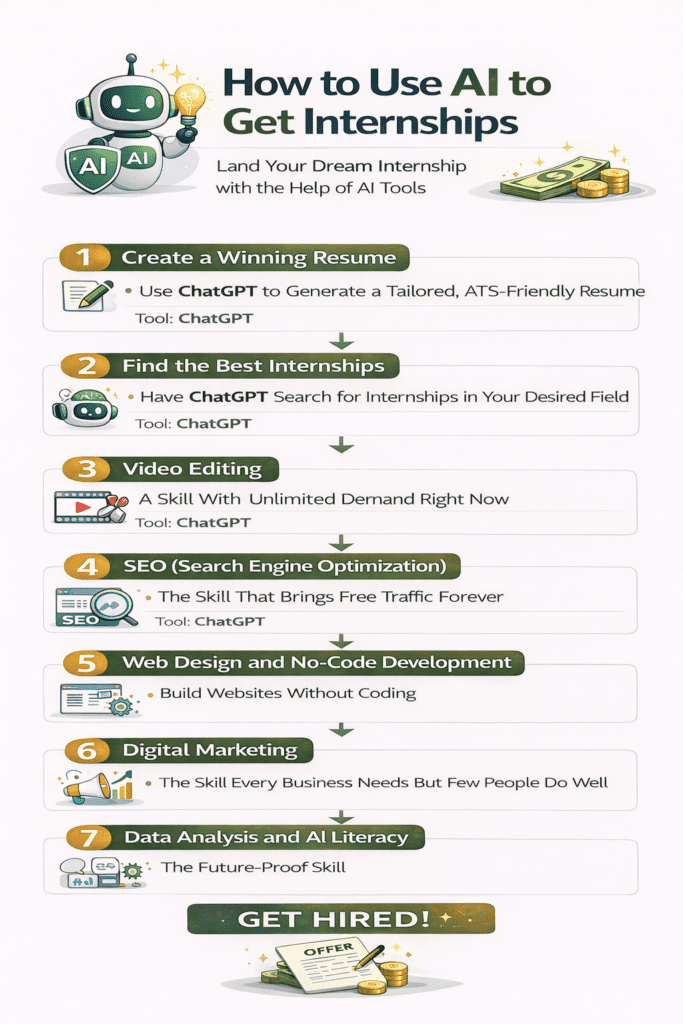
Best AI Tools Students Can Use for Their Internship Search
You don’t need to use all of these. Pick two or three and get good at them.
- ChatGPT — Great for writing resumes, cover letters, emails, and interview prep. The free version works well. GPT-4 is even better.
- Claude by Anthropic — Excellent for writing in a natural, human tone. Very good for cover letters and long-form content.
- Gemini by Google — Useful for research and finding company information. Integrates well with Google tools.
- Teal — A free tool specifically for job and internship applications. Helps you track applications and optimize your resume for ATS.
- Kickresume — Uses AI to help you build beautiful, ATS-friendly resumes quickly.
- LinkedIn’s AI features — LinkedIn now has AI tools built in that help you rewrite your profile and prepare for interviews.
- Notion AI — Great for organizing your internship search, tracking deadlines, and staying on top of follow-ups.
Common Mistakes Students Make When Using AI for Internships
Using AI is powerful, but only if you use it right.
Here are the biggest mistakes to avoid.
Mistake 1: Copying AI output without editing it. AI gives you a draft. It’s not a finished product. Always read it, make it sound like you, and remove anything that feels off. Recruiters can sometimes tell when something sounds too polished or too generic.
Mistake 2: Using the same AI-generated resume for every job. Customize it every time. It takes 5 minutes and it makes a big difference.
Mistake 3: Not fact-checking what AI tells you. AI can make mistakes. If it tells you something about a company or a statistic, verify it before you use it in an email or interview.
Mistake 4: Over-relying on AI for your story. Your experiences are yours. AI can help you tell them better, but it can’t create experiences for you. Make sure you’re also doing things worth talking about — projects, clubs, volunteering, freelance work.
Mistake 5: Not following up. AI can write the perfect follow-up email but only if you actually send it. Don’t let fear stop you.
Real Student Success Story: From Zero to Internship in 6 Weeks
Here’s how a typical student can transform their internship search using AI.
Imagine a second-year business student with no internship experience and average grades. They spend 6 weeks following this exact approach:
Week 1: Use AI to build a new resume and LinkedIn profile. Week 2: Use AI to write 30 customized cover letters for different companies. Week 3: Start cold emailing small companies directly using AI-written emails. Week 4: Land two interview calls and use AI to prep thoroughly. Week 5: Attend the interviews with confidence and send AI-assisted follow-up emails. Week 6: Receive and accept an internship offer.
This is not a fantasy. This is what happens when you use the right tools with real effort.
How AI Helps You Compete With Students From Better Colleges
Here’s something nobody talks about openly.
Students from top colleges have an advantage in name recognition. But that advantage shrinks fast when your application is sharper, your cover letter is more personalized, and you show up to interviews more prepared than they do.
AI levels the playing field.
When a recruiter at a company reads your application, they don’t see your college logo first. They read your words. If your words are clear, confident, and specific to their company, you get the call.
That’s how students from lesser-known colleges have been quietly winning internships at companies like Deloitte, Zomato, Razorpay, Flipkart, and hundreds of others.
Use AI. Work smart. Win.
Action Plan: Start Today, Not Tomorrow
Here’s a simple 7-day plan to kickstart your internship search with AI.
Day 1: Go to ChatGPT or Claude. Build your resume from scratch or improve your existing one. Make it ATS-friendly.
Day 2: Optimize your LinkedIn profile using AI. Update your headline, about section, and all experience descriptions.
Day 3: Make a list of 20 companies you want to intern at. Include big companies and small startups.
Day 4: Write a custom cover letter for each of your top 5 companies using AI. Apply to all 5 today.
Day 5: Write cold emails to 10 companies that might not have posted internship openings. Send them.
Day 6: Ask AI to help you prep for internship interviews. Practice your answers for 1 hour.
Day 7: Review everything. Follow up on any applications you haven’t heard back from. Apply to 5 more companies.
Repeat this process for 4 to 6 weeks and your results will surprise you.
Summary
Here’s everything we covered in a quick recap:
Getting internships is hard because competition is high and most applications never get read. AI tools like ChatGPT and Claude help students write better resumes, cover letters, and follow-up emails.
You can use AI to find hidden internship opportunities through company research and cold outreach. AI is a powerful interview prep tool — use it for mock interviews and company research.
The best AI tools for internships include ChatGPT, Claude, Teal, Kickresume, and LinkedIn AI. Avoid common mistakes like not editing AI output, using the same cover letter everywhere, or skipping follow-ups.
AI levels the playing field for students from all colleges and backgrounds. Start your 7-day action plan today and stick with it for 4 to 6 weeks.
Conclusion
Here’s the truth.
AI won’t get you the internship. You will.
But AI will help you show up sharper, faster, and more prepared than you ever could alone. It removes the paralysis of not knowing what to write. It removes the hours of staring at a blank page. It removes the fear of the follow-up email.
You still have to put in the work. You still have to show up to the interview. You still have to be curious, genuine, and hardworking.
But now you have tools that give you an unfair advantage.
The students who learn to use AI well in 2025 will have better internships, better jobs, and better careers than those who don’t.
Start today.
One resume. One email. One interview at a time.
Your internship is closer than you think.
Ready to start? Pick one AI tool today and spend 30 minutes rebuilding your resume. That’s all it takes to begin.
Frequently Asked Questions
Is it ethical to use AI for internship applications?
Yes. Using AI to help you write and prepare is no different from using spell check, hiring a career counselor, or practicing with a mentor. The ideas, experiences, and intentions are yours. AI just helps you express them better.
Will recruiters know I used AI?
Only if you don’t edit the output. If you copy AI responses word for word without making them sound like you, some recruiters may notice it feels generic. Always personalize what AI gives you.
What if I have absolutely no experience?
AI can help you highlight your coursework, academic projects, personal projects, volunteer work, and even relevant hobbies. No experience doesn’t mean nothing to say. It means you need to tell your story better.
Can AI help me with technical internship interviews?
Yes. For technical roles like software engineering or data science, AI can help you practice coding problems, explain concepts, and do mock technical interviews. Tools like ChatGPT are particularly strong here.
Which AI tool is best for internship applications?
ChatGPT and Claude are the top choices for writing. Teal is excellent for resume building and ATS optimization. LinkedIn’s built-in AI tools are great for profile optimization. Use a combination based on your needs.