
Can you really make $50 a day without ever showing your face on camera? Yes, you can. But not in a week, and not by accident.
If you have been searching for how to start faceless YouTube 2026, you have probably seen a hundred videos promising overnight riches. Most of them skip the boring part. The part where you actually build a channel step by step.
This guide is different. No hype, no fake screenshots, no “get rich by Friday” nonsense. Just a simple, honest, step-by-step plan that walks you from zero to your first real income on YouTube, without ever turning on a camera.
By the end of this post, you will know exactly what a faceless channel is, which niches actually pay, how YouTube’s 2026 monetization rules work, and the small daily habits that turn a brand-new channel into a $50-a-day channel.
Let’s get into it.
Table of Contents
What Is a Faceless YouTube Channel?
A faceless YouTube channel is exactly what it sounds like. You never appear on screen.
Instead, your videos use voiceovers, stock footage, screen recordings, animation, or AI-generated visuals to tell a story or teach something. The viewer never sees you, but they still get value from your content.
You have probably watched dozens of these channels without realizing it. Documentary-style finance channels, true crime narration channels, Reddit story channels, tech news roundups. None of them show a presenter, and many of them have millions of subscribers.
This model works so well because viewers care about the content, not the creator’s face. That is good news if you are camera-shy, introverted, or simply prefer working behind the scenes.
Why Faceless YouTube Still Works in 2026
A lot of people assume faceless channels are “played out.” They are wrong.
Here is the real picture right now:
Faceless channels are not a small trend anymore. A large share of YouTube’s top channels never show a presenter, including several with tens of millions of subscribers. AI tools have also made production faster than ever, so the barrier to entry has dropped while demand for good content keeps growing.
That said, YouTube tightened its rules in 2026 around what it now calls “inauthentic content.” Lazy AI-spam, recycled clips with no added value, and mass-produced videos with zero originality are getting demonetized or rejected during review. Faceless does not mean effortless anymore. It means original scripts, real research, and thoughtful editing, just without a face on screen.
That is actually good news for you. It filters out lazy competitors and rewards creators who put in real effort.
Step 1: Pick a Niche That Can Actually Pay You
This is the single biggest decision you will make, so do not rush it.
A good faceless niche needs three things: real audience demand, a format that works without a camera, and decent advertiser interest (also called RPM, or revenue per thousand views).
Here are some of the best faceless YouTube niches for 2026, based on current CPM and growth data:
High-paying niches (higher RPM, more competition)
- Personal finance and investing explainers
- AI news, tool reviews, and tutorials
- Business breakdowns and case studies
- Real estate and luxury home tours
Story-driven niches (lower RPM, huge watch time and loyalty)
- Horror and true crime narration
- Reddit stories and life-story animations
- Book summaries and self-improvement
- History and “how it started” documentaries
Low-competition niches worth testing
- Senior health and longevity tips
- Sleep soundscapes and ambient content
- Niche language-learning content
- Micro-topics inside finance, like tax tips for freelancers
If you are just starting out, do not pick “finance” or “true crime” as a whole category. That is too broad and too crowded. Narrow it down. Instead of “personal finance,” try “budgeting for single parents.” Instead of “true crime,” try “unsolved cases from small towns.” Specific beats generic every single time.
Quick tip: ask yourself if you can list 50 video ideas in this niche right now. If you can’t, pick a different one.
Step 2: Set Up Your Channel the Right Way
Once you have a niche, set up your channel properly before you upload anything.
- Pick a channel name that matches your niche, not your personal name.
- Write a clear channel description using your main keyword naturally, once or twice.
- Design a simple logo and banner. Canva works fine for this.
- Create a content calendar. Decide on your upload day and stick to it.
Consistency matters more than perfection here. A channel that posts one solid video every week will beat a channel that posts five rushed videos and then disappears for a month.
Step 3: Understand YouTube’s 2026 Monetization Requirements
Before you can earn ad revenue, your channel has to qualify for the YouTube Partner Program (YPP). The rules changed in 2026, and honestly, they got a bit more beginner-friendly.
Entry-level tier (early access to fan funding, memberships, and shopping):
- At least 500 subscribers
- 3 public videos uploaded in the last 90 days
- Either 3,000 watch hours in the past 12 months, or 3 million Shorts views in 90 days
Full monetization tier (ad revenue unlocked):
- At least 1,000 subscribers
- Either 4,000 valid public watch hours in the past 12 months, or 10 million Shorts views in 90 days
You will also need a linked AdSense account, two-step verification turned on, and zero active Community Guidelines strikes.
Here is the part most guides leave out. YouTube’s automated and human reviewers now check specifically for “inauthentic content,” meaning reused clips, AI-generated spam with no added value, or content copied from other creators. Faceless is completely fine. Lazy and unoriginal is not. Add your own commentary, structure, and editing style to everything you publish.
Step 4: Create Videos Without Showing Your Face
This is where the fun part begins. You have several options, and you do not need expensive gear.
- Scripting Write a simple script for every video. Use a hook in the first 5 seconds, deliver value in the middle, and end with a call to action. AI writing tools can help you draft faster, but always edit it in your own voice. Google and viewers can both tell when content sounds robotic.
- Voiceover You can record your own voice (it does not have to show your face) or use an AI voice generator. Natural-sounding AI voices have gotten very good in 2026, and many top faceless channels use them.
- Visuals Depending on your niche, use stock footage, screen recordings, simple animations, or AI-generated video clips. Keep the visuals matched closely to what your script is saying at every moment. That keeps people watching longer, which YouTube rewards heavily.
- Editing Free tools like CapCut or DaVinci Resolve are more than enough when you are starting out. Add captions. A huge number of viewers watch with the sound off, especially on mobile.
Step 5: Optimize Every Video for SEO
This is the step that gets skipped the most, and it is exactly why so many channels sit at zero views for months.
- Use your main keyword naturally in the video title.
- Write a full, keyword-rich description, at least 200 words, explaining what the video covers.
- Add relevant tags, including long-tail keywords like “faceless youtube channel ideas for beginners” or “how to start a faceless youtube channel with no money.”
- Design a bold, high-contrast thumbnail with 3 to 5 words max. Faceless channels rely on thumbnails even more since there is no recognizable face to grab attention.
- Add timestamps and closed captions. Both help with watch time and accessibility.
Small detail, big impact: search YouTube itself for your target keyword before you upload. Look at what is already ranking. If the top videos are outdated or low quality, that is your opening.
Step 6: Post Consistently and Track What Works
Pick a schedule you can actually keep, whether that is once a week or three times a week, and stick to it for at least 90 days before judging results.
Check YouTube Studio analytics after every upload. Look specifically at audience retention. If people are dropping off at the 30-second mark, your hook needs work. If they are dropping off halfway through, your pacing needs work.
Double down on whatever format keeps people watching the longest. That single habit, more than any hack or trick, is what actually grows channels in 2026.
Step 7: Turn Views Into Real Income
Ad revenue alone will not get you to $50 a day quickly, especially at the start. Here is the real math.
If your niche has a $10 RPM (revenue per 1,000 views), you would need around 5,000 daily views to hit $50 a day from ads alone. That is very achievable within 6 to 12 months of consistent uploads in a decent niche, but it will not happen in week one.
So stack multiple income streams from day one:
- Affiliate links in your description for tools or products related to your niche
- A simple digital product, like a short guide or template, once you have some trust built
- Brand sponsorships once your channel shows steady views, even at a small scale
- YouTube Shorts to fast-track subscriber growth while your long-form videos build watch hours
Many small faceless channels hit $50 a day faster through affiliate commissions and small digital products than through ads alone, especially in the first six months.
Common Mistakes That Keep Channels Stuck at Zero
- Picking a niche that is too broad or too saturated
- Copying other creators’ scripts word-for-word instead of adding your own angle
- Ignoring thumbnails and titles
- Uploading inconsistently, then giving up after a few weeks
- Relying only on ad revenue and ignoring affiliate or product income
- Using low-effort, repetitive AI content that trips YouTube’s inauthentic content filters
Avoid these, and you are already ahead of most people who try this and quit.
Summary
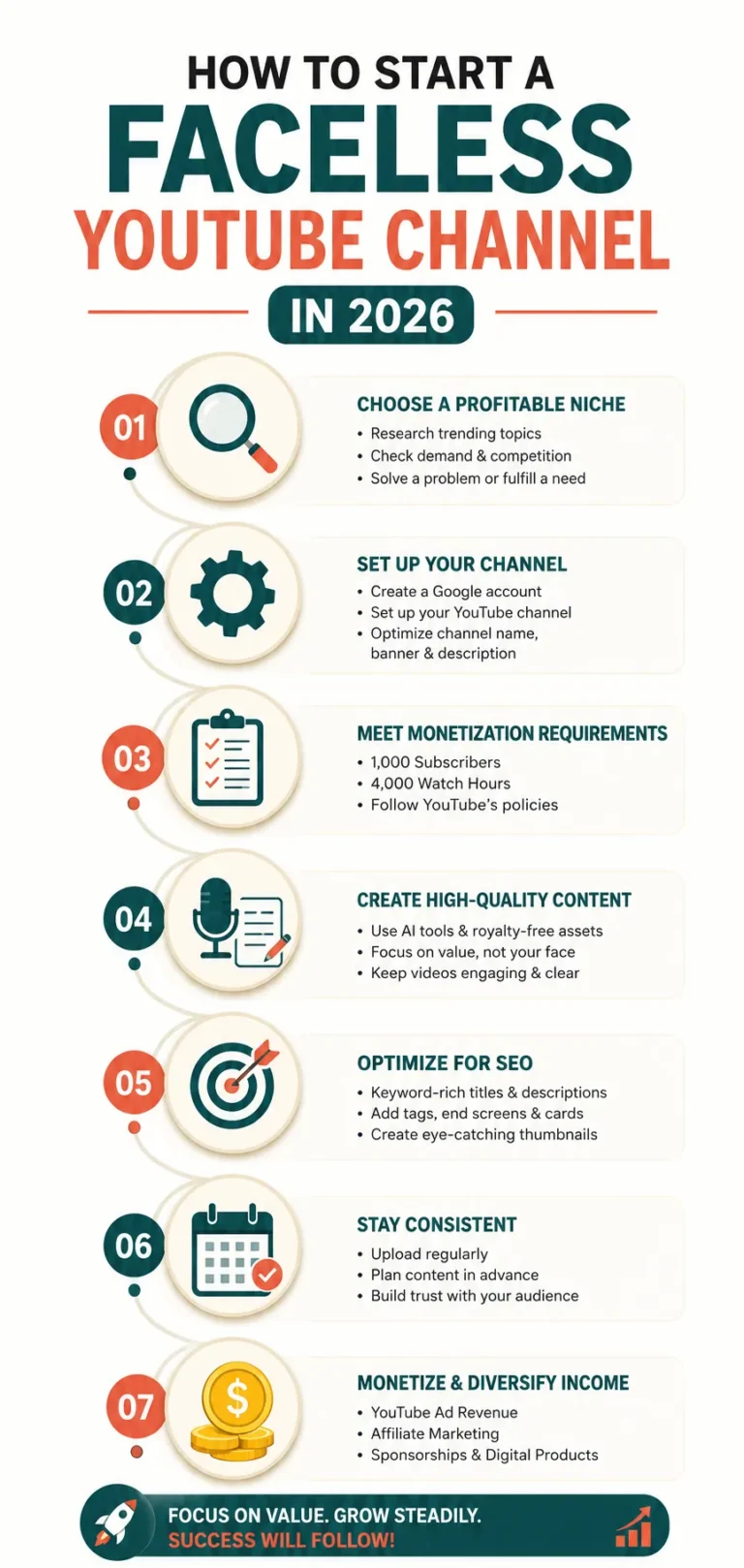
Starting a faceless YouTube channel in 2026 is still one of the most realistic ways to build an online income without showing your face. Pick a specific niche, understand YouTube’s updated monetization requirements, script and produce original videos, optimize every upload for SEO, and stack multiple income streams instead of relying on ads alone.
None of this is complicated. It just takes consistency.
Conclusion
You do not need a fancy camera, a perfect voice, or millions of subscribers to start earning from YouTube. You need a niche, a plan, and the willingness to show up every single week.
The creators making $50 a day right now started exactly where you are, at zero views, with no audience, and a lot of uncertainty. The only difference between them and everyone else who gave up is that they kept publishing.
So pick your niche today. Write your first script this week. Upload your first video before the month ends.
Your future channel is waiting on you to start it.
Frequently Asked Questions
How long does it take to make $50 a day with a faceless YouTube channel?
Most consistent creators start seeing meaningful income between month 4 and month 12, depending on niche and upload frequency.
Do I need expensive equipment to start a faceless channel?
No. A laptop, a free editing tool, and a script are enough to start. You can upgrade tools once you are earning.
Is faceless YouTube against YouTube’s policies?
No. Faceless content is fully allowed. What is not allowed is reused, low-effort, or spammy content that adds no original value.
What is the best faceless niche for beginners in 2026?
Story-driven niches like Reddit stories, book summaries, or true crime tend to be the easiest entry points because they need less technical setup.